How can commerce flourish across a vast region when merchants do not share modern banking systems, digital records, or instant communication?
The Indus Valley Civilization found a powerful answer:
Standardization.
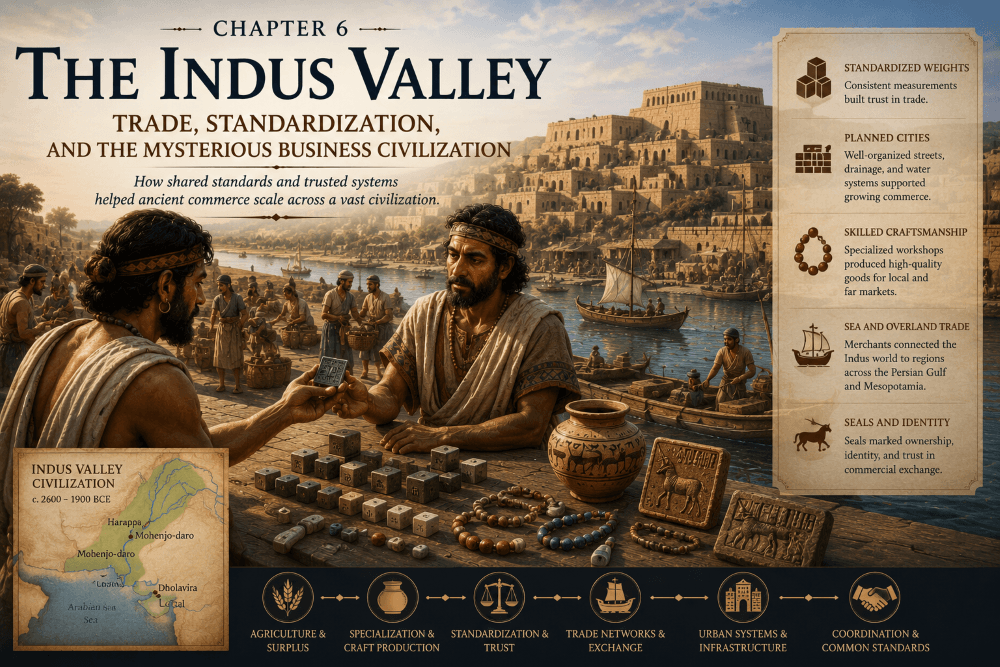
Across its cities and settlements, people used remarkably consistent weights, brick proportions, craft methods, and systems of urban organization. These shared standards reduced uncertainty, supported manufacturing, and made trade easier across long distances.
The civilization’s script remains undeciphered, so we cannot read its business records or identify its greatest merchants by name.
Yet its cities, seals, weights, workshops, and traded goods reveal a sophisticated commercial society whose influence stretched far beyond the Indus River.
What Was the Indus Valley Civilization?
The Indus Valley Civilization—also called the Harappan Civilization—developed across parts of what are now Pakistan and northwestern India.
Its mature urban period flourished approximately between 2600 and 1900 BCE.
Major settlements included:
- Harappa
- Mohenjo-daro
- Dholavira
- Lothal
- Rakhigarhi
- Kalibangan
The civilization included not only large cities but also smaller towns, villages, ports, farming communities, and specialized manufacturing centres.
It was one of the great Bronze Age civilizations, alongside ancient Egypt and Mesopotamia.

Why the Indus Valley Remains Mysterious
The Indus people developed a system of writing, but scholars have not conclusively deciphered it.
Most surviving inscriptions are very short.
As a result, historians cannot read:
- Royal chronicles
- Commercial contracts
- Tax records
- Business correspondence
- Merchant biographies
- Administrative documents
We do not know exactly how the cities were governed.
We cannot identify individual entrepreneurs.
We do not know whether commercial standards were enforced by rulers, merchants, communities, religious institutions, or shared custom.
This uncertainty makes the Indus world difficult to interpret.
It also makes the archaeological evidence especially important.
Planned Cities Reveal Economic Organization
Indus cities demonstrate an extraordinary level of coordination.
Archaeologists have uncovered:
- Organized street layouts
- Drainage systems
- Wells
- Reservoirs
- Brick buildings
- Storage facilities
- Workshops
- Public structures
Mohenjo-daro is famous for its planned streets, drainage, and structure commonly known as the Great Bath.
Dholavira developed sophisticated systems for collecting and storing water in a dry environment.
Such projects required more than architectural skill.
They required workers, materials, measurements, planning, transportation, and administration.
In modern terms, these cities depended on large-scale project management.
Standardized Bricks Made Construction More Efficient
One of the most striking features of the Indus world was the repeated use of bricks made in similar proportions.
Many followed a ratio of approximately:
4:2:1
That consistency made construction more predictable.
Builders could plan walls and structures around familiar dimensions.
Brickmakers could produce materials according to expected standards.
Workers could move between projects without relearning every method.
Not every brick across every settlement was identical, but the broader pattern demonstrates a strong culture of standardization.
Modern construction still depends on the same principle.
Buildings become easier and less expensive to produce when materials follow reliable specifications.
Standardized Weights Supported Indus Valley Trade
Indus merchants and craftspeople used carefully shaped stone weights.
Many were cubical and followed organized numerical progressions.
These weights have been found across widely separated settlements.
Standard measurement would have made it easier to trade commodities such as:
- Grain
- Metals
- Precious stones
- Beads
- Textiles
- Shell goods
- Manufactured products
A buyer and seller did not need to renegotiate the meaning of every quantity.
A recognized weight acted as a shared commercial language.
This reduced disagreements and increased trust.
Why Standardization Matters in Business
Standardization may not sound as exciting as exploration, invention, or conquest.
Yet it is one of the most important foundations of economic growth.
Without standards:
- Measurements become unreliable.
- Products become inconsistent.
- Repairs become difficult.
- Workers require more training.
- Buyers face greater uncertainty.
- Trade disputes increase.
- Businesses struggle to expand.
Standards reduce friction.
They allow people who do not know one another personally to cooperate with greater confidence.
That principle remains central to modern commerce.
Indus Seals and Commercial Identity
The Indus civilization produced thousands of small carved seals.
Many were made from steatite and featured:
- Animals
- Human or symbolic figures
- Short inscriptions
- Geometric designs
The exact meaning of the seals remains uncertain.
They may have represented identity, ownership, authority, family, profession, institution, or participation in commercial exchange.
Some may have been pressed into clay attached to packages, containers, doors, or goods.
Whatever their precise function, seals helped connect an object with a person or organization.
Modern equivalents include:
- Signatures
- Company logos
- Trademarks
- Shipping labels
- Barcodes
- Security seals
- Digital identities
The technology changed.
The business problem remained the same.
Who stands behind this product or promise?
Skilled Manufacturing in the Indus Economy
The Indus civilization supported highly specialized craftspeople.
They produced:
- Carnelian beads
- Shell ornaments
- Pottery
- Metal tools
- Seals
- Textiles
- Decorative objects
- Stone products
Bead manufacturing was especially sophisticated.
Craftspeople selected raw stone, shaped it, heated it, drilled it, polished it, and prepared it for exchange.
Some workshops required specialized tools and advanced technical knowledge.
This suggests an economy in which people developed expertise in particular stages of production.
Specialization increased both quality and efficiency.
Early Supply Chains
Many Indus products depended on raw materials that came from distant regions.
Marine shells travelled from coastal areas into inland settlements.
Stone and minerals moved from resource-rich regions to urban workshops.
Manufactured goods were then distributed to consumers and trading partners.
This required cooperation among:
- Resource suppliers
- Transporters
- Craftspeople
- Merchants
- Warehouse operators
- Buyers
Modern businesses call this a supply chain.
The Indus civilization organized similar networks more than 4,000 years ago.
Long-Distance Indus Valley Trade
The Indus economy extended beyond South Asia.
Archaeological evidence connects it with regions around:
- Mesopotamia
- Oman
- Bahrain
- The Persian Gulf
Indus-style seals and goods have been found outside the civilization’s core region.
Mesopotamian texts also mention a distant trading region called Meluhha, which many scholars associate with the Indus civilization or its commercial sphere.
Maritime trade likely connected Indus ports with Gulf intermediaries and Mesopotamian cities.
These routes carried more than products.
They also spread ideas, technologies, artistic styles, and administrative practices.
The Anonymous Entrepreneurs of the Indus Valley
The Indus script has not been deciphered, so its entrepreneurs remain unnamed.
We cannot identify:
- The merchant who financed a Gulf voyage
- The workshop owner who improved bead production
- The builder who supplied standardized bricks
- The trader who transported shells inland
- The administrator who managed weights and inventories
But someone performed those roles.
Someone recognized opportunities.
Someone organized workers.
Someone acquired raw materials.
Someone accepted commercial risks.
Someone maintained quality.
Someone earned the confidence of customers.
Entrepreneurship does not disappear simply because history forgot the entrepreneur’s name.
Was the Indus Civilization Equal or Peaceful?
The Indus cities contain fewer obvious royal monuments, enormous tombs, and statues of rulers than many contemporary civilizations.
This has led some people to imagine that the society was unusually equal or peaceful.
That conclusion remains uncertain.
The absence of large palaces or royal inscriptions does not prove that powerful elites did not exist.
The civilization may have been governed through institutions or social structures that are difficult to identify archaeologically.
The responsible conclusion is more limited:
The visible remains emphasize urban systems, craft production, measurement, water management, and coordination more than royal self-promotion.
What Happened to the Indus Valley Civilization?
After approximately 1900 BCE, many features of the mature urban system changed.
Large cities declined or were reorganized.
Trade networks shifted.
Some forms of standardization became less common.
Settlement patterns moved toward different regions.
The causes were probably complex and may have included:
- Changes in river systems
- Climate pressures
- Agricultural disruption
- Changing trade routes
- Migration
- Political or social transformation
The civilization did not simply vanish overnight.
Its urban system changed, while its people and cultural traditions continued in new regional forms.
What Modern Entrepreneurs Can Learn from the Indus Valley
The Indus civilization offers a lesson that remains essential to every growing business.
Success must be repeatable.
A founder may personally produce an excellent product.
But can another worker reproduce it?
Can customers expect consistent quality?
Can suppliers provide compatible materials?
Can the business expand into another city without losing control?
Standardization transforms individual talent into a scalable organization.
It turns a successful transaction into a reliable system.
The Entrepreneur’s Toolbox
Standardization
Standardization creates trust through consistency.
It allows businesses to establish:
- Reliable measurements
- Repeatable production
- Predictable quality
- Easier training
- Lower costs
- Greater compatibility
- Faster expansion
A business that depends entirely on one individual remains fragile.
A business with dependable standards can grow.
Five Lessons for Modern Entrepreneurs
1. Consistency Builds Trust
Customers return when they know what to expect.
2. Standards Make Growth Possible
Repeatable systems allow businesses to serve more people without sacrificing quality.
3. Infrastructure Enables Enterprise
Water systems, transport, measurements, and urban organization create the conditions in which entrepreneurs operate.
4. Trust Can Be Designed
Reliable weights, seals, labels, and procedures reduce uncertainty between strangers.
5. Successful Systems Must Adapt
Even strong institutions can weaken when climates, trade routes, technologies, or customer needs change.
Frequently Asked Questions
What was the Indus Valley Civilization?
The Indus Valley Civilization was a major Bronze Age civilization that flourished across parts of modern Pakistan and northwestern India, especially between approximately 2600 and 1900 BCE.
Why was Indus Valley trade important?
Indus Valley trade connected cities, farming regions, workshops, coastal areas, the Persian Gulf, and Mesopotamia through networks that exchanged raw materials and manufactured goods.
What did the Indus Valley Civilization trade?
Its people traded beads, shells, pottery, textiles, metals, stone products, agricultural goods, and other manufactured items.
Why were standardized weights important?
Standardized weights made quantities more predictable, reduced disputes, and allowed merchants in different cities to conduct business using shared measurements.
Can historians read the Indus script?
No. The script has not been conclusively deciphered, which limits what historians can know about the civilization’s politics, language, merchants, and institutions.
Were there entrepreneurs in the Indus Valley?
Although no individual entrepreneurs can currently be identified by name, archaeological evidence shows specialized manufacturing, risk-taking trade, supply chains, and organized commercial activity.
Continue the Journey
The Indus civilization demonstrated how standardization could support commerce across cities and regions.
Farther east, ancient China developed another influential commercial tradition.
Chinese societies advanced agriculture, metallurgy, manufacturing, transportation, markets, and state administration across many centuries.
Their history raises a question that remains important today:
How should governments and entrepreneurs interact?
In Chapter 7, we will explore Ancient China: How Innovation, Markets, and the State Shaped Commerce.
Related Articles
- The First Entrepreneur: When Did Entrepreneurship Begin?
- The Agricultural Revolution: How Farming Created the First Entrepreneurs
- How Writing Was Invented for Business: The First Accountants
- The First Merchants: How the Sumerians Created Professional Commerce
- The Birth of Money: How Currency Changed Entrepreneurship Forever
- Ancient China: Innovation, Markets, and Commerce (Coming Soon)
- The Phoenicians: Entrepreneurs of the Mediterranean (Coming Soon)
About The History of Entrepreneurship
This article is part of The History of Entrepreneurship, an ongoing series by Alain Guillot exploring how commerce, innovation, and enterprise shaped civilization—from prehistoric exchange to the modern artificial intelligence economy.
Each chapter examines the people, ideas, technologies, and institutions that helped humanity create, organize, and exchange value.
North Star
The Indus Valley Civilization showed that entrepreneurship scales when trust is built into shared standards. Its merchants remain anonymous, but its weights, seals, workshops, cities, and trade networks reveal the commercial power of reliability.