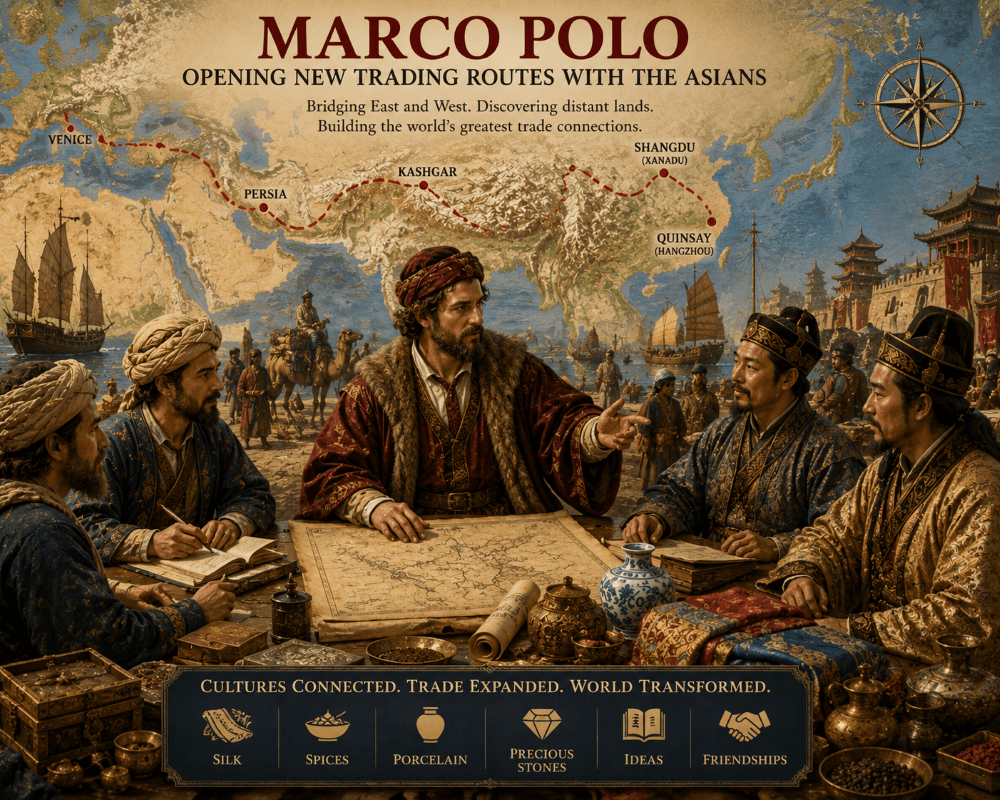
Marco Polo wasn’t the first European to travel to Asia, but he became by far the most influential, turning a 24-year journey into a bestselling account that reshaped European understanding of the East. His travels through the Mongol Empire reopened Europeans’ imagination about the commercial possibilities of Asia at a time when direct contact had grown rare. For entrepreneurs, his story is a reminder that documenting and sharing knowledge can be just as valuable as the trade itself.
Who Was Marco Polo?
Marco Polo was born around 1254 into a Venetian merchant family already experienced in long-distance trade. His father and uncle had previously traveled to the Mongol court, giving young Marco an unusually direct path into international commerce.
- In 1271, at about 17 years old, Marco joined his father and uncle on a journey toward the court of Kublai Khan.
- The journey took roughly four years, following overland routes through Persia, Central Asia, and eventually into China.
- Marco reportedly spent around 17 years in Asia, much of it in service to the Mongol court, before returning to Venice in 1295.
His nearly quarter-century absence made him a rare and valuable source of firsthand information about a part of the world most Europeans knew only through rumor.
Marco Polo and the Mongol Trade System
Traveling Under Mongol Protection
Marco Polo’s journey was made possible largely because of the political stability the Mongol Empire had created across Central Asia.
- The Mongols controlled and protected long stretches of overland trade routes, commonly called the Pax Mongolica.
- This relative safety allowed merchants and travelers to move across vast distances with far less risk than in previous centuries.
- Polo’s own accounts describe well-organized roads, relay stations, and administrative systems supporting long-distance trade and communication.
Without this Mongol-controlled infrastructure, a journey of Polo’s length and success would have been far less likely.
A Trusted Position at Court
According to his own account, Marco Polo didn’t simply pass through Asia as a tourist. He served in various capacities within Kublai Khan’s court, reportedly undertaking diplomatic missions across the empire.
- This position gave him access to regions and information most foreign merchants never encountered.
- His descriptions of Chinese cities, infrastructure, and governance were unusually detailed for a European observer of the era.
- Whether every detail in his accounts is fully accurate remains debated among historians, but the scale of access he describes was genuinely rare.
The Book That Changed European Commerce
From Prison Cell to Bestseller
After returning to Venice, Marco Polo was captured during a conflict with Genoa and imprisoned. During his imprisonment, he dictated his travel accounts to a fellow prisoner, a writer named Rustichello da Pisa.
- The resulting work, often called The Travels of Marco Polo, became one of the most widely copied manuscripts in medieval Europe.
- It described Asian wealth, goods, and trade opportunities in vivid detail, fueling European curiosity and ambition.
- Copies spread across Europe well before the invention of the printing press, an impressive feat of manuscript circulation for the era.
Reopening Commercial Imagination
Marco Polo’s account did something no single trade shipment could accomplish: it reshaped how an entire continent thought about Eastern trade.
- European merchants and rulers gained a far clearer picture of what lay beyond the Silk Road’s western terminus.
- His descriptions of spices, silk, and precious goods reinforced Asia’s reputation as an enormously profitable trading destination.
- Generations later, his accounts reportedly influenced explorers like Christopher Columbus, who carried an annotated copy of Polo’s book on his own voyages.
Marco Polo’s Business Legacy
Marco Polo wasn’t primarily a merchant closing individual trade deals — his greatest economic impact came from information itself.
- He demonstrated that knowledge and firsthand accounts could hold enormous commercial value.
- His writings helped later European merchants and explorers better understand the risks and rewards of Eastern trade.
- His journey reinforced the importance of political stability, like that provided by the Mongols, in enabling large-scale commerce.
Lessons from Marco Polo
- Information is an asset. Polo’s detailed accounts proved as commercially valuable as any physical trade good.
- Stability enables commerce. The Pax Mongolica shows how political conditions directly shape trade opportunity.
- Documentation extends influence. By recording his journey, Polo’s impact reached far beyond his own lifetime.
Frequently Asked Questions
Did Marco Polo actually travel to China? Most historians believe Marco Polo did travel extensively through Asia, including China, though some details in his accounts remain debated due to inconsistencies and omissions.
How long did Marco Polo stay in Asia? Marco Polo spent approximately 17 years in Asia, largely in service to the Mongol court, before returning to Venice after a 24-year absence.
What is Marco Polo’s book about? The Travels of Marco Polo describes his journey through Asia, detailing the cities, customs, wealth, and trade opportunities he observed, particularly within the Mongol Empire.
How did Marco Polo influence later explorers? His detailed accounts of Asian wealth and trade reportedly influenced later explorers, including Christopher Columbus, who is said to have carried an annotated copy of Polo’s book.
Related Articles
- Jewish Merchants: Diaspora Networks and the Power of Portable Trust
- The Islamic Golden Age: How Knowledge, Finance, and Global Trade Transformed Entrepreneurship
- Venice: How Merchant Capitalism Built a Commercial Empire
- The Medici Bank: How Banking Became an International Business
- The Phoenicians: How Maritime Trade Connected the Ancient World
About The History of Entrepreneurship
This article is part of The History of Entrepreneurship, an ongoing series exploring how civilizations, merchants, technologies, institutions, and entrepreneurs gradually created the foundations of modern business.