The debate over taxing the rich usually begins with a simple observation: wealthy people have more money, so they can afford to pay a larger percentage of it in taxes.
But that overlooks another important question: How did the wealth get created in the first place?
In competitive markets, many fortunes are built by creating products and services that other people voluntarily choose to buy. When entrepreneurs solve problems for millions of customers, they may become extraordinarily rich—but society often receives far more value than the entrepreneur personally captures.
Instead of asking how much of successful people’s wealth government can take, perhaps we should ask a different question:
How can we encourage successful value creators to keep creating?
Taxing the Rich Means Taxing Value Creation
Wealth is not always a fixed pie waiting to be divided.
Entrepreneurs make the pie bigger.
Someone who creates a successful company may introduce a new technology, employ thousands of people, lower prices, increase productivity, or create an entirely new industry.
The founder becomes wealthy because millions of people value what the company produces.
This distinction matters when discussing taxing the rich. If wealth came exclusively from taking something away from somebody else, aggressive redistribution would be easier to justify.
But productive entrepreneurship is different.
When a founder becomes a billionaire by creating something that millions of people willingly use, customers can benefit at the same time the entrepreneur becomes wealthy.
The Google Founders Created Far More Value Than They Captured
Consider Larry Page and Sergey Brin.
They transformed an academic research project into Google, giving billions of people an extraordinarily powerful way to navigate the world’s information.
Imagine trying to put a dollar value on every useful Google search ever performed.
Think about the student finding information for an assignment, the consumer comparing prices, the small business finding customers, the traveler navigating an unfamiliar city, or the researcher discovering information in seconds that once might have taken hours.
Page and Brin became extremely wealthy.
But they captured only a small fraction of the economic and social value created by their innovation.
That is an important feature of entrepreneurship: successful founders don’t necessarily take the value they create. Much of it spills over to everyone else.
Steve Jobs, Bill Gates and the Billionaires Who Changed Daily Life
The same pattern can be seen throughout economic history.
Steve Jobs
Steve Jobs helped build Apple into a company that transformed personal computing, music, smartphones and digital communication.
The iPhone alone put a camera, map, telephone, music player, internet browser, payment device and miniature computer into people’s pockets.
Jobs became wealthy, but billions of people received benefits from the technologies Apple helped popularize.
Bill Gates
Bill Gates became one of the world’s richest people by helping make personal computing accessible to ordinary businesses and households.
Microsoft software became part of the infrastructure of the modern economy.
The economic value generated by widespread computing extends far beyond the fortune Gates accumulated.
Henry Ford
Henry Ford did not invent the automobile, but he revolutionized its production.
Mass production helped transform cars from luxury products into transportation that middle-class families could eventually afford.
Ford became extraordinarily wealthy while simultaneously helping transform manufacturing, transportation and American economic life.
Jeff Bezos
Jeff Bezos built Amazon from an online bookstore into a massive commercial and logistics network.
Consumers gained enormous convenience, businesses gained access to new customers, and Amazon created a huge employment network.
Bezos captured part of that value through his ownership stake. Consumers, workers, suppliers and other businesses captured much of the rest.
Elon Musk
Whatever one thinks of his personality or politics, Elon Musk provides another example of entrepreneurial risk-taking.
Tesla helped push electric vehicles into the automotive mainstream, while SpaceX demonstrated that reusable rockets could dramatically change the economics of space launches.
Again, the important point isn’t that every decision these entrepreneurs make is correct.
It is that enormous fortunes can emerge from creating enormous amounts of economic value.
Are Rich People Better at Allocating Capital?
This is where the argument becomes more controversial.
I believe successful entrepreneurs and investors often demonstrate an unusual ability to allocate capital.
They identify opportunities, evaluate risks, organize people and resources, and decide which projects deserve additional investment.
Not every rich person possesses these abilities. Inherited wealth certainly doesn’t prove exceptional business judgment.
But someone who repeatedly builds successful businesses has demonstrated something valuable.
Markets also provide continuous feedback.
Invest $10 million into something consumers don’t want and eventually that money disappears. Invest it successfully and additional resources become available.
Profit and loss create a feedback mechanism.
Governments operate differently. Politicians and bureaucracies allocate enormous amounts of capital, but their incentives involve elections, lobbying, political priorities and public policy objectives rather than a direct profit-and-loss test.
Government can fund valuable infrastructure, scientific research, education and other public goods that markets may undersupply. But political allocation is not automatically superior simply because its objective is public rather than private.
That is why we should be cautious before assuming government will allocate an additional dollar better than a proven entrepreneur or investor.
The Problem With Progressive Taxation
A progressive income tax imposes higher marginal tax rates as income rises.
Supporters argue that those with the greatest ability to pay should contribute a larger share toward government services and redistribution.
There is a reasonable moral argument there.
But there is also an economic cost that deserves attention.
Higher marginal taxes reduce the after-tax reward from additional work, investment, entrepreneurship and innovation.
Research on inventors has found that taxes can affect both innovation and where highly productive inventors choose to live and work. The precise size of these effects is debatable, but incentives clearly matter.
If innovation creates benefits that spill far beyond the inventor’s personal income, discouraging even a small amount of productive innovation can impose costs on the rest of society.
That should be part of any serious discussion about taxing the rich.
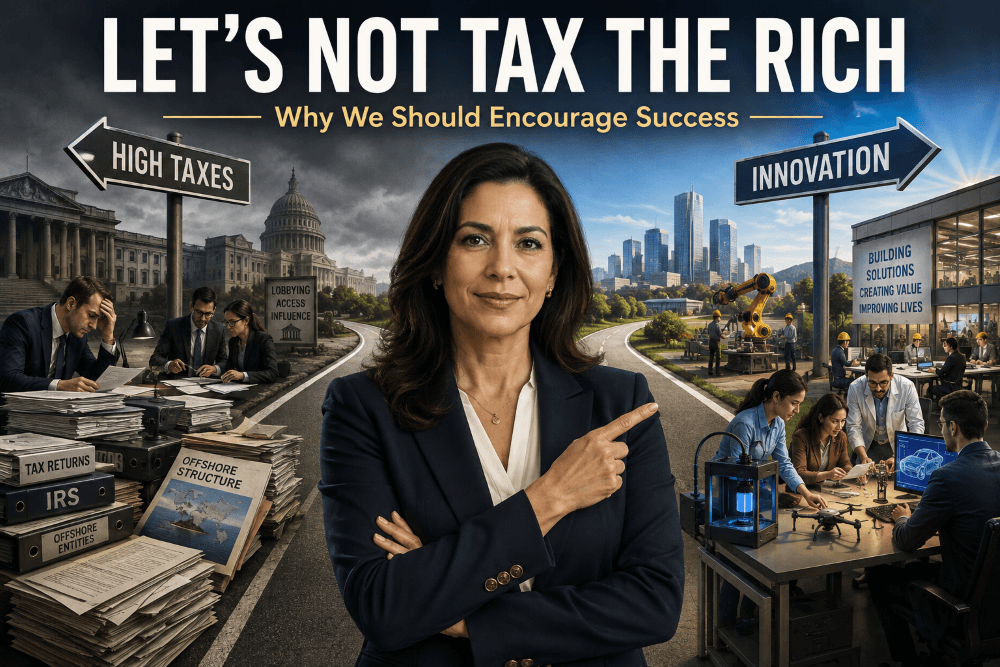
When governments make taxing the rich a central fiscal priority, wealthy individuals have a powerful incentive to devote enormous amounts of money, time, and talent to minimizing their tax bills. They hire brilliant accountants and tax lawyers, lobby for favorable loopholes, create sophisticated offshore structures, and, in some cases, move themselves or their businesses to more tax-friendly jurisdictions. From society’s perspective, much of this effort is wasted: instead of directing their resources and entrepreneurial energy toward creating new products, services, businesses, and jobs, successful people are encouraged to become experts at avoiding taxes.
Not Every Fortune Deserves the Same Defense
None of this means that every wealthy person deserves admiration.
There is an enormous difference between value creation and rent-seeking.
Someone might become rich through:
- inheritance;
- political connections;
- government subsidies;
- regulations designed to prevent competition;
- monopoly privileges;
- favorable government contracts;
- manipulating the tax code; or
- simply being extraordinarily lucky.
These cases should not be confused with entrepreneurship.
If a business becomes wealthy because politicians prevent competitors from entering its industry, the solution isn’t necessarily a higher income-tax bracket.
Remove the privilege.
If a company survives because taxpayers subsidize it, remove the subsidy.
If regulations exist primarily to protect established companies from competition, eliminate those barriers.
If politically connected businesses receive special treatment, end the special treatment.
The objective should not be to protect rich people.
The objective should be to protect value creation.
Famous Billionaires Who Didn’t Earn Their Wealth
MacKenzie Scott – Acquired her fortune through her divorce from Amazon founder Jeff Bezos and is now famous for her rapid, multi-billion-dollar philanthropic donations. It’s easy to throw money away when you didn’t create it.
Melinda French Gates – Built her billionaire status following her divorce from Microsoft co-founder Bill Gates and focuses her capital on global health and gender equality.
Françoise Bettencourt Meyers – Inherited her massive fortune from her mother, Liliane Bettencourt, making her the heiress to the L’Oréal cosmetics empire.
Alice Walton – Inherited her multi-billion-dollar stake in Walmart from her father, founder Sam Walton, and primarily spends her time curating art.
Julia Flesher Koch – Became one of the world’s richest women after inheriting a 42% stake in Koch Industries following the death of her husband, David Koch.
Taxing the Rich Less Doesn’t Mean Giving Them Special Favors
This distinction is important.
I don’t want billionaires receiving subsidies, special deductions, government bailouts or favorable regulations.
I want fewer special favors for everyone.
That is why I favor replacing complicated progressive taxation with a simpler and flatter tax system.
Under a flat income tax, someone earning $10 million would still pay vastly more dollars than someone earning $50,000.
They simply wouldn’t face an increasingly high percentage because they earned more.
I explored this idea in greater detail in my article “Flat Tax System: A Sensible Alternative to Today’s Tax Code.”
The broader principle is simple: government should collect revenue without unnecessarily punishing work, investment and productive risk-taking.
We could also shift more taxation toward consumption rather than investment and production.
Taxing what people take out of the economic system through consumption may be less damaging to long-term growth than heavily taxing money being saved, invested and reinvested.
What Research Says About Taxes and Innovation
This argument isn’t purely philosophical.
Economic research has found evidence that taxation affects innovation.
Researchers studying American inventors throughout the 20th century found that higher personal and corporate taxes negatively affected the quantity and location of innovation.
Other research has found that highly productive inventors respond to differences in top tax rates when deciding where to live.
That doesn’t prove that the optimal tax rate is zero, governments need tax revenue to operate, but just the same, the wealthy should not be punished for their success.
Taxes finance government functions, and some of those functions contribute directly to economic prosperity.
But it does demonstrate something important:
Tax rates create incentives, and incentives change behavior.
A tax system designed exclusively around redistribution can therefore unintentionally reduce the innovation and investment that generate future prosperity.
Why Do Billionaires Keep Working?
There is another fascinating question.
Why does someone worth $1 billion try to become worth $2 billion?
The second billion probably changes that person’s lifestyle very little.
Yet entrepreneurs routinely continue working long after they have accumulated enough money to live extravagantly for hundreds of lifetimes.
Money eventually becomes something more than consumption.
It becomes a scoreboard, a source of capital, independence, status and—most importantly—the ability to build something larger. Elon Musk continues building bigger and bigger projects every year. His billion are not just sitting idel in his bank account.
That is why society shouldn’t assume that because a billionaire doesn’t need another dollar, incentives no longer matter.
Entrepreneurs may not need another yacht.
But they may want another factory, research laboratory, rocket, computer platform or company.
Capital gives them the ability to try.
How We Should Reward Productive Rich People
We don’t need government programs handing awards or subsidies to billionaires.
Markets already provide powerful rewards: profits, ownership, reputation and the opportunity to reinvest.
But society can create an environment that encourages productive wealth creation:
- Celebrate builders and innovators. Entrepreneurs, inventors and job creators should receive cultural recognition alongside athletes, entertainers and celebrities. At this moment, out of jealosy, billionaires are vilified.
- Reduce taxes on long-term productive investment. Encourage capital to remain invested in businesses, technology and research.
- Protect property rights. Entrepreneurs are more willing to take risks when contracts are enforceable and ownership is secure.
- Remove regulatory barriers to competition. Regulations shouldn’t become moats that wealthy incumbent companies use to keep smaller competitors out.
- Eliminate corporate welfare. Successful businesses shouldn’t receive subsidies merely because they have powerful lobbying operations.
- Make investing more accessible. Ordinary people should have opportunities to participate in economic growth by owning businesses and diversified investments.
The objective isn’t to make rich people richer.
It is to create an economy where becoming rich by creating value is encouraged, while becoming rich through political privilege is discouraged.
Stop Treating Wealth as Evidence of Wrongdoing
The modern debate about taxing the rich too often treats extraordinary wealth as evidence that something has gone wrong.
Sometimes it is.
But most of the time extraordinary wealth is evidence that someone created something extraordinarily valuable.
A society that wants more innovation should be careful about attacking the rewards attached to innovation. This is why the U.S. continues outperforming Europe. Europe punishes their successful citizens with more taxes and more regulations.
We should distinguish between the billionaire who becomes wealthy because politicians protected his business and the entrepreneur who becomes wealthy because millions of customers love what she created.
Punish corruption.
Remove monopoly privileges.
Eliminate subsidies and political favoritism.
Encourage competition.
Then let people create.
If they become enormously wealthy because they created enormous value for everyone else, their success isn’t a problem we need to solve.
It is an outcome we should want to see happen again.
Frequently Asked Questions
Does taxing the rich reduce innovation?
Taxes can influence the incentives to invest, invent and take entrepreneurial risks. Research has found that higher personal and corporate taxes can affect the quantity and location of innovation, although the size of the effect and the optimal tax rate remain subjects of economic debate.
Would eliminating progressive taxation mean rich people pay less than everyone else?
Not necessarily. Under a flat tax, high-income people would still pay far more dollars because the same percentage would apply to a much larger income. The difference is that the marginal percentage would not automatically rise with income.
Are all rich people productive entrepreneurs?
No. Wealth can come from entrepreneurship, investment, inheritance, luck, political connections or rent-seeking. Public policy should distinguish value creation from wealth obtained through government privilege or barriers to competition.
What is a better alternative to taxing the rich?
One alternative is a simpler, flatter tax system combined with broader consumption taxes and fewer taxes on productive investment. Such a system could also eliminate subsidies, loopholes and regulatory privileges that disproportionately benefit politically connected businesses.