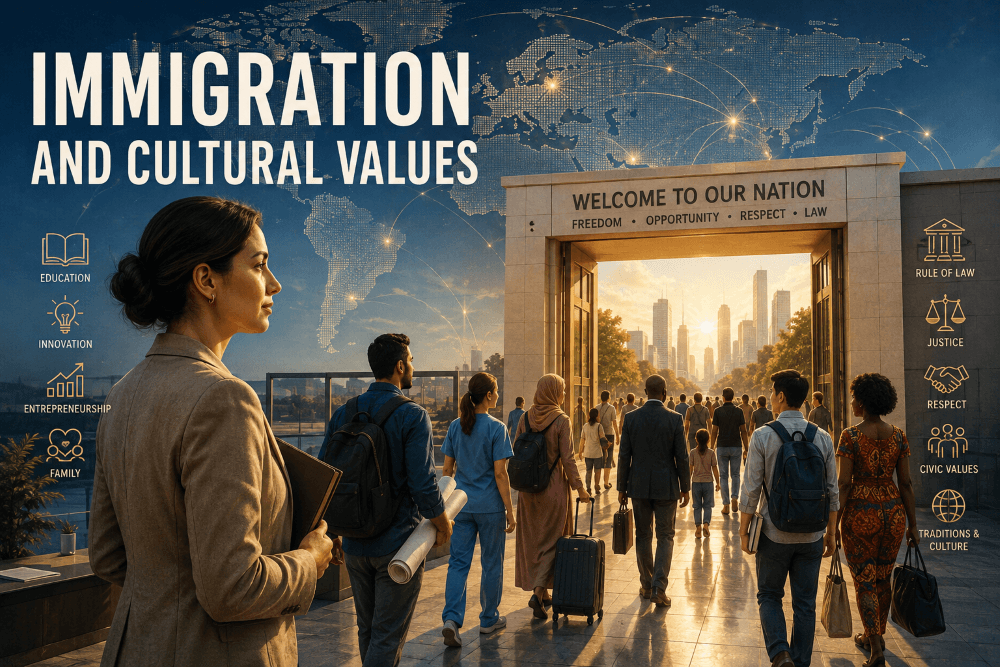
Immigration and cultural values are usually discussed as separate issues. Immigration debates tend to focus on numbers: How many immigrants should a country accept? What skills do they have? How much will they contribute to economic growth?
But immigrants don’t arrive carrying only their education, labor and financial capital. They also arrive with ideas about family, business, government, religion, gender roles, authority, trust, corruption and the rule of law.
In other words, when people move, some portion of culture moves with them.
That shouldn’t be controversial. The more difficult question is what governments should do about it.
The Somali Example
Somalia ranks among the most corrupt countries in the world by standard measures. Transparency International’s Corruption Perceptions Index (CPI) consistently places it at or near the bottom. Recent scores are around 9/100 (where 100 is least corrupt), often tied with South Sudan as the lowest or among the very lowest out of ~180 countries. This reflects decades of weak institutions, clan-based politics, conflict, limited accountability, and high levels of public-sector graft.
On fraud involving Somali-origin people in the United States: There is a documented, large-scale pattern concentrated in Minnesota (home to the largest Somali diaspora community in the US, roughly 80,000–100,000+ people). Federal prosecutions related to schemes exploiting COVID-era child nutrition programs (“Feeding Our Future”), housing stabilization services, autism therapy billing, and related social-service programs have charged dozens to nearly 100 people, with the large majority (roughly 80–90% in key cases) of Somali descent. Most defendants have been US citizens (by birth or naturalization). Confirmed losses in the main charged cases run into the hundreds of millions of dollars; prosecutors have publicly discussed broader estimates across multiple programs that reach into the low billions, though exact totals remain contested and some higher figures appear inflated or provisional. Convictions and guilty pleas number in the dozens.
Immigration and Cultural Values Matter to Institutions
Economists have long recognized that institutions matter enormously for prosperity.
Property rights, contract enforcement, low corruption, political stability and trust between strangers make economic cooperation easier. Countries with functioning institutions generally create better environments for investment, entrepreneurship and long-term economic growth.
But institutions don’t exist independently of people.
A society in which most citizens consider bribery unacceptable will probably have different institutions from one in which bribery is regarded as a routine cost of doing business.
Likewise, attitudes toward women’s equality, freedom of expression, religious tolerance, entrepreneurship and government authority can influence how societies develop.
Immigration therefore isn’t purely an economic transaction. It can also be an exchange of cultural and institutional norms.
Culture Doesn’t Disappear at the Border
Imagine someone growing up in a society where corruption is widespread and government institutions are rarely trusted.
That person may arrive in Canada, the United States or another liberal democracy with some attitudes influenced by that environment.
But the opposite is equally possible.
Someone coming from a high-trust society with strong democratic institutions may bring habits of civic participation, institutional trust and cooperation.
This does not mean every person reflects the average characteristics of his or her country. That’s where immigration policy needs nuance.
A dissident fleeing an authoritarian country may believe more passionately in democracy than someone born in a democracy.
A woman escaping a deeply patriarchal society may be seeking precisely the freedoms her home country denied her.
And an entrepreneur from a highly corrupt country may have spent a lifetime fighting against corruption rather than participating in it.
Countries have cultures. Individuals have values. The two overlap, but they aren’t interchangeable.
President Trump Is Doing a Great Job Enforcing Immigration Law
President Trump has done an excellent job enforcing immigration law by prioritizing the secure control of the nation’s borders and the consistent application of existing statutes. Under his administration, illegal crossings have been sharply reduced through physical barriers, expanded enforcement capacity, and clear deterrence measures that discourage unlawful entry. At the same time, the removal of individuals who have no legal right to remain in the United States—particularly those with criminal convictions or final removal orders—has been pursued with greater focus and efficiency, restoring a measure of order to a system long strained by lax enforcement. These steps reaffirm the basic principle that a sovereign country must be able to decide who enters and who stays, while still leaving lawful pathways open for those who follow the rules.
Should Immigration Policy Consider Country of Origin?
There is a legitimate policy question here.
If cultural norms influence institutions, should immigration authorities consider characteristics of immigrants’ countries of origin?
Governments already consider nationality in some contexts, particularly security screening, visa requirements and refugee policy.
President Trump issued presidential proclamations (starting in June 2025 and significantly expanded in December 2025, effective January 1, 2026) that restrict or suspend entry for nationals of dozens of countries. The stated rationale is national security, public safety, and deficiencies in those countries’ screening, vetting, information-sharing, and passport systems (along with high visa overstay rates in some cases). But the true reason is that citizens of those countries, generally bring the ill policies, corruption,and crimes of the countires they come from.
Full entry suspension (most immigrant and nonimmigrant visas blocked, with limited exceptions such as lawful permanent residents, certain diplomats, dual nationals traveling on a non-restricted passport, or case-by-case national-interest waivers) applies to nationals of:
- Afghanistan
- Burkina Faso
- Burma (Myanmar)
- Chad
- Republic of the Congo
- Equatorial Guinea
- Eritrea
- Haiti
- Iran
- Laos
- Libya
- Mali
- Niger
- Sierra Leone
- Somalia
- South Sudan
- Sudan
- Syria
- Yemen
Immigration Should Be About Human Capital
There is another side of immigration policy that deserves much more attention: competition for exceptional people.
Countries shouldn’t merely ask, “How many immigrants should we accept?”
They should also ask, “Whom should we be trying to attract?”
Albert Einstein is perhaps the classic example. When Nazi persecution drove Einstein from Germany, the United States didn’t merely receive another immigrant. It gained one of history’s greatest scientific minds.
Elon Musk provides a more contemporary and controversial example. Born in South Africa, he moved to Canada and later the United States, where he built and led businesses that became major forces in several industries.
Whatever one’s opinion of individual entrepreneurs, the broader principle is difficult to dispute: human capital isn’t evenly distributed, and countries benefit when talented people choose to build their lives there.
The desirable countries that could improve the local population
U.S. Census, American Community Survey, and Migration Policy Institute data consistently show large differences in average outcomes by country of origin among immigrants:
- Education and income: Immigrants from many Asian countries (especially India, Taiwan, South Korea, China, Philippines) and from Europe often have higher rates of college attainment and higher median household incomes than the U.S.-born average or the overall foreign-born average. European immigrants as a group have shown bachelor’s degree rates around 47% and median household incomes above the native-born level in recent data. Nordic countries produce populations with very high average education, skills, and economic performance at home; the (relatively small) numbers who migrate to the U.S. tend to reflect that selectivity.
- Crime and rule of law: Broad studies find immigrants overall have lower incarceration rates than the U.S.-born. Variation by origin exists historically and today, with some origin groups showing particularly low rates. High-trust, low-corruption societies (Nordics rank near the top globally on trust, low corruption, and rule-of-law indices) are frequently cited as exporting norms of law-abiding behavior and civic cooperation.
- Other human-capital measures: Groups from high-development, high-human-capital countries often show stronger labor-force participation in skilled occupations and lower poverty rates on average.
These patterns are averages only. Individual outcomes vary enormously within every nationality, and second-generation progress is common across many origin groups.
Cultural and values-based arguments
Commentators (including some policymakers) often point to cultural factors that correlate with those outcomes:
- High social trust and low corruption in Nordic and similar Western European societies are argued to produce immigrants more likely to respect laws, pay taxes, and integrate without high welfare dependence.
- Emphasis on education, work ethic, and individual responsibility in those societies is contrasted with outcomes from lower-trust or lower-skill-sending regions.
- President Trump has repeatedly voiced a preference for immigrants from places like Norway, Sweden, and Denmark over those from certain other countries, framing it in terms of desirable skills, values, and societal compatibility. Similar views appear in some conservative and restrictionist commentary that favors immigrants from high-performing, culturally closer societies.
Immigration Policy Is Also Economic Policy
A brilliant engineer can create technology employed by millions.
An ambitious entrepreneur can create thousands of jobs.
A medical researcher can develop treatments that save lives. A mathematician, scientist or computer programmer can contribute knowledge whose economic value vastly exceeds his or her salary.
This creates an international competition for talent.
Canada, the United States, Australia, Britain and European countries aren’t simply deciding whom to admit. They’re competing with one another for entrepreneurs, scientists, engineers, physicians, researchers and other highly productive people.
A smart immigration system should recognize this reality.
Instead of focusing exclusively on immigration quotas, governments should aggressively recruit exceptional talent.
But Intelligence Alone Isn’t Enough
An effective immigration system should also consider multiple dimensions:
Human capital: What can this person contribute?
Economic potential: Is the applicant likely to work, invest, innovate or create businesses?
Security: Does the individual present a legitimate threat?
Civic compatibility: Is the applicant prepared to live under the country’s laws and respect the rights of fellow citizens?
Integration potential: Does the applicant have the language skills and willingness necessary to participate successfully in society?
No system will measure these things perfectly. But acknowledging their importance is better than pretending immigration is purely about filling labor shortages.
Many Immigrants Never Assimilate. We Should Not Welcome Them
Assimilation means immigrants and their descendants adopt the host country’s core language, legal framework, secular public norms, gender equality expectations, and civic identity to a degree that parallel societies do not form and the host culture remains dominant. When large groups instead maintain or intensify origin-country religious-legal preferences, demand institutional exemptions, and engage in outreach that aims to expand their own framework, the dynamic shifts from integration to contestation of the host society’s character.
Persistent preference for religious law over host law
Multiple surveys in Europe document substantial minorities (and majorities among younger cohorts in some countries) who prioritize Sharia or Islamic rules over national statutes:
- In France, recent IFOP data show roughly one-third of Muslims overall identifying with Islamist currents, with 57% of those aged 15–24 saying Sharia should take precedence over French law on matters such as marriage, inheritance, and ritual slaughter. Support for radical or Islamist positions has roughly doubled since the late 1990s among French Muslims.
- Comparable findings appear in Germany, Britain, and other countries: significant shares endorse theocracy as preferable, view Quranic rules as superior to state law, support compulsory halal standards in public institutions, or hold highly restrictive views on homosexuality, gender roles, and free speech that clash with liberal democratic baselines. Second-generation respondents sometimes show higher religiosity or stricter attitudes than the first generation—the opposite of classic assimilation trajectories observed among earlier European or East Asian immigrant waves.
These are not fringe opinions in every poll, but they are large enough, especially among the young, to shape community norms, voting patterns, and local politics where concentrations are high. Religiosity among Muslim populations in Europe tends to remain elevated and stable across generations relative to native secularizing trends.
Protect the Institutions That Attract Immigrants
There is an interesting paradox in immigration.
People frequently migrate because certain countries offer greater prosperity, security, freedom and opportunity.
Those advantages didn’t appear accidentally. They emerged from institutions and cultural norms developed over generations: property rights, relatively low corruption, equality before the law, freedom of expression, democratic government and predictable legal systems.
A successful immigration policy should welcome newcomers while confidently defending those institutions.
The objective shouldn’t be cultural uniformity. Immigrants can enrich a society precisely because they bring different experiences, cuisines, languages, ideas and entrepreneurial perspectives.
But pluralism works best when people share certain foundational principles.
You can disagree about politics, religion, food, traditions and almost everything else while still agreeing that bribery is unacceptable, violence isn’t a legitimate response to disagreement, women and men possess equal legal rights, contracts should be honored and everyone is subject to the same law.
Immigration Is About More Than Borders
The immigration debate is often reduced to two positions: more immigration or less immigration.
That’s the wrong debate.
The more interesting question is what kind of immigration policy produces the greatest long-term benefit for the receiving society while treating applicants as individuals?
Countries should seek talented, ambitious and productive immigrants from everywhere. They should compete aggressively for the world’s scientists, entrepreneurs, engineers, physicians and exceptional minds.
They should also recognize that institutions and cultural norms matter and many immigrants will bring with them the crime and coruption that is normal in their culture.
Frequently Asked Questions
Do immigrants bring cultural values from their home countries?
Yes. Like everyone else, immigrants are influenced by the societies in which they grew up. Attitudes toward government, family, business, trust and social institutions can persist after migration, although those attitudes can also change over time.
Should a person’s country of origin determine whether they can immigrate?
Country-level conditions can provide context for security and policy decisions, and we should avoid immigrants from countries with lots of corruption or who have values completely different to western values.
Can immigration improve economic growth?
Yes. Immigrants can expand the workforce, create businesses, contribute specialized skills and generate innovation. Highly skilled immigrants can be particularly valuable when their knowledge or entrepreneurship creates benefits extending beyond their individual employment. We should open the doors to immigrants who would contribute to society and close that same door to immigrants who would abuse the system, like the Somali immigrants in Minnesota.
What should countries prioritize when selecting immigrants?
A strong immigration system can consider education, skills, entrepreneurship, language ability, employment prospects, security, integration potential and respect for the country’s fundamental legal and civic institutions.