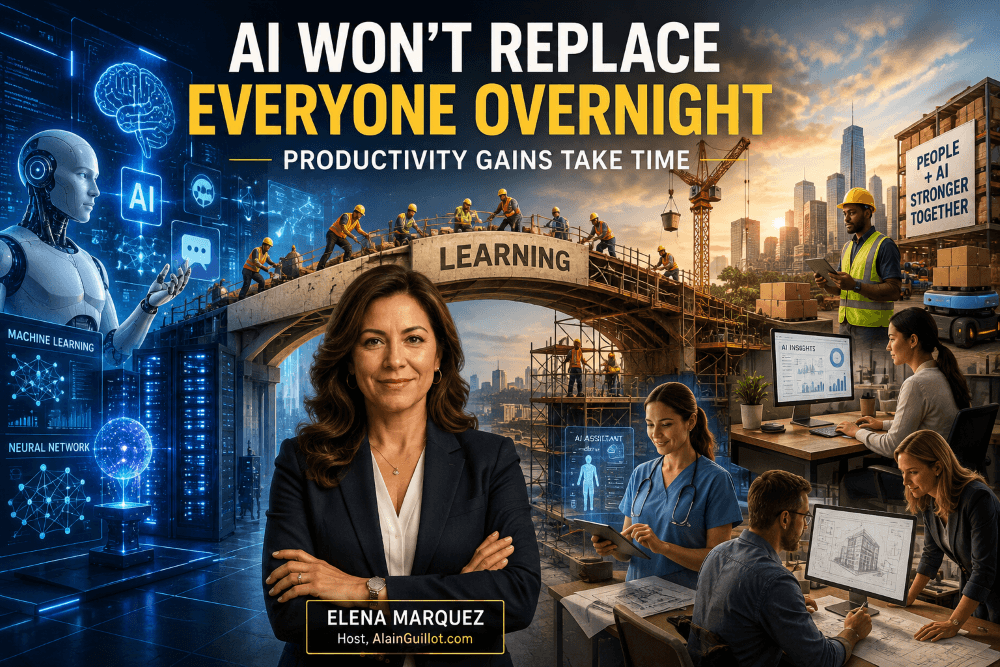
Every few months, another headline predicts that artificial intelligence will replace millions of workers. While AI is undoubtedly transforming the economy, AI won’t replace everyone overnight. History suggests something very different.
Economist James Bessen, author of Learning by Doing: The Real Connection Between Innovation, Wages, and Wealth, argues that new technologies rarely produce immediate productivity gains. Instead, businesses, workers, and entire industries must first learn how to use them effectively. That learning process often takes years—or even decades.
Understanding this pattern can help workers prepare for the future, entrepreneurs identify opportunities, and investors better understand where long-term value is created.
Why AI Won’t Replace Everyone Overnight
The invention of a new technology is only the beginning.
The difficult part is integrating that technology into real businesses with real customers, employees, regulations, and workflows.
Think of AI as buying a world-class piano. Owning it doesn’t make you a concert pianist. The value comes from years of practice.
Businesses face the same challenge.
Before AI can significantly increase productivity, companies must:
- Train employees
- Develop new workflows
- Build reliable processes
- Learn where AI succeeds—and where it fails
- Gain customer trust
- Meet legal and regulatory requirements
This learning phase is expensive, slow, and often invisible.
History Shows That Productivity Takes Time
History offers many examples where revolutionary inventions required decades before society experienced their full economic benefits.
Electricity
Electricity became commercially available in the late nineteenth century.
Yet many factories initially saw little improvement.
Why?
They simply replaced steam engines with electric motors while keeping the same factory layouts.
Only later did manufacturers redesign entire production lines around electricity, allowing machines to be placed exactly where they were most efficient.
That redesign dramatically increased productivity.
The invention alone wasn’t enough.
The Automobile
Henry Ford did not simply build cars.
He reinvented manufacturing.
The moving assembly line transformed production because Ford redesigned every step of the manufacturing process.
Other manufacturers spent years learning these techniques before similar productivity gains spread across the economy.
Personal Computers
Businesses began buying computers during the 1980s.
Many economists expected an immediate surge in productivity.
Instead, productivity remained disappointing for years.
Companies had to:
- Digitize records
- Train employees
- Develop software
- Redesign business processes
- Build computer networks
Only during the late 1990s did large productivity gains finally appear.
The Internet
When the internet became popular, many believed every business would instantly become more efficient.
Instead, thousands of companies failed during the dot-com crash.
The winners were businesses that learned how to build sustainable digital operations.
Amazon mastered logistics.
Google perfected online advertising.
Netflix reinvented media distribution.
The internet created enormous wealth—but only after years of experimentation.
Smartphones
Today’s smartphone seems indispensable.
But when the first iPhone launched in 2007, businesses had no idea how profoundly mobile technology would reshape commerce.
Ride-sharing, food delivery, mobile banking, remote work, digital payments, and countless new business models emerged gradually.
Entire industries had to learn how customers actually wanted to use smartphones.
AI Is Following the Same Pattern
Artificial intelligence is already helping people write documents, summarize meetings, analyze data, generate software code, create marketing campaigns, and answer customer questions.
Yet many companies are still experimenting.
Some organizations have purchased AI software but struggle to integrate it into daily operations.
Others discover that employees need extensive training before they become significantly more productive.
Many businesses are still asking:
- Which tasks should AI handle?
- Which tasks still require human judgment?
- How should employees verify AI-generated work?
- What legal risks exist?
- How can sensitive information remain secure?
These questions take time to answer.
The Hidden Investment Nobody Sees
Much of the investment in new technology is invisible.
Companies spend billions on:
- Employee training
- Consulting
- Internal documentation
- Process redesign
- Trial and error
- Software integration
- Data cleaning
- Cybersecurity
These investments rarely make headlines.
Yet they are essential before technology delivers meaningful returns.
Learning Creates Competitive Advantages
The first companies that master new technology often dominate their industries.
Amazon didn’t become successful simply because it had a website.
It built sophisticated logistics systems, warehouses, inventory management, recommendation algorithms, and customer service processes over many years.
Similarly, Nvidia’s leadership in AI isn’t the result of one breakthrough. It reflects decades of investment in graphics processors, software ecosystems, developer tools, and relationships with researchers and businesses.
OpenAI, Microsoft, Alphabet, Meta, and Anthropic are all investing billions not only in AI models but also in the infrastructure, data centers, safety systems, developer platforms, and enterprise tools needed to make AI useful at scale.
The lesson is simple:
Technology provides an opportunity.
Learning creates the advantage.
What This Means for Workers
Many people fear AI because they assume jobs disappear immediately.
History paints a more nuanced picture.
Some jobs certainly change.
Some disappear.
Entirely new professions also emerge.
Workers who continuously learn generally benefit the most.
The most valuable skills increasingly include:
- Critical thinking
- Communication
- Creativity
- Problem solving
- Managing AI tools
- Industry-specific expertise
- Adaptability
The future belongs less to people competing against AI than to those who learn to work effectively with it.
What This Means for Entrepreneurs
Entrepreneurs should resist the temptation to chase every new technology simply because it is fashionable.
Competitive advantage comes from solving real customer problems.
Instead of asking:
“How can I use AI?”
Ask:
“Which customer problem can AI help me solve better than anyone else?”
Businesses that patiently refine their processes will often outperform those chasing headlines.
What This Means for Investors
Investors frequently overestimate short-term technological change while underestimating long-term transformation.
This pattern has repeated itself through railroads, electricity, automobiles, computers, the internet, and now artificial intelligence.
The biggest winners are often the companies that build durable capabilities rather than those generating the loudest excitement.
Long-term investors should pay attention not only to AI innovation but also to which businesses are successfully teaching employees, redesigning workflows, and embedding AI into their operations.
Five Lessons Every Entrepreneur Can Learn from James Bessen
James Bessen’s research isn’t just about economics—it offers valuable insights for anyone building a business. Here are five practical lessons entrepreneurs can apply today.
1. Technology Is Not a Competitive Advantage by Itself
Buying the latest AI software won’t automatically make your business more profitable.
Your competitors can purchase the same tools.
Your real advantage comes from learning how to use those tools better than anyone else. The businesses that develop efficient processes, train their teams, and continuously improve their workflows will pull ahead.
2. Invest in Learning Before Expecting Big Results
Many entrepreneurs become frustrated when a new technology doesn’t deliver immediate returns.
That’s normal.
Whether you’re implementing AI, a new CRM, or accounting software, expect a learning curve. View training, experimentation, and small mistakes as investments rather than costs.
3. Build Systems, Not Just Products
Successful companies don’t rely on technology alone—they create systems around it.
Amazon didn’t become a global leader simply because it sold products online. It built world-class logistics, inventory management, customer service, and data analytics systems that competitors struggled to replicate.
The same principle applies to businesses of every size.
4. Continuous Learning Is Your Greatest Asset
Markets change. Technology changes. Customer expectations change.
Entrepreneurs who remain curious, read widely, test new ideas, and encourage learning within their organizations are far more likely to thrive over the long term.
As the saying goes, “In times of change, learners inherit the future.”
5. Think Long Term
Every major technological revolution—from electricity to the internet—created enormous wealth, but rarely overnight.
The entrepreneurs who succeeded were those who stayed focused through years of trial, improvement, and persistence.
Artificial intelligence will likely follow the same pattern. The biggest rewards won’t necessarily go to those who adopt AI first, but to those who learn to integrate it thoughtfully into their businesses over time.
The Bottom Line
James Bessen reminds us that innovation alone doesn’t create wealth—learning does. Entrepreneurs who combine new technology with continuous learning, disciplined execution, and a long-term perspective will be better positioned to succeed in the AI era than those chasing the latest trend.
Final Thoughts
Artificial intelligence will undoubtedly transform the global economy.
But AI won’t replace everyone overnight because innovation is only half the story.
The other half is learning.
Productivity gains come from people discovering better ways to use new technology. That process takes patience, experimentation, investment, and experience.
History suggests that the winners of the AI revolution won’t simply own the best technology.
They’ll be the individuals and organizations that learn how to use it better than everyone else.
Frequently Asked Questions
Will AI replace most jobs?
AI will automate many tasks, but history suggests that new technologies usually change jobs more than they eliminate them. New roles, industries, and opportunities often emerge alongside technological advances.
Why do productivity gains take so long?
Businesses must redesign workflows, train employees, integrate software, and develop best practices before technology delivers its full benefits. This learning process can take years.
What skills are most valuable in the AI era?
Adaptability, communication, critical thinking, creativity, problem-solving, and the ability to work effectively with AI tools are becoming increasingly valuable.
What is James Bessen’s main argument?
James Bessen argues that technological innovation creates wealth only after businesses and workers learn how to use new technologies effectively. Learning—not invention alone—is the primary driver of long-term productivity.