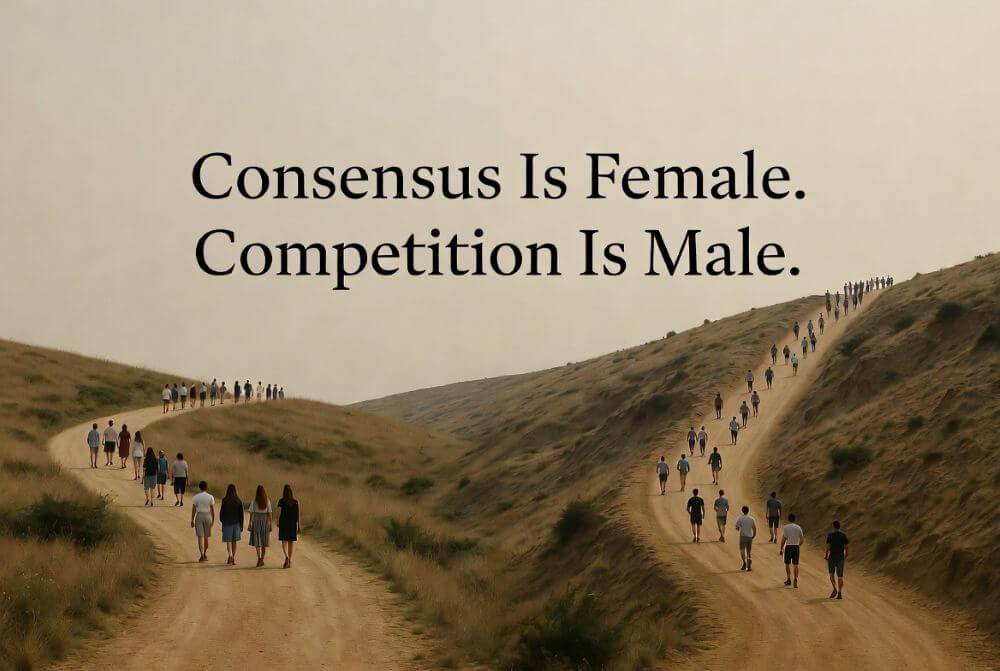
Society codes consensus as female behavior. That quiet rule shapes how we praise, train, and expect people to act at work, in politics, and in negotiations. Crisis avoidance, consensus building, conflict management, teambuilding, and non-zero-sum thinking get treated as feminine strengths. Competition, aggressive problem solving, haggling, and zero-sum thinking get coded as masculine.
These are cultural scripts. But they are not the whole story.
How Culture Assigns Skills by Gender
Leadership talk has long followed a familiar pattern. Soft skills—empathy, relationship focus, collaboration, and consensus—get labeled feminine. Harder-edged traits—assertiveness, dominance, competitiveness, and directness—get labeled masculine.
Feminine leadership is usually described as democratic and consensus-oriented. Masculine leadership is framed as directive and competitive. Women who keep groups cohesive earn praise for “bringing people together.” Men who drive hard bargains or cut through conflict earn praise for decisiveness.
The practical result is simple. Women are encouraged to expand the pie. Men are encouraged to claim the largest slice.
Modern Examples That Affirm the Pattern
Leadership and Teambuilding
Female leaders often get celebrated for collaborative styles. Descriptions highlight emotional intelligence, relationship building, and consensus. Male leaders more often get described as assertive, competitive, and focused.
In real offices, women in senior roles frequently get asked to manage the emotional temperature of teams and secure buy-in. This teambuilding work keeps things running, yet it rarely gets rewarded as highly as aggressive goal pursuit.
Negotiation Styles
Training advice still frames women as more likely to seek win-win outcomes. They are expected to preserve relationships and expand joint gains. Men are assumed to be more comfortable with competitive, winner-take-all tactics.
Women often approach talks looking for ways everyone can leave better off. Men more frequently default to haggling over who gets the bigger share. The stereotype feeds itself: women get coached toward collaboration; men get coached toward hard bargaining.
Politics and Crisis Management
Female political figures are routinely highlighted for de-escalation and bridge-building. Angela Merkel’s 2015 decision to open Germany’s borders to Syrian refugees was widely framed by supporters as an act of humanitarian leadership and moral consensus-building.
Unfortunately, Germany paid a heavy price on Merkel’s suicidal empathy since many of those immigrants turned out to be terrorist and rapist.
Male politicians are more often rewarded for public confrontation and zero-sum framing of wins and losses. A good example is President Donald Trump. His political brand has been built on refusal to compromise on core issues, and zero-sum framing—especially on immigration.
Trump’s uncompromizing leadership have saved hundreds of Americans from the rapes and murders commited by illegal immigrants.
Everyday Workplace Facilitation
In many organizations, women carry a larger share of the “glue” work. They organize offsites, mediate interpersonal friction, make sure quieter voices get heard, and stop small disagreements from turning into open conflicts. This is classic conflict management and crisis avoidance. It stabilizes teams yet seldom shows up in promotion criteria the way high-stakes deal-making does.
The Costs of the Coding
The cultural assignment creates a double bind. Women who do the expected collaborative labor well may be valued as stabilizers but judged less decisive when leadership is defined in tougher terms. Women who adopt assertive or zero-sum styles sometimes face backlash for stepping outside the expected script.
However, there have been assertive female leaders who have been praised for their firm leadership. For Example, Margaret Thatcher stands out as a prominent counter-example. As Britain’s first female prime minister, she was widely known for an assertive, confrontational leadership style that rejected consensus politics in favor of firm, uncompromising positions. Her approach—often summarized by the nickname “Iron Lady”—earned both strong admiration and fierce criticism, and it challenged the cultural expectation that women should primarily supply collaboration and peacekeeping. She had been considered as one of the best British Prime Minister at par with Wiston Churchil.
Men who prioritize consensus or caretaking can be viewed as less masculine, they look gay and are less effective. They are looked as feminine less effective. Examples are:
Justin Trudeau – Frequently praised for emphasizing empathy, listening, inclusivity, and a caring, progressive leadership style.
Barack Obama – Often described as a consensus-seeker who valued listening, bringing different voices into the room, and building coalitions.
Organizations publicly ask for collaboration and psychological safety while continuing to reward aggressive problem solving and visible wins in status and pay.
These Patterns Run Deeper Than Modern Culture
Watch a group of young children at play and the same tendencies often appear long before anyone has taught them about gender roles. Boys, on average, lean toward competitive games and building things; girls, on average, lean toward cooperative play and caring for others. These differences show up across cultures and throughout history—not just in today’s offices or political debates. From ancient hunting societies to modern cities, people have repeatedly sorted themselves into roles that track these leanings. Culture can exaggerate them, soften them, or argue about them, but it does not invent them from scratch. The expectation that women will keep the peace and men will compete for the prize has roots that run deeper than any single ideology.
Men and women are different on average, and that is fine. We should not try to change our authentic selves just to please the latest social construct of non-binary desirability. Pretending the differences do not exist does not make them disappear. It only makes honest conversation harder.
Moving Beyond the Script
The most effective people switch registers. They expand the pie when possible and claim value when necessary. Recognizing that society codes consensus as female behavior and competition as masculine is useful. But it is even more useful to remember that the underlying patterns are older and deeper than today’s cultural arguments.
The pattern is real. Naming both the cultural scripts and the deeper regularities opens the possibility of better results for teams, organizations, and societies—without demanding that people rewrite their basic nature.
Frequently Asked Questions
What does it mean that society codes consensus as female behavior? It means culture associates skills such as consensus building, conflict management, and non-zero-sum thinking more strongly with women. Women are socialized and rewarded for performing them, while men are steered toward competitive and assertive approaches.
Are these gender differences biological or cultural? Both. Average differences in personality and interests appear across cultures and early in life, pointing to biological roots. Culture then shapes how those tendencies are expressed, valued, and sometimes exaggerated.
Why do organizations still reward zero-sum thinking? Many promotion systems and status hierarchies continue to favor visible wins, decisive action, and competitive results. Collaborative labor is valued in rhetoric but often remains informal and under-rewarded.
Can people of any gender develop both skill sets? Yes. The most effective professionals and leaders learn to use integrative approaches when they create value and distributive approaches when claiming value is necessary. The cultural coding simply makes some styles feel more natural or expected for each gender.