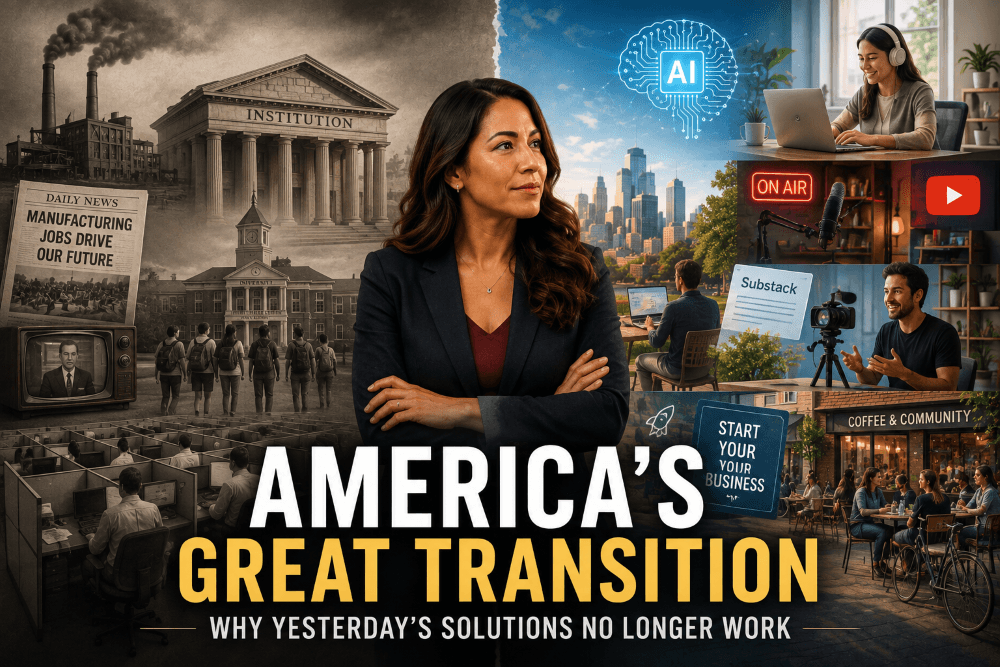
Many of today’s political, economic, and social debates are built on assumptions that no longer match reality.
We argue about jobs as if everyone still expects to work for one employer until retirement. We debate education as though universities are the only path to success. We talk about communities as if churches, unions, neighborhood associations, and civic clubs still play the central role they once did.
The world has changed dramatically over the past few decades. Our institutions have not.
This disconnect lies at the heart of why America feels so divided.
Many of today’s frustrations come from trying to solve modern problems using institutions designed for a completely different era. Instead of longing for the past, we need to build institutions that fit today’s realities.
This message is not simply about politics. It is about work, education, technology, entrepreneurship, families, communities, and the future of society itself.
Why America Feels So Divided in the Twenty-First Century
America is wealthier than ever.
Technology has made communication instantaneous. Artificial intelligence can perform tasks that would have seemed impossible just a few years ago. Medical advances continue to improve lives. Consumers enjoy unprecedented choice.
Yet surveys consistently show declining trust in government, the media, corporations, universities, and even one another.
How can both statements be true?
The answer may be that our economic progress has outpaced our institutional evolution.
Many of the organizations that shaped twentieth-century America were built around stability.
People worked for the same employer for decades.
Families often remained in the same city for generations.
Local newspapers informed entire communities.
Political parties represented broad coalitions.
Universities were the primary gateway to professional careers.
Today’s society operates very differently.
People change careers several times during their lives.
Millions work independently.
Information comes from thousands of competing voices.
Artificial intelligence is reshaping entire industries.
Traditional institutions no longer hold the same influence they once did.
Yet many public debates still assume the old world exists.
The Age of Individualism
We are living in an era of growing individualism.
This does not simply mean people have become more self-centered.
Instead, individuals have gained more freedom to make choices that previous generations rarely had.
People can work remotely.
Launch businesses from their homes.
Create audiences on YouTube.
Publish newsletters on Substack.
Teach courses online.
Build consulting practices from anywhere in the world.
A motivated entrepreneur no longer needs permission from a newspaper editor, television producer, or publishing company to reach millions of people.
This is one of the greatest expansions of opportunity in human history.
But freedom also brings new challenges.
When everyone follows their own path, shared experiences become less common.
Communities become fragmented.
People consume different media.
Trust different experts.
Believe different facts.
The institutions that once connected society together become weaker.
Artificial Intelligence Is Accelerating the Transition
Artificial intelligence is making this transformation happen even faster.
Much of today’s discussion focuses on jobs that AI may eliminate.
That is understandable.
History shows that technological change can be disruptive.
But as economist James Bessen has repeatedly argued, new technologies rarely replace workers overnight. Instead, they change the skills workers need and reward those who learn to use new tools effectively.
The introduction of spreadsheets did not eliminate accountants.
Instead, accountants became more productive.
The internet did not eliminate marketing professionals.
It created digital marketers, SEO specialists, content strategists, social media managers, and online educators.
Today AI is following a similar path.
Graphic designers increasingly use AI-assisted software.
Lawyers automate routine research.
Doctors use AI to analyze medical images.
Software developers generate code faster than ever.
The most successful professionals are not those resisting AI but those learning how to combine human judgment with machine intelligence.
This transformation requires something many institutions struggle to provide: continuous learning throughout an entire career.
The End of the Lifetime Career
For much of the twentieth century, success followed a relatively predictable path.
Graduate.
Find a stable employer.
Work hard.
Receive promotions.
Retire with a pension.
That model still exists for some professions, but it is no longer the norm.
Today’s workforce increasingly consists of freelancers, consultants, creators, independent contractors, coaches, influencers, and entrepreneurs.
Many people earn income from multiple sources simultaneously.
Someone might teach online, consult with businesses, publish books, host a podcast, and invest in index funds—all at the same time.
Technology has made these careers possible.
Institutions have not always kept pace.
Tax systems, employment laws, health insurance, retirement planning, and higher education were largely designed for traditional employment.
The result is a growing mismatch between the way people actually live and the way many systems continue to operate.
Remote Work Changed More Than the Office
The COVID-19 pandemic accelerated one of the biggest workplace transformations in modern history.
Remote work became mainstream.
Many employers initially viewed remote work as a temporary emergency measure.
Employees discovered something different.
Many valued flexibility more than long commutes.
Companies realized talent could be hired from anywhere.
Entire industries began rethinking what a workplace actually is.
This shift fundamentally changed the relationship between employers and employees.
Work became something people do rather than somewhere people go.
That sounds like a small distinction.
It isn’t.
It changes hiring.
Management.
Company culture.
Real estate.
Transportation.
Urban planning.
Even family life.
Our institutions were designed around centralized organizations.
Increasingly, society is becoming decentralized.
Trust Is Moving Away from Institutions
Perhaps the clearest example of institutional change can be found in how people consume information.
Not long ago, a handful of newspapers and television networks shaped public conversation.
Today millions of people receive their news from podcasts, YouTube channels, newsletters, independent journalists, and social media creators.
Some of the world’s most influential interviewers never worked for traditional media organizations.
Independent writers now build audiences larger than many newspapers.
Experts communicate directly with readers without going through editors or publishers.
This democratization has created enormous opportunities.
It has also created enormous confusion.
When everyone has a microphone, determining whom to trust becomes far more difficult.
Psychologist Jonathan Haidt has argued that social media algorithms amplify outrage because outrage captures attention.
Platforms reward emotional engagement.
Nuance spreads slowly.
Anger spreads instantly.
This helps explain why America often appears more divided online than it may actually be in everyday life.
Many citizens interact peacefully with neighbors, coworkers, and local businesses while simultaneously consuming highly polarized content online.
The digital world magnifies conflict far beyond what most people experience face-to-face.
Universities Are No Longer the Only Gatekeepers
For generations, earning a college degree was considered the safest path to a successful career. Universities provided not only knowledge but also credibility, networking opportunities, and access to employers.
Some higher learning institutions have shifted from centers of open inquiry into environments that prioritize ideological conformity over rigorous debate. In these settings, students are often exposed to frameworks labeled as “woke” ideology, taught sympathetic views of communism or Marxist analysis, and encouraged to view American history and institutions primarily through a lens of systemic oppression and national failure. At the same time, certain campuses promote gender identity theories that treat biological sex as secondary or malleable, presenting transgender concepts as settled moral and scientific truths rather than subjects open to evidence-based scrutiny. The resul is that many students emerge less equipped for independent critical thinking and more inclined toward political activism shaped by these specific doctrines.
Some students pursue college degrees that carry substantial tuition costs and opportunity costs yet deliver little economic return, leaving them burdened with significant student loan debt and limited ability to recover those expenses through higher earnings. After graduation, many find themselves in low-paying fields with weak job prospects relative to the investment, struggling for years to service debt while forgoing the income they might have earned by entering the workforce earlier or choosing a higher-value path. Among the college majors consistently ranked as having the worst economic value—based on low median earnings, poor return on investment, and high underemployment—are theology and religion, early childhood education, visual and performing arts, psychology, gender studies, and family and consumer sciences.
Today, millions of people avoid college all together and acquire skills through online courses, boot camps, professional certifications, YouTube tutorials, AI-assisted learning platforms, and hands-on experience. A software developer might learn programming on Coursera or Udemy. A marketer may become an expert through Google certifications. A designer can build a portfolio entirely online.
Increasingly, employers care less about where someone learned a skill and more about whether they can demonstrate it.
Artificial intelligence is accelerating this trend. Instead of memorizing information, professionals now need to know how to ask better questions, evaluate AI-generated answers, and apply critical thinking.
Economist Tyler Cowen has argued that the future belongs to people who learn quickly, adapt continuously, and work effectively alongside intelligent machines. In a rapidly changing economy, curiosity becomes more valuable than credentials alone.
Universities still have an important role to play. But like many institutions, they must evolve to serve a world where learning is lifelong rather than concentrated in four years of early adulthood.
The Decline of Traditional Media—and the Rise of Independent Voices
Media has undergone a transformation similar to education.
Unfortunately, much of the mainstream media has also embraced a “woke” orientation, prioritizing virtue signaling and emotional affirmation of preferred narratives over impartial reporting. Outlets such as CNN, MSNBC, The New York Times, and The Washington Post are frequently cited for framing stories through progressive lenses on race, gender, and identity while downplaying or omitting inconvenient facts that challenge those views. Rather than serving as neutral watchdogs, these organizations are accused of catering to the ideological preferences of their audiences and elite circles, offering moral reassurance and selective outrage in place of rigorous, objective journalism. The result, is a media environment that reinforces groupthink instead of informing the public with balanced, evidence-based coverage.
For decades, newspapers, television networks, and magazines controlled the flow of information. Editors decided which stories mattered. Journalists served as gatekeepers.
Today, anyone with a smartphone and an internet connection can reach millions.
Independent journalists publish on Substack.
Experts host podcasts.
Creators build audiences on YouTube.
Researchers communicate directly through newsletters and social media.
This shift has produced remarkable benefits. Diverse voices can now find audiences without needing the approval of large organizations.
But there is also a downside.
The internet rewards attention, not necessarily accuracy.
Algorithms prioritize engagement, and outrage often generates more clicks than thoughtful analysis.
As a result, public debate can become increasingly polarized even when most people hold nuanced views.
The challenge is not simply finding information. It is learning how to evaluate it.
In today’s world, media literacy may be just as important as traditional literacy.
Why Loneliness Is Rising in an Age of Constant Connection
One of the great paradoxes of modern life is that people have never been more connected digitally, yet many report feeling increasingly lonely.
We can instantly message friends across the world.
Join online communities.
Attend virtual meetings.
Follow thousands of people on social media.
Yet many struggle to build deep, meaningful relationships.
Political scientist Robert Putnam warned about this long before social media existed. In Bowling Alone, he documented the decline of civic organizations, neighborhood associations, religious participation, and volunteer groups.
These institutions once created regular opportunities for people to meet, cooperate, and develop trust.
When they weaken, loneliness often grows.
Digital communication can supplement real relationships, but it rarely replaces them.
This is one reason entrepreneurship can feel isolating. Many independent professionals work from home, manage their own schedules, and spend much of the day interacting through screens.
I work from home. I spend most of my day in fron of the screen. But I also make it a priority to share some face time with friends. Usually I go for lunch with a friend and I go salsa dancing every evening.
Building intentional communities becomes more important than ever.
The Housing Crisis and the Changing American Dream
For much of the twentieth century, buying a home represented a major milestone of adulthood.
It symbolized financial stability, community, and upward mobility.
Today, that dream feels increasingly out of reach for many younger people.
Housing prices have risen much faster than incomes in many cities.
Higher interest rates have made ownership more expensive.
Young families often postpone buying homes, having children, or putting down permanent roots.
This has consequences beyond personal finance.
Communities become less stable when residents move frequently.
People are less likely to know their neighbors.
Local civic engagement declines.
The traditional vision of the American Dream is evolving.
For some, success may no longer mean owning a large suburban house.
Instead, it may mean flexibility, financial independence, meaningful work, and stronger relationships.
Our institutions need to recognize these changing priorities rather than assuming every generation wants exactly the same life.
Can Local Communities Rebuild Social Trust?
If national politics often feels increasingly divisive, local communities may offer reason for optimism.
Author Arthur Brooks argues that rebuilding trust begins with ordinary human relationships rather than political victories.
People rarely change their minds because someone won an argument on social media.
They change through conversations with neighbors.
Coworkers.
Friends.
Family members.
Entrepreneurs have an important role to play here.
Small businesses create gathering places.
Coffee shops.
Dance studios.
Local bookstores.
Restaurants.
Gyms.
These businesses do more than generate revenue.
They create relationships.
As someone who teaches dance, I’ve seen this firsthand.
People often come to salsa classes expecting to learn steps.
What they discover is a community.
Friendships form.
Couples meet.
Immigrants find connection in a new country.
Professionals reduce stress after work.
Students gain confidence.
A dance floor becomes more than entertainment—it becomes a social institution.
In an age of increasing isolation, those kinds of communities matter more than ever.
New Digital Communities Are Emerging
Not all new institutions exist in physical spaces.
Entrepreneur and investor Balaji Srinivasan argues that technology is enabling entirely new forms of community built around shared interests rather than geography.
People increasingly belong to digital communities centered on entrepreneurship, investing, software development, health, education, or creative pursuits.
These networks often cross national borders.
Someone in Montreal can collaborate daily with entrepreneurs in Singapore, London, São Paulo, and Austin without ever meeting in person.
While these digital communities cannot completely replace local relationships, they expand opportunities for learning, collaboration, and innovation.
I live in Canada, but most of my clients are in England and most my blog readers are in The U.S.
The challenge for society is not choosing between physical and digital communities.
It is learning how to combine both.
So What Can Be Done?
We need institutions capable of serving modern individuals rather than trying to force modern individuals into outdated institutions.
That requires humility.
Experimentation.
Local leadership.
Entrepreneurship.
Community building.
Rather than asking how we can restore yesterday’s institutions, perhaps we should ask a different question:
What kinds of institutions does today’s society actually need?
Some already exist.
Others have yet to be created.
History suggests that periods of great technological change often produce uncertainty before they produce stability.
The Industrial Revolution transformed work, cities, education, and politics.
The digital revolution—and now the AI revolution—is likely to do the same.
The challenge is not resisting change.
It is guiding it wisely.
Five Lessons Every Entrepreneur Can Learn
Whether you run a global company or a one-person business, these ideas offer practical guidance.
1. Build Communities, Not Just Audiences
Followers are valuable.
Communities are transformative.
Focus on creating places where people interact with one another, not just with your content.
2. Don’t Wait for Institutions to Solve Your Problems
The future belongs to people who create opportunities instead of waiting for permission.
Entrepreneurs have always succeeded by building solutions where institutions fall short.
3. Learn Continuously
Artificial intelligence will continue changing every profession.
The competitive advantage will belong to lifelong learners who adapt faster than technology changes.
4. Invest in Real Relationships
Your network is more than a list of LinkedIn connections.
Strong friendships, professional relationships, mentors, and local communities create opportunities that algorithms cannot.
5. Become Adaptable Rather Than Nostalgic
The past offers valuable lessons.
It cannot provide complete solutions.
The entrepreneurs who thrive will respect history while building for tomorrow.
Final Thoughts
America feels divided not simply because people disagree.
Every generation has disagreements.
What makes this moment different is that the institutions that once helped people cooperate, learn, work, and build trust are disapearing or adapting more slowly than the society they serve.
Yuval Levin reminds us that nostalgia is not a strategy.
Jonathan Haidt warns us about the incentives of social media.
Arthur Brooks encourages us to rebuild trust through kindness and friendship.
Robert Putnam reminds us of the importance of civic engagement.
James Bessen shows that technological revolutions reward continuous learning.
Tyler Cowen argues that adaptability is becoming one of the defining skills of the twenty-first century.
Balaji Srinivasan points toward new forms of digital communities that transcend geography.
Taken together, these thinkers offer a hopeful message.
The future is not predetermined.
The institutions that shape tomorrow have not all been built yet.
Entrepreneurs, educators, community leaders, and ordinary citizens all have a role to play.
The solution to America’s divisions will not come from one election, one policy, or one technological breakthrough.
It will come from millions of people choosing to build stronger communities, earn trust, embrace lifelong learning, and create institutions worthy of the twenty-first century.
And perhaps that is the most encouraging lesson of all: if people created today’s institutions, people can also create better ones for tomorrow.