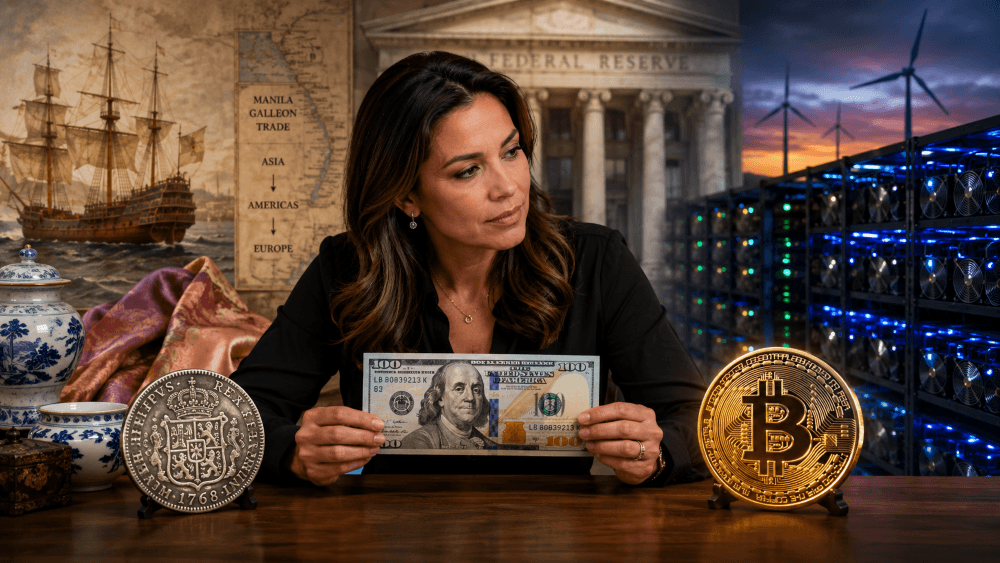
Bitcoin and the history of money raise one of the strangest questions in economics: Why do human beings exchange things with obvious practical value for things whose value depends largely on other people believing they are valuable?
A farmer produces food. A factory produces tools. A Chinese artisan makes porcelain. An electrician provides electricity. These things have obvious utility.
But a silver coin, a $100 bill, or a Bitcoin is different.
Their greatest usefulness comes from our expectation that somebody else will accept them tomorrow.
This may seem irrational. Yet this collective agreement is also one of humanity’s most powerful inventions.
The Strange Human Invention Called Money
Imagine that I work for several hours and you give me a $100 bill.
I have exchanged something very real—my time, knowledge and labor—for a small piece of printed paper.
Why would I do that?
Because I don’t really want the paper.
I want what the paper allows me to obtain later.
I know that a grocery store will give me food for it. A restaurant will give me dinner. A mechanic will repair my bicycle or car. A dance teacher will give me a private dance lesson. Someone else might give me several hours of their labor.
Money allows us to separate two transactions.
Without money:
My labor → something you own that I happen to want
With money:
My labor → money → almost anything I want later
This is an extraordinary social technology.
Money is essentially stored purchasing power.
But that raises another question: Why do we trust the thing sitting between those two transactions?
The Global Silver Trade: When China Wanted Silver
One of the greatest historical examples comes from the global silver trade that developed after Europeans reached the Americas.
Spain gained access to enormous silver deposits in the Americas, most famously at Potosí in present-day Bolivia and in the mines of Mexico.
At the same time, Europeans desperately wanted Asian goods.
Chinese producers made products Europeans valued enormously, including:
- Silk
- Porcelain
- Tea
- Textiles
- Other manufactured goods
There was a problem.
China did not have an equivalent appetite for many European products.
What Chinese merchants did want was silver.
This created one of history’s most important trading relationships.
Chinese goods → Spanish-American silver
The Manila Galleon trade helped connect these worlds. Silver from the Americas crossed the Pacific through Manila and flowed into Asian markets, while Asian goods moved in the opposite direction.
For perhaps the first time, the economies of the Americas, Europe and Asia became deeply connected through sustained global commerce.
Why Did China Want So Much Silver?
It would be misleading to say that silver had no real value.
Silver could be used for jewelry, decorative objects and other purposes. It was durable, divisible and relatively easy to transport.
But those uses alone cannot explain the extraordinary quantities of silver that moved around the world.
Silver had acquired something much more powerful:
monetary value.
In China, silver became increasingly important for commerce and taxation. Once taxes, debts and transactions were denominated in silver, people had a powerful reason to obtain it.
This created an interesting economic phenomenon.
People were exchanging goods that had obvious practical utility—silk, porcelain and tea—for metal that they primarily wanted because it could subsequently be exchanged for something else or used to satisfy monetary obligations.
And obtaining that silver was enormously expensive.
The Real Resources Behind a Silver Coin
Think about what was required to produce and transport Spanish silver.
Mines had to be discovered and developed. Workers had to extract enormous quantities of ore.
The ore had to be processed and refined.
Animals, tools, timber, food and transportation were required.
Then the silver had to travel enormous distances.
Ships had to be constructed and crews paid. Trade routes had to be protected. Merchants faced piracy, storms, shipwrecks and enormous financial risks.
Human beings devoted extraordinary quantities of labor and natural resources to producing a metal that was increasingly valuable because society had decided to use it as money.
This historical story leads to an interesting modern comparison.
Bitcoin and the History of Money Repeat an Old Pattern
Bitcoin seems radically new.
In some ways, it is.
But viewed through the history of money, Bitcoin repeats a very old human behavior.
Bitcoin mining requires real economic resources.
Mining operations purchase specialized computers. Those computers require factories and raw materials to manufacture.
Mining facilities require buildings, cooling equipment, maintenance and technical expertise.
Most importantly, Bitcoin mining consumes electricity.
So we have something resembling the historical silver process:
Energy + equipment + labor + capital → Bitcoin
We transform resources with obvious practical uses into a scarce monetary asset whose value depends heavily on whether other humans continue wanting it.
That is remarkably similar to what happened with silver.
But there is an important difference.
A $100 Bill Is Incredibly Cheap to Produce
Consider a modern $100 banknote.
The physical note itself costs only a tiny fraction of its face value to manufacture. Governments don’t need to consume $100 worth of paper, ink, electricity and labor to create a $100 bill.
This is one of the remarkable efficiencies of fiat currency.
The value is not stored in the paper.
The value comes from the monetary system surrounding it.
Governments accept their currencies for taxes. Employers pay salaries in them. Banks lend in them. Businesses price products in them. Courts enforce contracts denominated in them.
An enormous network already exists that makes the currency useful.
Consequently, society does not need to expend $100 of real resources every time another $100 enters circulation.
Bitcoin deliberately works differently.
Bitcoin Turns Scarcity Into an Expense
Bitcoin does not have a government guaranteeing its monetary system.
Instead, Bitcoin attempts to create trust and scarcity through software, cryptography, a distributed network and proof-of-work mining.
Producing new Bitcoin therefore involves substantial computational work and electricity consumption.
Bitcoin supporters might argue that this expenditure is not waste but part of what secures the network and makes it difficult to manipulate.
That’s a legitimate argument.
But from another perspective, it creates a fascinating economic paradox.
We already possess monetary systems capable of creating units of exchange at very low marginal physical cost.
Bitcoin intentionally creates a monetary system in which maintaining consensus and issuing new coins requires significant real-world resources.
Electricity could power homes.
Computers could perform other calculations.
Capital could build factories.
Instead, some of those resources are used to maintain a digital monetary network and compete for newly issued Bitcoin.
If Bitcoin’s primary purpose is viewed simply as a medium of exchange, this can appear extraordinarily inefficient.
Is Bitcoin Irrational?
This is where Bitcoin and the history of money become particularly interesting.
It would be easy to conclude that Bitcoin is irrational because it consumes real resources to create something intangible.
But that would miss part of the story.
Silver mining also consumed enormous resources.
Gold mining still does.
Humans have spent thousands of years digging holes in the ground, extracting precious metals, refining them—and sometimes placing those metals into heavily guarded vaults.
From a purely physical perspective, that behavior can also look peculiar.
Bitcoin may therefore represent not an entirely new form of irrationality, but a digital version of a very old human tendency.
We are willing to expend real resources to create things that we collectively agree can store and transfer value.
Use Value Versus Monetary Value
The distinction I find most interesting is between use value and monetary value.
A loaf of bread has immediate use value. You can eat it.
A house provides shelter.
Electricity can produce light, heat or computing power.
Porcelain can hold food.
Money is different.
Its greatest utility often comes from its ability to obtain something else.
That gives money an almost circular characteristic:
I accept money because I believe you will accept money.
You accept it because you believe another person will accept it.
And that person accepts it for exactly the same reason.
Eventually millions—or billions—of people participate in the same belief.
At that point, is the value still imaginary?
Money Is a Claim on the Future
Perhaps calling money “worthless” misses its most important function.
Consider the Chinese merchant who exchanged porcelain for Spanish silver.
He did not necessarily want to speculate on the price of silver.
He wanted optionality.
Without money:
Porcelain → something I want today
With money:
Porcelain → silver → something I might want tomorrow
Money allows us to store the value of today’s production and decide later what we want in return.
In that sense, money could be thought of as a claim on future exchange.
Today we do essentially the same thing.
Labor → dollars → future goods and services
And Bitcoin proposes another version:
Electricity + computing power → Bitcoin → future goods, services or currency
The real debate is therefore not whether Bitcoin physically exists in the same way a house exists.
The important question is whether people will continue recognizing its claim on future exchange.
The Fundamental Difference Between Silver, Dollars and Bitcoin
Silver, fiat currency and Bitcoin all depend on human acceptance.
But they obtain that acceptance differently.
Silver developed monetary value through scarcity, physical characteristics, historical convention, international trade and government demand.
Fiat money derives much of its usefulness from governments, taxation, banking systems, contracts, salaries and enormous existing networks of users.
Bitcoin attempts to create monetary scarcity and trust without either a scarce physical commodity or a central government issuer.
Instead, it relies on cryptography, software, proof of work and decentralized consensus.
That makes Bitcoin a remarkable economic experiment even if one remains skeptical about its long-term value.
When Does Imaginary Value Become Real?
This leaves us with a philosophical question.
What does it mean for something to have “real” value?
A $100 bill has little physical value.
Yet I will happily teach, write or work in exchange for one because I know what I can obtain with it.
Bitcoin is even more abstract.
Yet millions of people are willing to exchange dollars, electricity, computers, labor and other real resources for it.
Perhaps money demonstrates something fundamental about human civilization:
Value does not have to be physical to be real.
Property rights are abstract.
Corporations are legal abstractions.
Contracts are pieces of paper or electronic records.
Bank balances are mostly numbers in databases.
Yet all of them influence the allocation of real resources.
The fascinating question surrounding Bitcoin isn’t simply whether Bitcoin is real or imaginary.
It is this:
How much should society be willing to sacrifice in real resources to manufacture and maintain monetary scarcity?
A government can produce the physical representation of $100 for very little.
Bitcoin deliberately makes the creation of new units costly.
Perhaps that cost helps make Bitcoin valuable.
Perhaps it represents an enormous economic inefficiency.
Or perhaps both statements can be true simultaneously.
History shows that humans have always been willing to exchange useful things for symbols of value.
From Chinese porcelain and Spanish silver to electricity and Bitcoin, the technology changes.
The human behavior is surprisingly familiar.
Frequently Asked Questions
Why did China want Spanish silver?
Silver became extremely important in Chinese commerce and taxation. Chinese demand combined with European demand for Chinese goods helped pull enormous quantities of American silver toward Asia.
Is a $100 bill intrinsically worth $100?
No. The paper and printing do not account for anything close to its face value. Its purchasing power comes primarily from the monetary, governmental, legal and economic system in which people accept it.
Why does Bitcoin require so much electricity?
Bitcoin uses a proof-of-work system in which miners perform computational work to compete to add blocks, secure the network and receive rewards. This deliberately makes participation in mining resource-intensive.
Is Bitcoin similar to silver?
There are similarities and important differences. Both involve costly production of scarce monetary assets, but silver is a physical commodity while Bitcoin is a digital asset whose scarcity and ownership are maintained through a decentralized network.