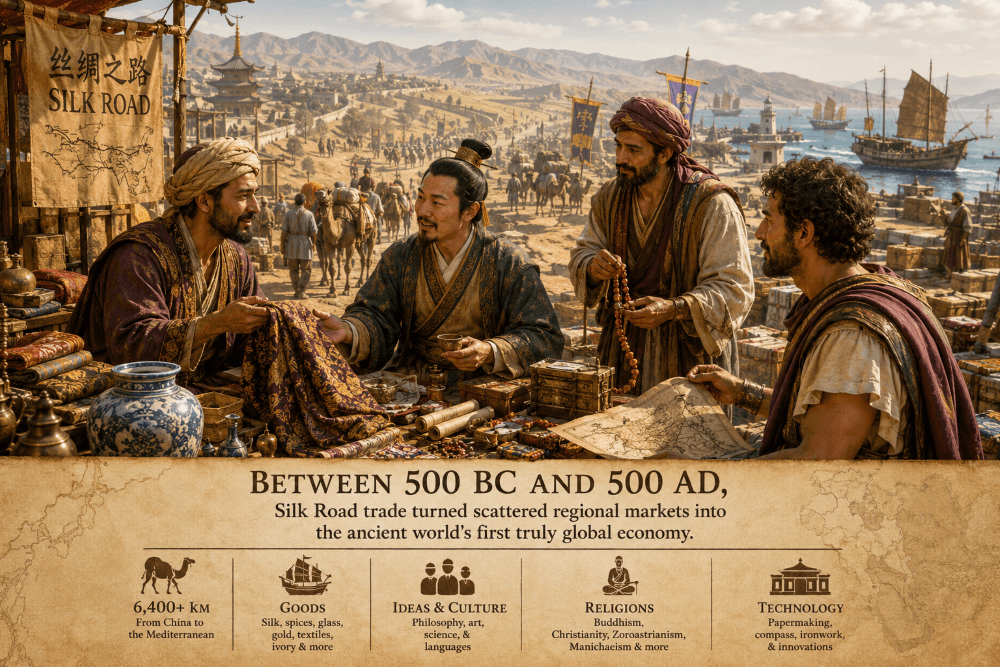
Between 500 BC and 500 AD, Silk Road trade turned scattered regional markets into the ancient world’s first truly global economy. Stretching more than 6,400 kilometers from China to the Mediterranean, this network of overland and maritime routes carried goods, ideas, religions, and technologies across three continents. For entrepreneurs today, the Silk Road offers an early masterclass in building networks, managing risk, and creating value across cultural and political borders.
What Was the Silk Road?

The Silk Road wasn’t a single road at all. It was a web of interconnected trade routes linking China, Central Asia, India, Persia, Arabia, and Rome.
- It got its name from the lucrative Chinese silk trade, though goods flowing along the routes included spices, glass, gems, metals, and paper.
- No single merchant traveled the entire length. Instead, goods passed through a relay of regional traders, each covering a segment they knew well.
- The network relied on oasis cities, caravanserais (roadside inns), and river crossings that became commercial hubs in their own right.
This relay structure is itself an entrepreneurial insight: rather than one person controlling an entire supply chain, thousands of independent operators specialized in their own local leg of the journey.
How Silk Road Trade Created Entrepreneurial Opportunity
Specialized Merchant Classes
Different groups carved out niches along the routes. Sogdian traders from Central Asia became especially famous as middlemen, mastering multiple languages and building trust-based networks across ethnic and religious lines.
Financial Innovation
Long-distance trade demanded new financial tools:
- Credit arrangements let merchants finance goods before payment arrived.
- Partnership agreements spread risk across multiple investors.
- Standardized currencies and weights made cross-border transactions predictable.
Risk and Reward at Scale
Caravans faced bandits, harsh terrain, and unpredictable politics. Successful merchants pooled resources into caravan associations, sharing security costs and losses the same way modern businesses use insurance and joint ventures.
The Role of Empires in Silk Road Trade
Trade didn’t happen in a vacuum. Political stability directly shaped commercial success.
- The Han Dynasty in China secured western trade routes and promoted silk exports as state policy.
- The Roman Empire created enormous demand for Eastern luxury goods, feeding gold and silver into the network.
- The Parthian and later Sassanid Empires in Persia positioned themselves as essential middlemen, taxing and controlling the flow of goods between East and West.
Entrepreneurs who understood these shifting political relationships could time their ventures for maximum advantage — an early lesson in reading macro conditions before committing capital.
Innovation Beyond Silk
Silk Road trade moved far more than fabric. It became history’s most effective channel for technology transfer.
- Papermaking techniques spread from China westward, eventually reshaping European record-keeping and commerce.
- Buddhism, and later Christianity and Islam, traveled the same routes as merchants, creating shared cultural touchpoints that made trust between distant traders easier.
- Agricultural products like grapes, alfalfa, and various fruits moved in both directions, changing diets and farming practices across Eurasia.
Lessons for Modern Entrepreneurs
The Silk Road offers principles that still apply to building any large-scale venture:
- Networks beat vertical control. No merchant owned the whole route, yet the system moved goods efficiently for centuries.
- Trust is infrastructure. Reputation and relationships substituted for formal contracts across cultures with no shared legal system.
- Diversification reduces risk. Traders who dealt in multiple goods and routes survived disruptions better than single-product specialists.
- Adapt to political change. The merchants who thrived were the ones who adjusted quickly as empires rose and fell.
Frequently Asked Questions
What was traded on the Silk Road besides silk? Merchants moved spices, precious stones, glassware, ceramics, metals, paper, tea, and livestock, along with religious and cultural ideas that spread alongside physical goods.
Who controlled the Silk Road trade routes? No single power controlled the entire network. Regional empires like the Han Dynasty, Parthian Empire, and later Byzantine Empire each controlled and taxed segments of the route within their territory.
Why was Silk Road trade important for entrepreneurship? It created some of history’s earliest examples of long-distance partnerships, credit systems, and cross-cultural business relationships, laying groundwork for modern international trade practices.
When did the Silk Road decline? Overland routes gradually declined after the rise of maritime trade in the late medieval period, though the network’s core period of influence covered roughly 500 BC to 1500 AD.
Related Articles
- The First Entrepreneur: When Did Entrepreneurship Begin?
- The Agricultural Revolution: How Farming Created the First Entrepreneurs
- How Writing Was Invented for Business: The First Accountants
- The First Merchants: How the Sumerians Created Professional Commerce
- The Birth of Money: How Currency Changed Entrepreneurship Forever
- The Indus Valley: Trade, Standardization, and the Mysterious Business Civilization
- Ancient China: Innovation, Markets, and Continuous Improvement
- The Phoenicians: How Maritime Trade Connected the Ancient World
- Ancient Greece: How Competition and Markets Shaped Entrepreneurship
- Ancient Rome: How Infrastructure, Law, and Scale Built an Economic Empire
- The Islamic Golden Age: How Knowledge, Finance, and Global Trade Transformed Entrepreneurship
About The History of Entrepreneurship
This article is part of The History of Entrepreneurship, an ongoing series exploring how civilizations, merchants, technologies, institutions, and entrepreneurs gradually created the foundations of modern business.
Rather than treating entrepreneurship as a modern invention, the series follows its evolution across civilizations—from the earliest exchanges between prehistoric humans to the global businesses of the modern economy.
Each chapter adds another tool to the entrepreneur’s toolkit.