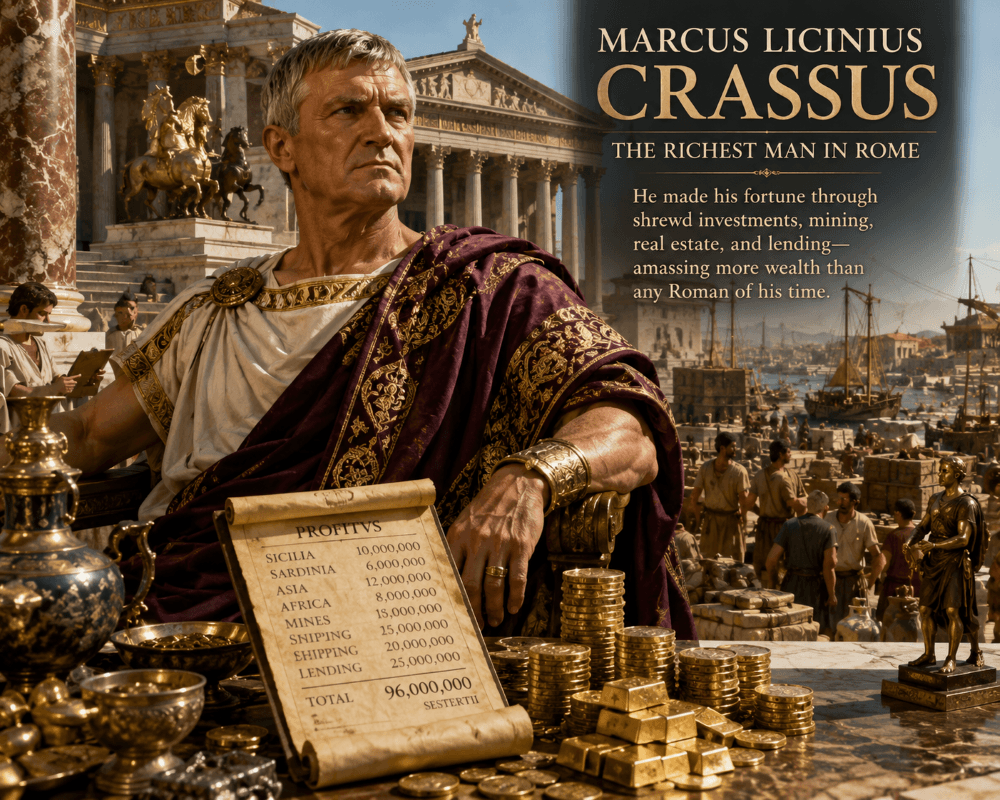
Marcus Licinius Crassus wasn’t born into legendary wealth — he built it, piece by ruthless piece, until he became the richest man in Roman history. Estimates place his fortune at roughly 200 million sesterces, a sum so large that ancient writers used it as the benchmark for extreme wealth for centuries afterward. His story is a case study in aggressive dealmaking, calculated risk, and the dangerous places unchecked ambition can lead.
Who Was Marcus Licinius Crassus?
Crassus was born around 115 BC into a respected but not especially wealthy patrician family. His early life was shaped by chaos: his father and brother died during Rome’s brutal civil wars between Marius and Sulla.
- He fled Rome as a young man and hid in Spain to escape political violence.
- He later allied himself with Sulla, who rewarded loyal supporters with confiscated property from defeated enemies.
- This alliance gave Crassus his first real opportunity to accumulate serious capital.
From this shaky start, Crassus transformed himself into Rome’s most formidable businessman.
How Marcus Licinius Crassus Built His Fortune
Real Estate and Disaster Capitalism
Crassus’s most famous business scheme exploited a simple problem: Rome burned constantly, and it had no public fire department.
- He assembled a private brigade of enslaved firefighters.
- When a building caught fire, Crassus would arrive and offer to buy the burning property — and neighboring buildings at risk — for a fraction of their value.
- Only after the owner agreed to sell would his crew put out the flames.
This ruthless cycle let him accumulate enormous amounts of Roman real estate at rock-bottom prices.
Slave Trading and Silver Mining
Beyond real estate, Crassus diversified aggressively:
- He invested heavily in enslaved labor, training slaves in valuable trades like reading and business skills before selling them at higher prices.
- He acquired silver mines, one of the most reliable sources of income in the ancient economy.
- He extended loans to fellow senators, using debt as a political tool as much as a financial one.
This diversification meant Crassus wasn’t dependent on any single revenue stream — a principle modern investors still follow today.
Crashing the Spartacus Revolt
In 71 BC, Crassus took personal command of Rome’s legions to crush the slave rebellion led by Spartacus. It was a calculated political investment as much as a military campaign.
- Victory gave him enormous prestige, something his wealth alone couldn’t buy.
- It positioned him as a rival to Pompey, Rome’s other rising military star.
- The campaign demonstrated how Crassus consistently converted financial capital into political capital.
Power Through Partnership: The First Triumvirate
Crassus understood that money alone couldn’t secure lasting power in Rome. In 60 BC, he formed an unofficial alliance with Julius Caesar and Pompey the Great, now known as the First Triumvirate.
- Crassus financed Caesar’s early political career, effectively bankrolling a future dictator.
- In exchange, he gained political protection and influence far beyond what his fortune alone provided.
- The arrangement shows an early, high-stakes example of strategic partnership between capital and ambition.
The Fatal Overreach at Carrhae
Despite his fortune, Crassus wanted something money couldn’t buy: military glory equal to Caesar’s conquests. In 53 BC, he launched an invasion of the Parthian Empire.
- The campaign was poorly planned and driven largely by ego and rivalry.
- Roman forces were decisively defeated at the Battle of Carrhae.
- Crassus was killed, reportedly along with much of his army, in one of Rome’s worst military disasters.
His death is a stark reminder that even the most successful entrepreneurs can be undone by chasing goals outside their actual expertise.
Lessons from Marcus Licinius Crassus
- Diversify aggressively. Real estate, mining, lending, and labor all fed his fortune simultaneously.
- Convert wealth into influence. Money alone rarely secures lasting power without political capital.
- Know your edge. Crassus thrived in business and finance but was crushed once he stepped into unfamiliar military territory.
Frequently Asked Questions
How rich was Marcus Licinius Crassus? Ancient sources estimate his wealth at around 200 million sesterces, an amount so vast it made him a permanent symbol of extreme riches in Roman history.
How did Crassus make his fortune? He built his wealth primarily through real estate speculation, enslaved labor, silver mining, and strategic lending to fellow senators.
What was the First Triumvirate? It was an informal political alliance between Crassus, Julius Caesar, and Pompey the Great that let all three men expand their power beyond what any could achieve alone.
How did Marcus Licinius Crassus die? He was killed in 53 BC at the Battle of Carrhae after his invasion of the Parthian Empire ended in a catastrophic military defeat.
Related Articles
- The First Entrepreneur: When Did Entrepreneurship Begin?
- The Agricultural Revolution: How Farming Created the First Entrepreneurs
- How Writing Was Invented for Business: The First Accountants
- The First Merchants: How the Sumerians Created Professional Commerce
- The Birth of Money: How Currency Changed Entrepreneurship Forever
- The Indus Valley: Trade, Standardization, and the Mysterious Business Civilization
- Ancient China: Innovation, Markets, and Continuous Improvement
- The Phoenicians: How Maritime Trade Connected the Ancient World
- Ancient Greece: How Competition and Markets Shaped Entrepreneurship
- Ancient Rome: How Infrastructure, Law, and Scale Built an Economic Empire
- The Islamic Golden Age: How Knowledge, Finance, and Global Trade Transformed Entrepreneurship
- The Silk Road Trade: How Ancient Networks Built Global Commerce
About The History of Entrepreneurship
This article is part of The History of Entrepreneurship, an ongoing series exploring how civilizations, merchants, technologies, institutions, and entrepreneurs gradually created the foundations of modern business.
Rather than treating entrepreneurship as a modern invention, the series follows its evolution across civilizations—from the earliest exchanges between prehistoric humans to the global businesses of the modern economy.
Each chapter adds another tool to the entrepreneur’s toolkit.