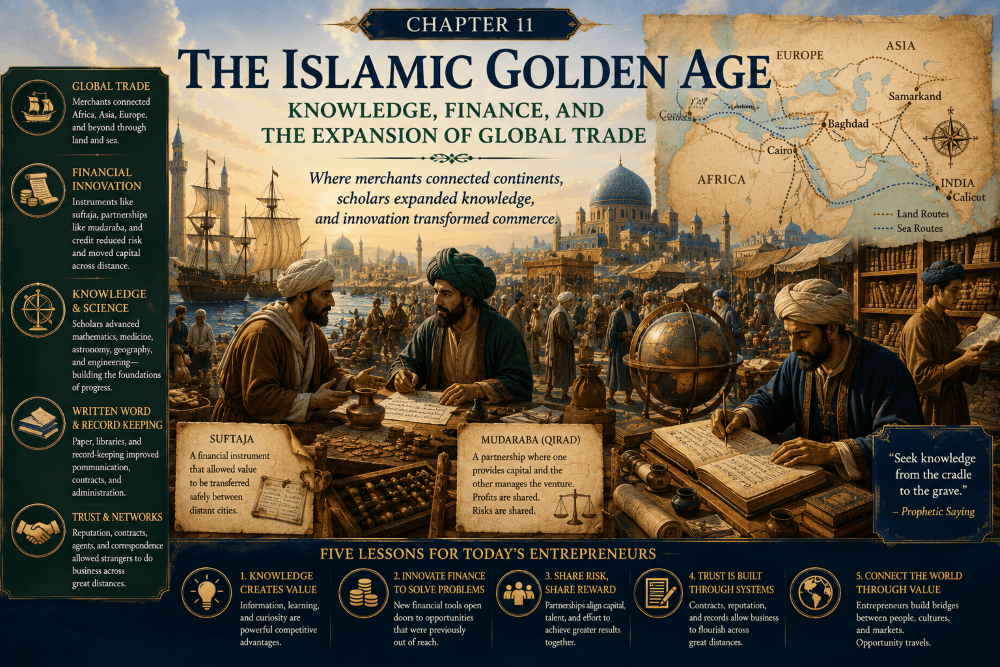
How do you conduct business with someone thousands of kilometers away?
How do you finance a trading expedition without providing all the capital yourself?
How do you transport wealth without carrying bags of gold across dangerous territory?
And how do strangers from different cultures establish enough trust to do business together?
Merchants operating during the Islamic Golden Age confronted all of these problems.
Their solutions helped advance long-distance commerce.
Between roughly the eighth and thirteenth centuries, commercial networks across the Islamic world connected the Mediterranean, Africa, the Middle East, Central Asia, India, and routes extending toward China and Southeast Asia.
Merchants used partnerships, contracts, credit arrangements, agents, written records, and sophisticated financial practices to conduct business across enormous distances.
At the same time, scholars advanced mathematics, geography, astronomy, medicine, and other fields.
The result was a powerful combination:
Knowledge and commerce reinforced one another.
What Was the Islamic Golden Age?
The term Islamic Golden Age generally refers to a period of remarkable intellectual, scientific, cultural, and economic development beginning around the eighth century.
Its geography was enormous.
Important commercial and intellectual centers included:
- Baghdad
- Cairo
- Damascus
- Basra
- Alexandria
- Cordoba
- Samarkand
- Aden
These cities connected different economic worlds.
To the west lay Europe and the Mediterranean.
To the south lay Africa.
To the east stretched Persia, Central Asia, India, Southeast Asia, and China.
Merchants operating within these networks occupied one of the most strategically important commercial regions on Earth.
Baghdad Became a Global Commercial Center
Founded in 762 CE, Baghdad grew into one of the great cities of the medieval world.
Its position near major land and river routes helped make it a center of commerce.
Markets offered products originating thousands of kilometers away:
- Silk
- Spices
- Paper
- Perfumes
- Precious stones
- Textiles
- Ceramics
- Metals
- Books
But successful merchants traded in something even more valuable than merchandise.
Information.
They needed to know:
- Where prices were rising
- Which products were scarce
- Which trade routes were safe
- Which currencies were accepted
- Which partners were trustworthy
- Where new opportunities were emerging
Information became competitive advantage.
Long-Distance Trade Created a Financial Problem

Successful international merchants faced a dangerous problem.
Money was heavy.
And valuable.
Imagine completing a profitable transaction in Baghdad and then traveling hundreds of kilometers carrying the proceeds in gold or silver.
Bandits would immediately become a serious concern.
Commerce therefore benefited from financial mechanisms that reduced the need to physically transport precious metals for every transaction.
Written instructions, credit relationships, agents, and other financial arrangements increasingly allowed merchants to settle obligations across distance.
An important principle was emerging:
Money did not always have to travel physically for value to travel.
The Suftaja Helped Money Travel Safely
One financial instrument associated with medieval Islamic commerce was the suftaja.
Its precise use varied across time and place, but it could function as a written financial arrangement through which funds or obligations were transferred between locations.
Instead of carrying large quantities of money across dangerous territory, merchants could work through trusted financial relationships.
This reduced transportation risk.
The technology was different from modern banking, but the entrepreneurial problem was familiar.
How can money move safely?
Today we use electronic transfers.
Medieval merchants developed solutions appropriate to their own commercial world.
Mudaraba and Qirad: Sharing Capital and Risk
International trade was expensive.
A merchant might need money to:
- Purchase cargo
- Hire transportation
- Provision a voyage
- Pay workers
- Rent storage
- Cover travel expenses
The return might not arrive for months.
Partnership arrangements provided a solution.
One important form was known as mudaraba, also associated historically with the qirad.
In a typical arrangement, one party supplied capital while another managed the commercial venture.
If the venture succeeded, profits were divided according to an agreed formula.
Financial losses generally fell on the capital provider unless misconduct or negligence by the managing partner was involved.
This separated two entrepreneurial resources:
Capital and expertise.
One person had money.
Another had knowledge and opportunity.
Together they could pursue a business neither could undertake as effectively alone.
The principle should sound familiar.
Modern investors and entrepreneurs often operate through a similar division of roles.
Reputation Became Commercial Capital
Doing business locally is relatively simple.
You may know your customers personally.
International commerce is different.
A merchant in Cairo might need an agent in Damascus.
A trader in Baghdad might rely on someone hundreds of kilometers away.
A shipowner in Aden might carry merchandise belonging to investors he rarely saw.
Commerce required trust beyond personal familiarity.
Merchants therefore depended heavily on:
- Reputation
- Contracts
- Family and community networks
- Commercial correspondence
- Agents
- Repeat transactions
- Recommendations
A strong reputation became an economic asset.
The more distant the transaction, the more valuable trust became.
Islamic Law Created Rules for Commerce
Commercial activity occupied an important place in medieval Islamic society.
Islamic jurisprudence addressed matters involving:
- Property
- Contracts
- Partnerships
- Debts
- Sales
- Inheritance
- Commercial disputes
These legal traditions did not make markets perfect, nor were practices identical throughout the enormous Islamic world.
But commercial rules helped define obligations and provide frameworks for resolving disagreements.
Entrepreneurs benefit when expectations are clear.
Predictability reduces risk.
And lower risk encourages investment.
Financial Constraints Encouraged Innovation
Islamic commercial finance developed within religious rules concerning riba, a concept generally associated with prohibited forms of interest or unjustified increase.
That constraint did not eliminate finance.
Instead, merchants and legal scholars worked with alternative structures involving:
- Profit sharing
- Partnerships
- Trade financing
- Leasing
- Investment arrangements
This illustrates a recurring entrepreneurial principle.
Constraints can produce innovation.
When one path is unavailable, entrepreneurs search for another.
Paper Revolutionized Information
Paper originated in China.
Over time, papermaking technology spread westward through Central Asia and into the Islamic world.
Its adoption had enormous consequences.
Compared with many earlier writing materials, paper could make written information cheaper and easier to reproduce.
That benefited:
- Merchants
- Governments
- Scholars
- Accountants
- Lawyers
- Teachers
Businesses could maintain more records.
Merchants could send correspondence.
Contracts could be documented.
Books could circulate more widely.
Knowledge became easier to preserve.
Paper lowered the cost of information.
That made commerce more efficient.
Al-Khwarizmi and the Business Value of Mathematics
Commerce becomes increasingly difficult without mathematics.
Merchants need to calculate:
- Profits
- Losses
- Debts
- Partnership shares
- Exchange rates
- Measurements
- Inheritance
- Inventory
During the ninth century, the mathematician Muhammad ibn Musa al-Khwarizmi worked in Baghdad.
His writings helped systematize algebraic methods and transmitted important mathematical knowledge.
The word algebra derives from al-jabr, a term appearing in the title of one of his works.
His name eventually contributed to the word algorithm.
These mathematical advances reached far beyond academic scholarship.
Better methods of calculation made complicated commercial relationships easier to manage.
Knowledge Became Economic Infrastructure
Rome demonstrated the value of physical infrastructure.
Roads.
Ports.
Bridges.
The Islamic Golden Age demonstrates another kind of infrastructure:
Knowledge.
Libraries, schools, translators, mathematicians, astronomers, physicians, geographers, engineers, and scholars created intellectual networks.
Knowledge from different civilizations circulated through them.
Greek works were translated and studied.
Indian mathematics influenced scholarship.
Persian knowledge contributed to administration and science.
Chinese technologies traveled westward.
Scholars did not merely preserve earlier knowledge.
They debated, developed, and transmitted it.
Ideas traveled along many of the same routes as merchandise.
The Indian Ocean Was a Global Marketplace
Histories of international commerce often focus heavily on the Mediterranean.
But the Indian Ocean was another extraordinary commercial system.
Merchants learned to use seasonal monsoon winds to travel among:
- Arabia
- East Africa
- India
- Southeast Asia
Ports became multicultural commercial centers.
Arab, Persian, Indian, African, Jewish, and other merchants participated in overlapping trading networks.
Different religions.
Different languages.
Different customs.
Yet commerce created incentives for cooperation.
International entrepreneurship was already deeply multicultural.
What Did Medieval Merchants Trade?
The commercial networks associated with the Islamic world carried an enormous variety of products.
These included:
- African gold
- Indian spices
- Chinese silk
- Chinese ceramics
- Central Asian horses
- Mediterranean textiles
- Arabian perfumes
- Precious stones
- Metals
- Timber
- Paper
- Books
International merchants increasingly specialized in connecting producers with distant consumers.
They did not necessarily manufacture the products themselves.
Their entrepreneurial value came from recognizing opportunities across geography.
Markets Were Information Networks
A medieval marketplace was not simply a place to purchase goods.
It was an information exchange.
Merchants constantly asked questions.
Which caravan had arrived?
Which ship had been delayed?
Where had grain prices increased?
Which route had become unsafe?
Which city needed textiles?
Which ruler had introduced a new tax?
Entrepreneurs who obtained reliable information faster could make better decisions.
Today we call this market intelligence.
The principle is centuries old.
Entrepreneurship Without Modern Technology
Medieval merchants had no:
- Internet
- Smartphones
- Container ships
- Electronic banking
- Credit cards
- Instant messaging
Yet they confronted problems modern entrepreneurs would immediately recognize.
How do I raise capital?
How do I share risk?
How do I find trustworthy partners?
How do I enter foreign markets?
How do I move money safely?
How do I obtain reliable information?
How do I enforce agreements?
How do I protect my reputation?
Technology changes.
Entrepreneurial problems persist.
When Knowledge and Commerce Reinforce Each Other
The Islamic Golden Age demonstrates an especially powerful economic cycle.
Trade generated wealth.
Wealth supported cities and institutions.
Cities attracted scholars.
Scholars improved mathematics, navigation, engineering, medicine, geography, and administration.
Those advances helped strengthen commerce.
Commerce then generated additional resources.
Knowledge and entrepreneurship reinforced each other.
This pattern appears repeatedly throughout history.
Prosperous societies invest in knowledge.
Knowledge creates new possibilities for prosperity.
The Entrepreneur’s Toolbox
Knowledge and Financial Innovation
Entrepreneurs create value not only by producing goods.
They also develop systems that move resources toward opportunity.
Partnerships share risk.
Contracts preserve promises.
Financial instruments move value.
Mathematics measures complicated transactions.
Paper preserves information.
Commercial networks distribute knowledge.
Together, these tools allow entrepreneurship to operate across greater distances and at greater levels of complexity.
Five Lessons Modern Entrepreneurs Can Learn
1. Knowledge Is Capital
Understanding customers, competitors, technologies, and markets creates enormous competitive advantage.
2. Finance Expands Opportunity
Good ideas often require capital before they can become successful businesses.
3. Share Risk Intelligently
Partnerships allow entrepreneurs to pursue opportunities larger than they could finance alone.
4. Trust Needs Systems
Contracts, records, reputation, and institutions allow strangers to cooperate.
5. Constraints Can Inspire Innovation
Limitations often force entrepreneurs to develop better solutions.
Frequently Asked Questions
What was the Islamic Golden Age?
The Islamic Golden Age generally refers to a period beginning around the eighth century when cities across the Islamic world became major centers of scholarship, science, commerce, culture, and technological development.
Why was trade important during the Islamic Golden Age?
Trade connected markets stretching from Europe and Africa through the Middle East and Central Asia toward India, Southeast Asia, and China, allowing goods, capital, technologies, and ideas to circulate.
What was a mudaraba?
A mudaraba was a commercial partnership in which one party generally provided capital while another managed the business venture, with profits divided according to an agreed arrangement.
What was a suftaja?
A suftaja was a financial instrument used in parts of the medieval Islamic commercial world to facilitate payments or obligations across distance, reducing some of the risks involved in physically transporting money.
How did mathematics contribute to entrepreneurship?
Mathematics made it easier to calculate debts, profits, exchange rates, partnership shares, measurements, inheritance, and other complicated commercial transactions.
Why was paper important for commerce?
Paper made record-keeping, correspondence, contracts, administration, and the transmission of knowledge easier and less expensive.
What was Al-Khwarizmi’s contribution?
Al-Khwarizmi helped systematize algebraic methods and transmit mathematical knowledge. The terms “algebra” and “algorithm” are historically connected to his work and name.
Continue the Journey
Knowledge, finance, and commercial networks allowed merchants of the Islamic world to conduct business across extraordinary distances.
Those innovations did not remain confined to one civilization.
Commercial ideas traveled with merchants.
Across the Mediterranean, European trading cities participated in increasingly sophisticated international commerce.
One city would become particularly important.
Venice.
Built on islands in a lagoon, Venice possessed little agricultural land and few natural resources.
Instead, it built wealth from ships, merchants, contracts, finance, and international trade.
In Chapter 12, we’ll explore:
Venice: How Merchant Capitalism Built a Commercial Empire.
The Entrepreneur’s Toolkit So Far
| Chapter | Entrepreneurial Contribution |
|---|---|
| Chapter 1 | Exchange |
| Chapter 2 | Surplus |
| Chapter 3 | Accounting |
| Chapter 4 | Professional Merchants |
| Chapter 5 | Money |
| Chapter 6 | Standardization |
| Chapter 7 | Continuous Improvement |
| Chapter 8 | Networks |
| Chapter 9 | Competition |
| Chapter 10 | Scale |
| Chapter 11 | Knowledge & Financial Innovation |
Every chapter adds another piece to the entrepreneur’s toolkit.
Together they show that modern entrepreneurship was not invented by one person or one civilization.
It emerged gradually through thousands of years of experimentation.
Related Articles
- The First Entrepreneur: When Did Entrepreneurship Begin?
- The Agricultural Revolution: How Farming Created the First Entrepreneurs
- How Writing Was Invented for Business: The First Accountants
- The First Merchants: How the Sumerians Created Professional Commerce
- The Birth of Money: How Currency Changed Entrepreneurship Forever
- The Indus Valley: Trade, Standardization, and the Mysterious Business Civilization
- Ancient China: Innovation, Markets, and Continuous Improvement
- The Phoenicians: How Maritime Trade Connected the Ancient World
- Ancient Greece: How Competition and Markets Shaped Entrepreneurship
- Ancient Rome: How Infrastructure, Law, and Scale Built an Economic Empire
- Venice: How Merchant Capitalism Built a Commercial Empire (Coming Soon)
About The History of Entrepreneurship
This article is part of The History of Entrepreneurship, an ongoing series exploring how civilizations, merchants, technologies, institutions, and entrepreneurs gradually created the foundations of modern business.
Rather than treating entrepreneurship as a modern invention, the series follows its evolution across civilizations—from the earliest exchanges between prehistoric humans to the global businesses of the modern economy.
Each chapter adds another tool to the entrepreneur’s toolkit.
North Star
The Islamic Golden Age demonstrated that entrepreneurship grows when knowledge, capital, information, and trust can move across distance. Its commercial networks remind us that the most valuable economies exchange not only products, but ideas.