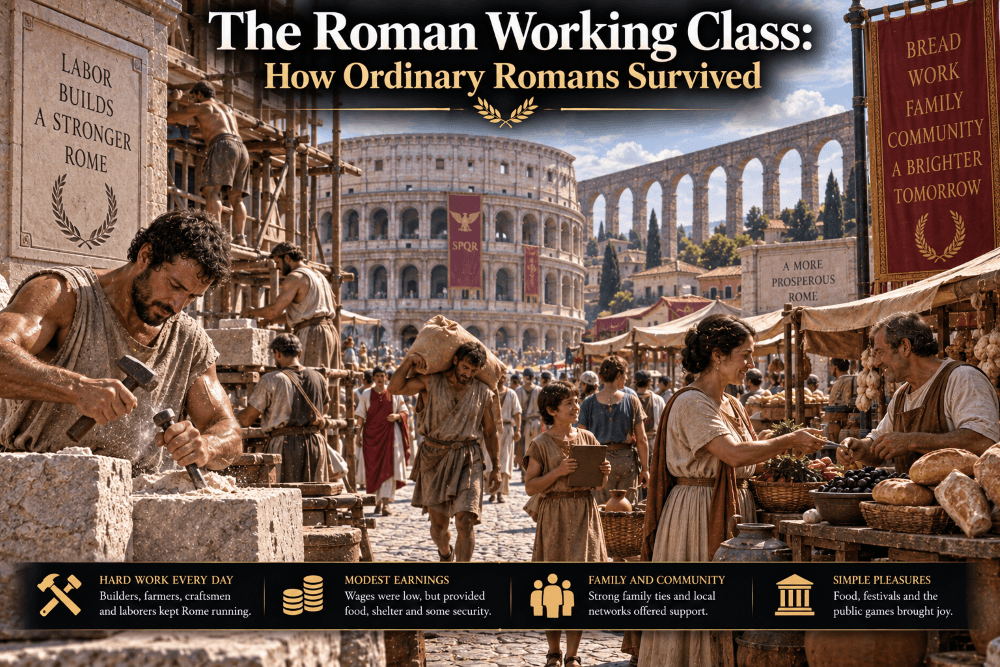
Most surviving accounts of ancient Rome come from wealthy elites like Cicero, describing a world of villas, banquets, and leisure. But the Roman working class, the tenant farmers, day laborers, and small shopkeepers who made up the vast majority of the empire’s population, lived an entirely different economic reality: thin margins, constant financial improvisation, and a surprisingly sophisticated set of tools for managing scarcity. Their story reveals an economy far more complex than the elite-authored histories suggest.
Beyond the Elite Narrative
Why Historical Texts Distort Our View
Most of what survives from ancient Rome was written by and for a tiny, wealthy fraction of society.
- Writers like Cicero moved almost exclusively within elite political and social circles, and their surviving letters and speeches reflect that narrow world.
- This creates a skewed historical record that emphasizes luxury, leisure, and political intrigue over the daily economic struggles most Romans actually faced.
- Archaeological evidence, including account records, contracts, and everyday objects, offers a far more accurate window into how most Romans actually lived and worked.
We published a story of Marcus Licinius Crassus, the richest man in Rome, bit it’s good to understand how the Roman working class lived.
Thin Margins, Constant Risk
For most Romans, daily survival depended on managing persistent financial fragility rather than accumulating wealth.
- Tenant farmers and day laborers typically operated with very little financial cushion against bad harvests, illness, or unexpected expenses.
- A single poor growing season could push a family from stability into serious debt.
- This constant exposure to risk shaped nearly every economic decision ordinary Romans made.
How the Roman Working Class Diversified Income
Beyond Subsistence Farming
Ordinary Roman farmers rarely relied solely on subsistence crops for survival. Diversification was essential to managing risk and generating cash.
- Farmers grew specialized cash crops, including dates, grapes for wine production, and herbs like thyme, specifically intended for local market sale.
- This diversification allowed families to generate cash income beyond what subsistence farming alone could provide.
- Selling surplus or specialty goods at local markets gave working families a crucial buffer against the unpredictability of relying on a single crop.
This approach reflects a genuinely entrepreneurial mindset: spreading risk across multiple income sources rather than depending entirely on one.
Multitasking as Economic Strategy
Beyond agriculture, many working Romans combined multiple forms of labor and small-scale commerce to make ends meet.
- Individuals often worked as farmers during planting and harvest seasons while taking on additional labor, craft work, or small trade during slower periods.
- Household members frequently contributed different income streams simultaneously, spreading financial risk across the family unit.
- This flexibility helped working families adapt to Rome’s seasonal and often unpredictable economic conditions.
Rome’s Sophisticated Monetary System
A Trimetallic Currency
Rome operated a genuinely complex monetary system built around multiple metals, each serving different transaction needs.
- Gold coins, called the aureus, were used for the largest transactions.
- Silver coins, particularly the denarius, served as a common mid-value currency.
- Bronze coins, including the sestertius and as, along with localized coins like the drachma and obol in certain regions, handled smaller everyday transactions.
Even ordinary working-class Romans regularly handled higher-value coins, particularly during harvest season when larger sums of money changed hands for crop sales.
Beyond Simple Coins and Barter
Contrary to a common assumption that ancient economies relied purely on coins or barter, Romans used surprisingly sophisticated financial tools.
- Shopkeepers and merchants kept detailed ledgers tracking credit extended to regular customers.
- Romans engaged in early forms of futures trading, including agreements to sell unharvested crops or unshorn sheep’s wool in advance of the actual harvest or shearing.
- Pawnshops operated as a common mechanism for accessing short-term credit by temporarily exchanging goods for cash.
This financial sophistication shows that ordinary Romans navigated a genuinely complex economic system, not a simplistic exchange economy.
Women as Financial Managers
Managing Household Finances
Despite operating within a broadly patriarchal political system, Roman women frequently played central roles in managing family finances.
- Women commonly managed household account books, tracking income, expenses, and debts.
- Dowries legally remained a woman’s property even after marriage, and importantly, upon divorce, giving women a meaningful degree of financial independence.
- This legal protection gave women real financial leverage within the household economy, even without formal political power.
Active Participants in Lending and Pawning
Roman women weren’t simply passive holders of household wealth. They actively participated in broader financial activity.
- Women engaged directly in money lending, extending credit to others within their communities.
- They participated in pawning transactions, both as lenders accepting goods as collateral and as borrowers seeking short-term credit.
- This active financial participation challenges assumptions that women were entirely excluded from ancient Roman economic life.
Managing Debt and Crisis
Extreme Measures During Hardship
When droughts, floods, or other crises struck, Roman families sometimes resorted to severe financial strategies to secure necessary loans.
- Families facing crisis sometimes pledged their children’s labor as collateral against interest owed on loans, a practice functioning as a form of debt bondage.
- This arrangement obligated children to work for a creditor until the family’s debt obligations were satisfied.
- These extreme measures reveal just how thin the margin for error was for much of Rome’s working population.
A System Built for Survival, Not Comfort
The full picture of Roman working-class financial life shows a population constantly adapting to manage genuine scarcity.
- Credit, diversification, and financial improvisation weren’t optional strategies. They were essential tools for basic survival.
- This stands in sharp contrast to the leisure and abundance often associated with Roman elite life in popular historical imagination.
- Understanding this reality gives a far more complete and honest picture of how the Roman economy actually functioned for most people.
Lessons from the Roman Working Class
- Diversification manages risk. Combining subsistence farming with cash crops and additional labor helped families survive unpredictable conditions.
- Financial tools existed long before modern banking. Credit ledgers, futures agreements, and pawnshops show real sophistication in ancient economic life.
- Crisis reveals the true margin of survival. Extreme measures like debt bondage expose just how fragile ordinary economic life could be.
Frequently Asked Questions
How did ordinary Romans differ from Roman elites economically? While elites like Cicero and Crassus lived amid wealth and leisure, most Romans, particularly tenant farmers and day laborers, faced thin financial margins and constant economic risk.
What kind of currency did ordinary Romans use? Rome used a trimetallic system including gold aureus coins, silver denarius coins, and bronze coins like the sestertius and as, with ordinary Romans regularly handling higher-value coins during transactions like harvest sales.
Did ancient Romans use credit and financial instruments? Yes, Romans used shop ledgers to track credit, engaged in early futures trading for crops and wool, and relied on pawnshops for short-term loans.
What financial role did women play in ancient Rome? Roman women commonly managed household finances, retained control over their dowries even after divorce, and actively participated in money lending and pawning transactions.