What allows a business to grow beyond one neighborhood, one city, or even one country?
Ancient Rome answered that question more than 2,000 years ago.
Its greatest entrepreneurial contribution was not a new product or invention.
It was a system.
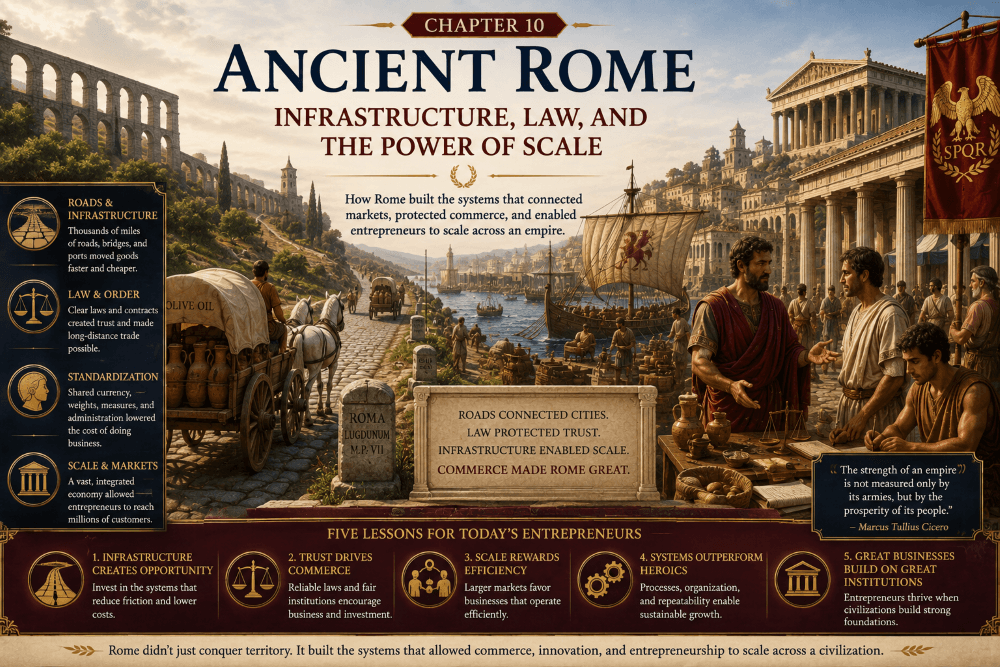
By combining reliable infrastructure, enforceable laws, standardized administration, and an enormous internal market, Rome created one of history’s most successful commercial economies.
The Roman Empire demonstrates that entrepreneurs flourish when institutions make commerce predictable and efficient.
Rome Created One of History’s Largest Markets
At its height, the Roman Empire stretched from Britain to Egypt and from the Atlantic Ocean to Mesopotamia.
Millions of people lived within its borders.
Hundreds of cities.
Thousands of towns.
Countless farms, workshops, ports, and marketplaces.
For entrepreneurs, this represented an enormous opportunity.
A successful business could serve customers across vast distances.
Scale became possible.
Roman Roads Connected the Economy
One of Rome’s greatest achievements was its transportation network.
The Romans constructed tens of thousands of miles of durable roads using carefully engineered foundations, drainage systems, and stone paving.
These roads connected:
- Cities
- Military bases
- Ports
- Markets
- Farms
- Manufacturing centers
Merchants transported:
- Grain
- Olive oil
- Wine
- Pottery
- Textiles
- Marble
- Metal products
- Livestock
Lower transportation costs encouraged trade.
Greater trade created larger markets.
Larger markets rewarded entrepreneurs.
Modern highways perform much the same function today.
The Mediterranean Became Rome’s Commercial Highway
The Romans called the Mediterranean Mare Nostrum, meaning “Our Sea.”
Merchant ships carried enormous quantities of goods between provinces.
Different regions specialized in different products.
Examples included:
- Egypt → Grain
- Spain → Silver
- North Africa → Olive oil
- Gaul → Wine
- Syria → Glass
- Eastern provinces → Luxury goods and spices
This specialization increased productivity.
Each region focused on what it produced most efficiently.
Commerce benefited everyone.
Roman Law Built Trust
Infrastructure moved products.
Law moved business.
Roman legal institutions established principles governing:
- Contracts
- Property rights
- Partnerships
- Inheritance
- Commercial disputes
Entrepreneurs gained something invaluable.
Predictability.
Businesses invest more confidently when agreements are enforceable.
Stable legal systems reduce uncertainty.
That principle remains fundamental in every modern economy.
Cities Became Economic Engines
Roman cities attracted entrepreneurs.
Markets connected buyers and sellers.
Craftspeople specialized.
Warehouses stored imported products.
Banks facilitated financial transactions.
Public buildings supported administration.
Urbanization increased productivity because businesses benefited from being close to customers, suppliers, workers, and information.
Modern cities continue performing exactly the same role.
Standardization Reduced Business Costs
Imagine trying to expand a business into dozens of regions where every city used different laws, currencies, and measurements.
Growth would become expensive and inefficient.
Rome encouraged greater consistency throughout much of its empire.
Standardized coinage became widely accepted.
Administrative procedures became more uniform.
Engineering methods followed common practices.
Legal principles spread across provinces.
Uniform systems reduced friction.
Scaling became easier.
Engineering Supported Entrepreneurship
Roman engineering solved practical business problems.
Roads reduced transportation costs.
Bridges connected markets.
Aqueducts supported growing cities.
Harbors expanded trade.
Warehouses protected inventory.
Infrastructure allowed entrepreneurs to spend less time overcoming obstacles and more time creating value.
Many modern governments continue investing in similar projects because infrastructure encourages long-term economic growth.
Why Scale Matters
Many businesses succeed locally.
Far fewer succeed nationally or internationally.
Scaling requires more than ambition.
It requires systems.
Reliable logistics.
Repeatable processes.
Standardized operations.
Efficient transportation.
Clear laws.
Rome demonstrated these principles centuries before the Industrial Revolution.
Why Ancient Rome Still Matters
Modern entrepreneurs continue relying on many ideas that Rome helped refine.
Road networks became highways.
Harbors became container ports.
Roman legal traditions influenced legal systems around the world.
Large integrated markets remain essential for economic growth.
Technology has changed dramatically.
The underlying principles have not.
The Entrepreneur’s Toolbox
Scale
Growth requires systems.
Infrastructure, logistics, administration, legal certainty, and repeatable processes allow businesses to expand beyond local markets.
The entrepreneur who understands scale can build organizations that continue growing long after the founder’s direct involvement.
Five Lessons Modern Entrepreneurs Can Learn
1. Infrastructure Creates Opportunity
Businesses expand more easily when transportation and communication improve.
2. Trust Encourages Investment
Stable legal systems reduce uncertainty.
3. Systems Beat Heroics
Growth depends on repeatable processes, not extraordinary effort alone.
4. Large Markets Reward Efficiency
Serving more customers requires organization and consistency.
5. Great Businesses Need Great Institutions
Successful entrepreneurship depends upon reliable laws, infrastructure, and public trust.
Frequently Asked Questions
Why was Ancient Rome economically successful?
Rome combined roads, ports, legal institutions, standardized administration, and a large internal market, making commerce more efficient across a vast territory.
Why were Roman roads important?
Roman roads reduced transportation costs, connected cities and markets, supported trade, and allowed goods to move quickly throughout the empire.
How did Roman law influence business?
Roman law established principles governing contracts, property rights, inheritance, and commercial disputes that influenced many later legal systems.
What entrepreneurial lesson does Ancient Rome teach?
Businesses grow when systems reduce friction. Infrastructure, law, logistics, and standardized processes allow entrepreneurs to scale successfully.
What does “scale” mean in business?
Scale is the ability to serve more customers efficiently without increasing costs at the same rate. Rome achieved this by building systems that supported commerce across an entire empire.
Continue the Journey
Rome demonstrated how infrastructure and law could support commerce across an enormous empire.
After Rome’s decline, new commercial centers emerged across the Middle East, North Africa, and Central Asia.
During the Islamic Golden Age, merchants, scholars, and financiers connected markets from Spain to India, preserved knowledge, advanced mathematics, and developed sophisticated commercial practices.
In Chapter 11, we’ll explore The Islamic Golden Age: Knowledge, Finance, and Global Trade.
Related Articles
- The First Entrepreneur: When Did Entrepreneurship Begin?
- The Agricultural Revolution: How Farming Created the First Entrepreneurs
- How Writing Was Invented for Business: The First Accountants
- The First Merchants: How the Sumerians Created Professional Commerce
- The Birth of Money: How Currency Changed Entrepreneurship Forever
- The Indus Valley: Trade, Standardization, and the Mysterious Business Civilization
- Ancient China: Innovation, Markets, and Continuous Improvement
- The Phoenicians: How Maritime Trade Connected the Ancient World
- Ancient Greece: How Competition and Markets Shaped Entrepreneurship
- The Islamic Golden Age: Knowledge, Finance, and Global Trade (Coming Soon)
The Entrepreneur’s Toolkit So Far
| Chapter | Entrepreneurial Contribution |
|---|---|
| Chapter 1 | Exchange |
| Chapter 2 | Surplus |
| Chapter 3 | Accounting |
| Chapter 4 | Professional Merchants |
| Chapter 5 | Money |
| Chapter 6 | Standardization |
| Chapter 7 | Continuous Improvement |
| Chapter 8 | Networks |
| Chapter 9 | Competition |
| Chapter 10 | Scale |
Every chapter adds another building block to the entrepreneur’s toolkit, showing how thousands of years of innovation gradually shaped modern business.
About The History of Entrepreneurship
This article is part of The History of Entrepreneurship, an ongoing series by Alain Guillot exploring how civilizations, institutions, technologies, and entrepreneurs built the foundations of modern commerce.
Rather than simply recounting historical events, the series identifies the timeless entrepreneurial principles each civilization contributed—principles that remain relevant to business leaders today.
North Star
Ancient Rome showed that entrepreneurship flourishes when infrastructure, law, and administration make commerce predictable and scalable. Great markets are built on systems that reduce friction, encourage trust, and allow businesses to serve millions of people.