Why do some businesses constantly improve while others fall behind?
One answer comes from Ancient Greece.
Although the Greeks inherited many commercial traditions from earlier civilizations, they added something new to the entrepreneur’s toolkit:
Competition.
Greek merchants, artisans, shipbuilders, and traders operated in an environment where customers could compare products, prices, and quality. Businesses had to innovate continuously or risk losing customers to their rivals.
More than 2,500 years later, competition remains one of the most powerful forces driving entrepreneurship.
A Civilization of Independent City-States
Unlike Egypt or Persia, Ancient Greece was not a single unified kingdom during most of its classical period.
Instead, it consisted of independent city-states, including:
- Athens
- Corinth
- Sparta
- Thebes
- Rhodes
- Miletus
Each city developed its own economy, laws, and commercial relationships.
Rather than competing only on the battlefield, many cities also competed economically.
Ports sought merchants.
Craftspeople searched for prosperous communities.
Businesses followed opportunity.
Competition existed not only between companies but between cities themselves.

Geography Encouraged Commerce
Greece’s mountainous terrain made travel by land difficult.
Fortunately, the Mediterranean Sea connected hundreds of ports.
Greek merchants became accomplished sailors.
Their ships carried:
- Olive oil
- Wine
- Pottery
- Marble
- Metal goods
- Timber
- Grain
Trade linked Greece with Egypt, Phoenicia, Asia Minor, Italy, and the Black Sea.
These commercial networks expanded both wealth and knowledge.
The Agora: Where Business Met Society
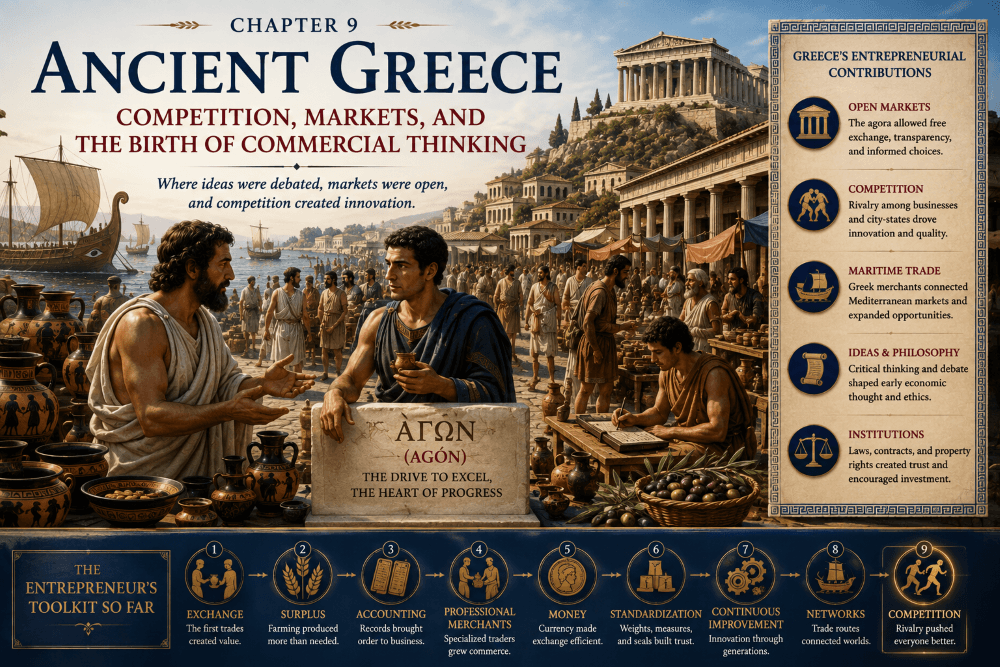
At the heart of many Greek cities stood the agora.
The agora was far more than a marketplace.
It served as:
- A commercial center
- A meeting place
- A political gathering area
- A social hub
- A place for public debate
Here, merchants displayed their goods openly.
Customers compared prices.
Artisans competed for business.
Ideas spread alongside products.
Transparency encouraged trust.
Competition encouraged improvement.
Modern shopping districts, stock exchanges, and business conferences all reflect similar principles.
Why Competition Improves Business
Imagine a town with only one baker.
Customers have little choice.
Now imagine ten excellent bakers.
Each wants to attract more customers.
One introduces higher-quality bread.
Another lowers prices.
A third develops healthier recipes.
A fourth offers faster service.
Everyone improves because competition rewards innovation.
This principle has shaped successful markets throughout history.
Innovation Through Rivalry
Competition inspired Greek entrepreneurs to improve their products continuously.
Craftspeople refined pottery.
Shipbuilders designed faster vessels.
Metalworkers developed stronger tools.
Architects experimented with new techniques.
Entrepreneurs discovered that standing still meant falling behind.
Competition encouraged constant learning.
That lesson remains just as relevant in today’s economy.
Greek Philosophy and Commerce
The Greeks contributed something unusual.
They thought deeply about business.
Philosophers such as Aristotle examined questions including:
- What creates value?
- What makes exchange fair?
- What role should wealth play in society?
- How should markets operate?
Although modern economics would not emerge until much later, Greek thinkers helped establish the habit of analyzing commerce rather than simply participating in it.
Entrepreneurs still benefit from asking thoughtful questions about customers, markets, and value creation.
Strong Institutions Support Markets
Successful businesses need more than talented entrepreneurs.
They also depend on institutions.
Greek cities experimented with:
- Property rights
- Commercial laws
- Contracts
- Courts
- Coinage
- Public infrastructure
Reliable institutions reduce uncertainty.
When entrepreneurs trust the rules, they are more willing to invest, innovate, and expand.
This principle remains fundamental in every successful economy.
Learning Through Competition
Competition extended beyond commerce.
Greek athletes competed in the Olympic Games.
Artists sought recognition.
Playwrights entered festivals.
Philosophers challenged one another in public debates.
Shipbuilders refined designs.
Innovation became part of everyday life.
Competition encouraged continuous learning.
Businesses today continue benefiting from the same dynamic.
Athens and the Value of Openness
Athens became one of the Mediterranean’s most dynamic commercial centers.
Its ports welcomed foreign merchants.
Its marketplaces attracted buyers from many regions.
Its citizens debated ideas publicly.
When people, goods, and knowledge move freely, innovation accelerates.
Open societies often become more entrepreneurial because they encourage experimentation and exchange.
Why Ancient Greece Still Matters
Modern entrepreneurs continue relying on principles that flourished in Ancient Greece.
Healthy competition encourages better products.
Open markets reward innovation.
Institutions protect commerce.
Ideas improve through debate.
Customers ultimately determine success.
Although technology has changed dramatically, these economic principles remain remarkably consistent.
The Entrepreneur’s Toolbox
Competition
Competition encourages businesses to improve continuously.
Rather than fearing competitors, successful entrepreneurs study them.
Competitors reveal weaknesses, inspire innovation, and encourage higher standards.
Businesses that embrace competition usually become stronger over time.
Five Lessons Modern Entrepreneurs Can Learn
1. Competition Creates Better Businesses
Strong competitors encourage innovation and higher quality.
2. Customers Decide
Markets reward businesses that consistently create value.
3. Learning Never Stops
Continuous improvement is essential in competitive markets.
4. Strong Institutions Matter
Reliable laws and property rights encourage entrepreneurship and investment.
5. Great Ideas Spread
Innovation grows when knowledge circulates freely.
Frequently Asked Questions
Why is Ancient Greece important to entrepreneurship?
Ancient Greece demonstrated how competition, open markets, commercial institutions, and public debate encourage innovation and economic growth.
What was the Greek agora?
The agora was the central marketplace and public gathering place where commerce, politics, and social life came together.
Why was competition important in Ancient Greece?
Competition encouraged merchants, artisans, and businesses to improve quality, lower costs, and develop new products.
Did Greek philosophers influence business?
Although they did not create modern economics, philosophers such as Aristotle explored important questions about value, wealth, exchange, and ethics that continue influencing business thought.
What entrepreneurial lesson does Ancient Greece teach?
Competition should be viewed as an opportunity rather than a threat. Businesses improve by serving customers better than their rivals.
Continue the Journey
The Greeks showed how competition and open markets encourage innovation.
The Romans confronted a different challenge.
How can commerce operate across a vast empire stretching thousands of kilometres?
Their answer was extraordinary.
Roads.
Ports.
Law.
Engineering.
Administration.
In Chapter 10, we’ll explore Ancient Rome: How Infrastructure, Law, and Scale Built an Economic Empire.
Related Articles
- The First Entrepreneur: When Did Entrepreneurship Begin?
- The Agricultural Revolution: How Farming Created the First Entrepreneurs
- How Writing Was Invented for Business: The First Accountants
- The First Merchants: How the Sumerians Created Professional Commerce
- The Birth of Money: How Currency Changed Entrepreneurship Forever
- The Indus Valley: Trade, Standardization, and the Mysterious Business Civilization
- Ancient China: Innovation, Markets, and Continuous Improvement
- The Phoenicians: How Maritime Trade Connected the Ancient World
- Ancient Rome: Infrastructure, Law, and Scale (Coming Soon)