| 📊 Alain’s Holdings — August 7, 2026 | ||||
|---|---|---|---|---|
| Symbol | Name | Price | Change | Change % |
| VOO | Vanguard S&P 500 ETF | 710.71 | +4.31 | +0.61% |
| QQQ | Invesco QQQ Trust | 723.03 | +8.38 | +1.17% |
| XIU.TO | iShares S&P/TSX 60 ETF | 54.13 | +0.17 | +0.32% |
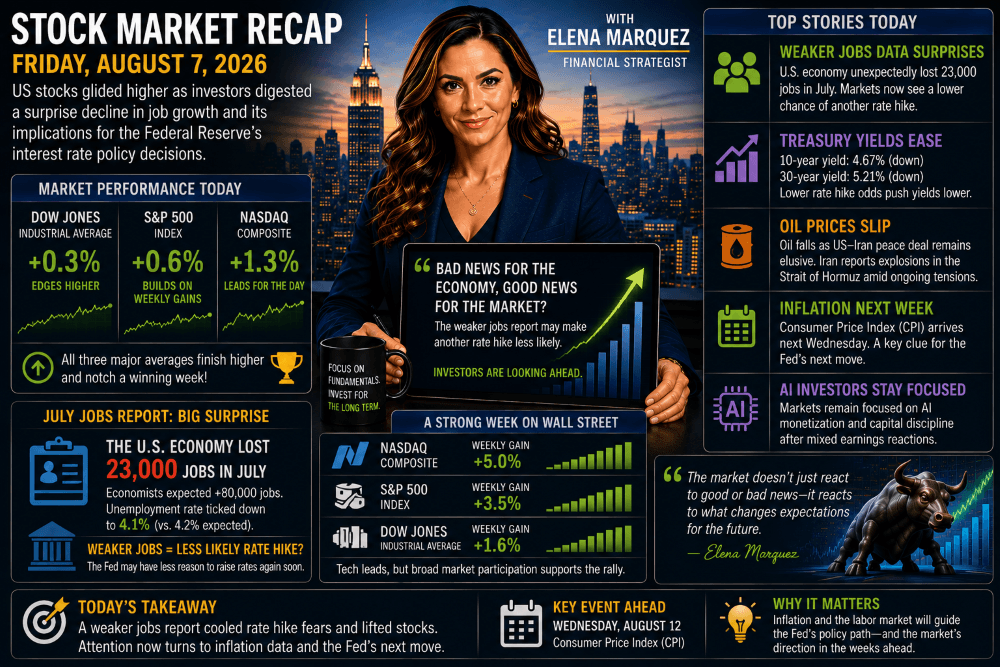
Wall Street finished the week on a positive note Friday, but the reason stocks rallied was unusual: the U.S. economy unexpectedly lost jobs in July.
The surprisingly weak employment report raised concerns about the strength of the economy, but it also reduced expectations that the Federal Reserve will raise interest rates again soon.
Market Performance
- 📈 Nasdaq Composite: +1.3%
- 📈 S&P 500: +0.6%
- 📈 Dow Jones Industrial Average: +0.3%
It was also an impressive week overall.
The Nasdaq gained roughly 5% for the week, while the S&P 500 advanced nearly 3.5%.
The Big Surprise: U.S. Economy Loses 23,000 Jobs
Friday’s employment report delivered a significant surprise.
The U.S. economy lost 23,000 jobs in July, compared with economists’ expectations for approximately 80,000 new jobs.
At the same time, the unemployment rate unexpectedly edged down to 4.1%, rather than rising to the anticipated 4.2%.
For investors, the report creates an interesting dilemma.
A weaker labor market isn’t necessarily good news for the economy.
But it could be good news for interest rates.
After several Federal Reserve officials recently signaled concern about persistent inflation, Friday’s employment report makes another rate hike more difficult to justify.
That possibility helped push stocks higher.
Nasdaq Caps a Huge Week
Technology stocks were once again the market leaders.
The Nasdaq’s approximately 5% weekly gain came after several weeks of extraordinary volatility surrounding artificial intelligence.
Investors continue trying to determine which companies can translate enormous AI investments into sustainable profits.
Recent earnings have produced some spectacular winners—and equally spectacular losers—but enthusiasm for the long-term AI opportunity remains strong.
Now Inflation Takes Center Stage
The Federal Reserve’s dilemma isn’t over.
Next Wednesday brings another major test: the Consumer Price Index (CPI).
If inflation continues cooling while employment weakens, the case for keeping rates unchanged—or eventually cutting them—could strengthen considerably.
But if inflation surprises to the upside, policymakers could face an uncomfortable combination of slowing employment and stubbornly high prices.
That would make the Fed’s job considerably more difficult.
Strait of Hormuz Remains a Wild Card
Oil prices slipped Friday, but geopolitical uncertainty remains high.
Iran and Oman continue negotiating a potential agreement to reopen the Strait of Hormuz, one of the world’s most important oil-shipping routes.
Reports of explosions in the region Thursday night reminded investors how fragile the situation remains.
Any renewed disruption could quickly send oil prices higher, potentially adding another source of inflation just as the Federal Reserve evaluates its next move.
The Bottom Line
Friday demonstrated one of the stock market’s great paradoxes:
Bad economic news can sometimes become good news for stocks.
Losing 23,000 jobs isn’t something to celebrate.
But investors interpreted the report as evidence that the Federal Reserve may have less reason to raise interest rates.
The market now faces two critical questions:
Is the labor market simply cooling—or is the economy beginning to weaken?
And perhaps more importantly:
What will Wednesday’s inflation report tell us about the Fed’s next move?
For now, investors are betting that weaker employment will keep the Federal Reserve on the sidelines.
Other Stock Market blog posts