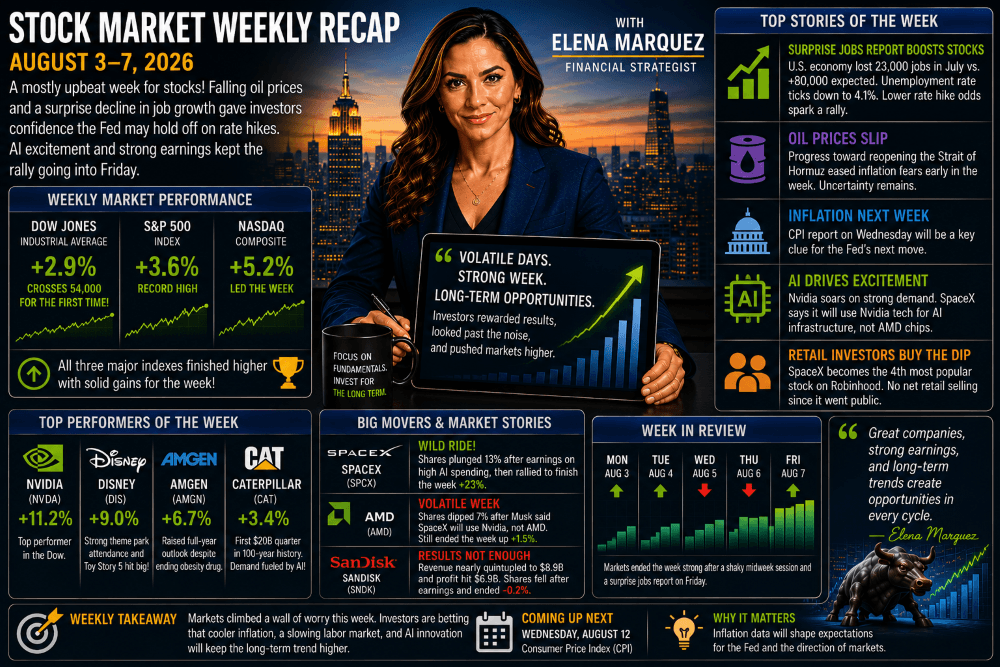
Wall Street delivered a strong week, even if getting there wasn’t exactly smooth.
Investors navigated volatile AI stocks, SpaceX’s first earnings report as a public company, changing expectations for Federal Reserve policy, and continuing negotiations over the Strait of Hormuz.
By Friday’s close, however, the bulls had clearly won the week.
Weekly Market Performance
- 📈 Nasdaq Composite: +5.2%
- 📈 S&P 500: +3.6% — record high
- 📈 Dow Jones Industrial Average: nearly +3%
The Dow also crossed 54,000 for the first time, while strong earnings and renewed enthusiasm for artificial intelligence helped technology stocks regain leadership.
Falling Oil Prices Start the Rally
The week began with encouraging developments in the Middle East.
Signs of progress toward reopening the Strait of Hormuz initially pushed oil prices lower, reducing fears that another energy shock could reignite inflation.
That mattered because energy prices and interest rates have become closely intertwined.
Lower oil prices eased some inflation concerns and gave investors another reason to buy stocks.
Then Came the Jobs Surprise
Friday delivered the week’s biggest economic surprise.
The U.S. economy unexpectedly lost 23,000 jobs in July, compared with expectations for approximately 80,000 new jobs.
Normally, declining employment wouldn’t be something investors celebrate.
But markets immediately considered what the report could mean for the Federal Reserve.
A weakening labor market makes another interest-rate hike harder to justify.
That helped stocks finish the week strongly and pushed the S&P 500 to another record high.
Nvidia Becomes the Week’s AI Winner
Artificial intelligence remained at the center of the market.
Nvidia surged more than 11% for the week, making it one of the market’s standout performers.
The company received another boost after Elon Musk said SpaceX plans to build its AI infrastructure exclusively around Nvidia technology rather than AMD chips.
That announcement initially hammered AMD shares, which plunged about 7% Wednesday.
Yet AMD recovered enough to finish the week approximately 1.5% higher.
The episode demonstrates how fiercely companies are competing for a share of the enormous AI infrastructure buildout.
SpaceX: From 13% Plunge to 23% Weekly Gain
Perhaps the week’s most remarkable stock was SpaceX.
The company released its first earnings report since going public.
Revenue nearly doubled to $7.8 billion, but investors focused on something else: spending.
SpaceX invested approximately $18.4 billion in capital expenditures during the quarter, including an extraordinary $15.8 billion on AI-related projects.
Shares initially plunged more than 13%.
Then something interesting happened.
Investors bought the dip.
Despite concerns surrounding the expiration of its post-IPO lockup period, SpaceX rebounded dramatically and finished the week approximately 23% higher.
Retail investors appear particularly enthusiastic. According to the figures you provided, SpaceX has already become the fourth-most-popular investment on Robinhood, behind Nvidia, Tesla, and Apple.
Great Earnings Aren’t Always Enough
Sandisk provided one of the week’s best examples of how demanding today’s market has become.
Revenue nearly quintupled to almost $9 billion, while the company swung from a $23 million loss a year earlier to nearly $7 billion in profit.
Extraordinary numbers.
Yet the shares initially fell more than 5% and ultimately finished the week slightly lower.
Why?
Expectations.
When enormous future growth is already reflected in a stock’s valuation, even spectacular results can disappoint investors.
The Dow Gets Help From Disney, Amgen and Caterpillar
The rally wasn’t limited to technology.
Disney gained roughly 9% after strong theme-park attendance and the success of Toy Story 5 contributed to better-than-expected earnings.
Amgen climbed 6.7% after raising its full-year outlook, supported by strong sales from existing treatments.
And Caterpillar gained 3.4% after recording the first $20 billion quarter in its century-long history.
Interestingly, Caterpillar is becoming another indirect beneficiary of AI as demand grows for generators, engines and construction equipment needed to build data centers and related infrastructure.
The Bottom Line
This week illustrated one of the strangest characteristics of today’s market.
Weak employment helped stocks.
Spectacular earnings sometimes hurt stocks.
And a company that plunged 13% after earnings somehow finished the week 23% higher.
Markets don’t simply react to whether news is good or bad.
They react to the difference between reality and expectations.
For investors, that may be the most important lesson of the week.
With the S&P 500 at a record high and the Dow above 54,000, optimism is clearly alive.
But valuations are also high, which means companies will need to keep delivering exceptional results to justify them.
Next week’s inflation report will provide the next major test.
Other Stock Market blog posts