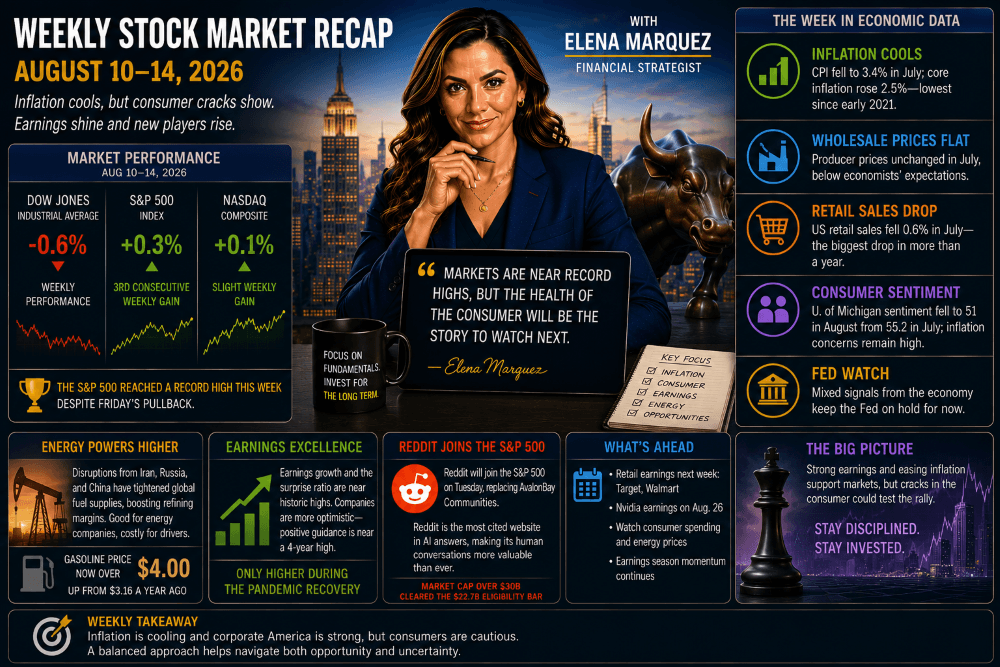
Wall Street finished a relatively quiet but revealing week with the S&P 500 reaching another record high, even as new economic data raised questions about the strength of the American consumer.
Inflation cooled, corporate earnings remained remarkably strong, energy companies joined technology stocks in driving the market, and Reddit prepared to join the S&P 500.
But weaker retail sales and falling consumer sentiment provided a reminder that beneath record stock prices, parts of the economy are beginning to soften.
Weekly Market Performance
- 📈 Nasdaq Composite: +0.1%
- 📈 S&P 500: +0.3%
- 📉 Dow Jones Industrial Average: -0.6%
The S&P 500 completed its third consecutive winning week.
Inflation Is Finally Moving in the Right Direction
The week’s most encouraging economic news came from inflation.
Annual consumer inflation eased to 3.4% in July, while core prices increased 2.5% over the previous 12 months, according to the figures provided.
Wholesale inflation provided another positive surprise.
Producer prices were essentially unchanged in July, despite economists expecting an increase.
Together, the reports reduced expectations that the Federal Reserve will raise interest rates at its September meeting.
That’s exactly what investors wanted to see.
But then came Friday.
Is the American Consumer Starting to Crack?
Friday’s economic reports complicated the optimistic picture.
U.S. retail sales fell 0.6% in July, rather than posting the modest increase economists expected.
Consumer confidence weakened as well.
The University of Michigan’s preliminary Consumer Sentiment Index fell to 51 in August from 55.2 in July.
Consumers remain concerned about persistent high prices and the economic consequences of the conflict with Iran.
This creates an important distinction.
Inflation is falling, but prices aren’t falling.
Consumers are still paying substantially more for many goods and services than they did several years ago.
And gasoline provides an excellent example.
The average U.S. gasoline price has climbed above $4 per gallon, compared with roughly $3.16 a year ago.
If consumers begin cutting spending more aggressively, the Federal Reserve may have another reason to avoid raising rates.
But weakening consumption could eventually become a problem for corporate profits.
Energy Joins the Stock Market Rally
One of the most interesting developments is that this market isn’t being driven exclusively by artificial intelligence.
Old-school energy companies are joining Big Tech in pushing the S&P 500 toward records.
A remarkable combination of geopolitical disruptions has tightened global energy markets.
The Iran conflict has disrupted Middle Eastern refining and shipping.
Ukraine continues attacking Russian energy infrastructure.
China has restricted fuel exports.
And traffic through the Strait of Hormuz remains constrained.
The result has been a sharp increase in refining margins—the difference between what refiners pay for crude oil and what they receive for products such as gasoline and diesel.
That’s potentially excellent news for major oil companies.
For consumers?
Not so much.
Higher gasoline prices act almost like a tax on households, leaving less money available for restaurants, travel, entertainment and other discretionary spending.
Corporate America Is Feeling Confident
Despite concerns about consumers, corporate earnings have been remarkably strong.
Both earnings growth and the percentage of companies exceeding Wall Street expectations are running near historically high levels.
Perhaps even more interesting is what executives are saying about the future.
According to Bespoke Investment Group figures cited in the information you provided, the ratio of positive to negative corporate earnings guidance is near a four-year high.
That’s significant.
Corporate executives generally have strong incentives to remain conservative with guidance. Raising expectations creates the risk of disappointing investors later.
The fact that so many companies are becoming more optimistic suggests corporate America remains remarkably confident despite higher interest rates and geopolitical uncertainty.
Reddit Is Joining the S&P 500
One of the week’s most interesting individual stock stories came from Reddit.
Just two years after going public, Reddit will join the S&P 500 on Tuesday, replacing AvalonBay Communities as consolidation in the real-estate sector creates an opening.
Reddit shares jumped more than 12% Friday following the news.
The company’s relationship with artificial intelligence is particularly fascinating.
Earlier this year, investors worried that AI-generated answers would reduce the need for users to visit Reddit.
Instead, Reddit has become extraordinarily important to AI itself.
According to AI visibility data cited in the information you provided, Reddit is the most frequently cited website in AI-generated answers.
That makes its enormous collection of human conversations, opinions and experiences increasingly valuable—not only to users, but also to AI companies, advertisers and brands trying to understand how information surfaces inside chatbots.
Sometimes technological disruption doesn’t destroy an existing platform.
It makes that platform more valuable in an entirely different way.
The Bottom Line
This week’s market tells two different stories.
Corporate America looks strong.
Earnings are beating expectations, management teams are increasingly optimistic, and the S&P 500 continues setting records.
But American consumers look considerably less enthusiastic.
Retail sales fell.
Consumer sentiment deteriorated.
Gasoline prices are above $4.
And last week’s employment report showed the economy unexpectedly losing jobs.
That creates an increasingly important question for investors:
Can corporate profits remain strong if consumers continue weakening?
For now, Wall Street believes they can.
The S&P 500’s third consecutive winning week demonstrates that investors remain optimistic.
But as we move deeper into the second half of 2026, the health of the American consumer may become just as important to the market as artificial intelligence.
Other Stock Market blog posts