| 📊 Alain’s Holdings — August 14, 2026 | ||||
|---|---|---|---|---|
| Symbol | Name | Price | Change | Change % |
| VOO | Vanguard S&P 500 ETF | 713.71 | -1.24 | -0.17% |
| QQQ | Invesco QQQ Trust | 731.07 | -1.00 | -0.14% |
| XIU.TO | iShares S&P/TSX 60 ETF | 54.82 | -0.06 | -0.11% |
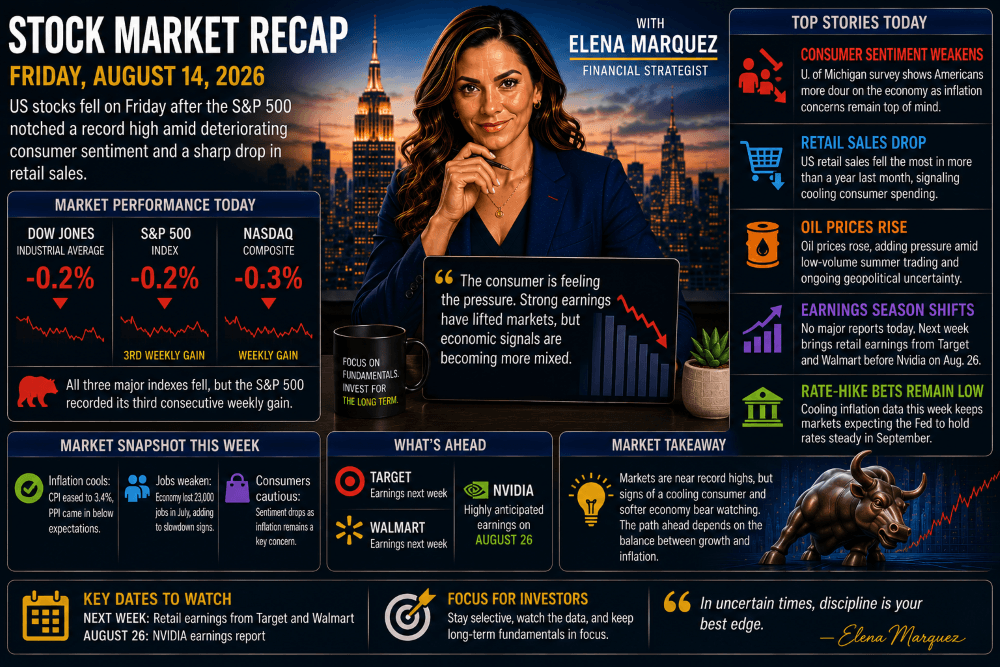
Wall Street ended the week modestly lower Friday as weak retail sales and deteriorating consumer sentiment reminded investors that American households may be feeling increasing pressure from higher prices and economic uncertainty.
The pullback came one day after the S&P 500 reached a record high.
Market Performance
- 📉 Nasdaq Composite: -0.3%
- 📉 S&P 500: -0.2%
- 📉 Dow Jones Industrial Average: -0.2%
Despite Friday’s decline, the S&P 500 recorded its third consecutive winning week, while the Nasdaq managed a slight weekly gain. The Dow finished the week lower.
Consumers Are Becoming More Cautious
The day’s most important development came from the American consumer.
The University of Michigan’s preliminary August survey showed consumer sentiment deteriorating, with households remaining particularly concerned about inflation.
That’s important because consumer spending represents roughly two-thirds of U.S. economic activity.
When consumers become less confident, they may postpone vacations, restaurant visits, automobiles and other discretionary purchases.
And Friday brought another warning sign.
Retail Sales Drop Sharply
U.S. retail sales fell by the most in more than a year last month, according to new Census Bureau data.
That adds to evidence that economic momentum may be slowing.
Last week’s employment report already delivered a major surprise when the economy lost 23,000 jobs in July.
Now retail spending appears to be weakening as well.
For investors, that creates an interesting contradiction.
Slower economic growth reduces inflationary pressure and could encourage the Federal Reserve to keep interest rates unchanged.
But if consumers pull back too aggressively, weaker spending could eventually hurt corporate revenue and profits.
The market wants a slowdown.
It doesn’t want a recession.
Inflation Is Cooling—but Consumers Still Feel It
This week’s economic data generally provided good news on inflation.
Wednesday’s CPI showed annual inflation declining to 3.4%, while Thursday’s Producer Price Index came in below expectations.
Those reports reduced expectations for a Federal Reserve rate hike in September.
But consumer sentiment demonstrates an important distinction:
Lower inflation doesn’t mean lower prices.
It simply means prices are increasing more slowly.
Households are still dealing with the cumulative effects of years of higher prices for housing, groceries, transportation and other necessities.
That helps explain why consumer confidence can remain weak even when official inflation statistics improve.
Oil Prices Rise Again
Oil prices also moved higher Friday, adding another complication.
Energy prices have been extremely volatile as investors monitor developments surrounding the Strait of Hormuz.
Higher oil prices can quickly affect gasoline, transportation and manufacturing costs.
That means oil remains one of the biggest threats to the recent improvement in inflation.
Earnings Season Turns Toward the Consumer
The major technology earnings reports may be mostly behind us, but next week brings an important new test.
Retail earnings take center stage.
Target and Walmart are among the companies scheduled to report.
Their results could provide valuable insight into how American consumers are responding to higher prices and a cooling labor market.
Then comes one of the most anticipated earnings reports of the quarter:
Nvidia on August 26.
Given the enormous amount of capital flowing into artificial intelligence infrastructure, Nvidia’s results could become another major test of whether the AI boom continues to justify today’s elevated expectations.
The Bottom Line
Friday’s modest decline isn’t particularly alarming.
After reaching another record high Thursday, some consolidation is normal.
But the economic signals beneath the surface deserve attention.
Jobs weakened.
Retail sales declined.
Consumer confidence deteriorated.
At the same time, inflation is cooling and expectations for another immediate Federal Reserve rate hike have faded.
That leaves investors searching for the ideal balance:
An economy weak enough to bring inflation under control—but strong enough to keep corporate earnings growing.
For now, Wall Street still appears to believe that balance is achievable.
The S&P 500’s third consecutive winning week suggests the bulls remain firmly in the game.
Other Stock Market blog posts