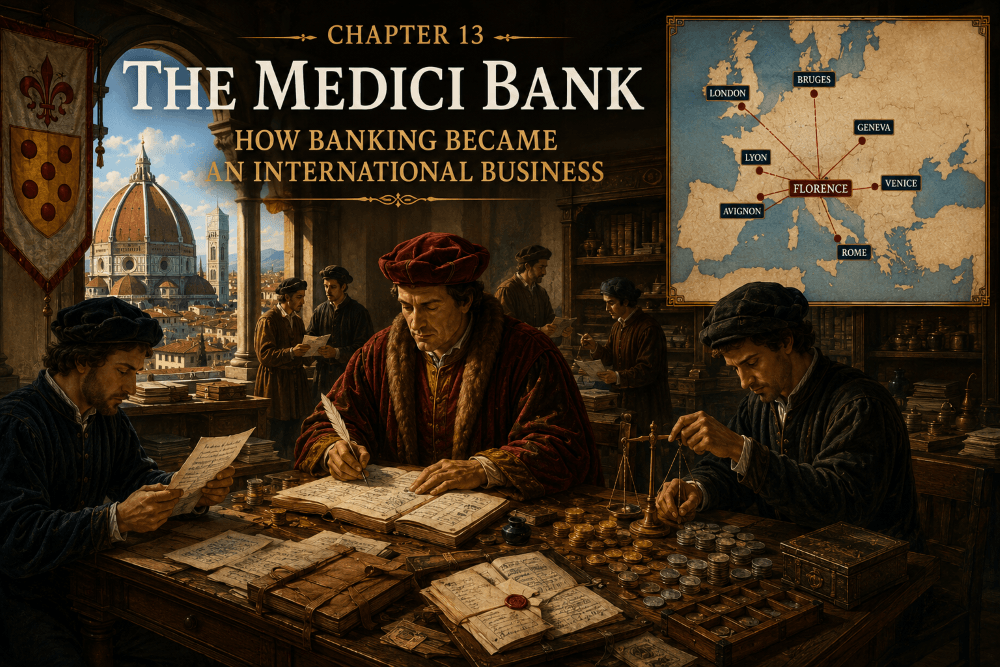
How do you manage a business when your customers, employees, and money are spread across Europe?
The Medici Bank confronted that problem more than 600 years ago.
Founded in Florence in 1397 under Giovanni di Bicci de’ Medici, the bank developed operations across important European commercial centers. Its organization required branch managers, accounting systems, correspondence, partnerships, financial instruments, and constant flows of information.
The Medici did not invent banking.
Their achievement was different.
They demonstrated how banking could become an international organization.
And in doing so, they encountered a problem every successful entrepreneur eventually faces:
How do you build a company that can operate without the founder personally supervising everything?
Florence: The Financial Center Behind the Medici Bank
During the Renaissance, Florence became one of Europe’s great commercial centers.
Textile manufacturers produced valuable woolen cloth.
Merchants traded internationally.
Money changers converted currencies.
Bankers financed commerce.
Competition was intense.
The Medici were certainly not Florence’s first bankers. Powerful Italian banking families had operated internationally before them.
What the Medici did exceptionally well was combine existing financial practices with organization, relationships, information, and management.
Entrepreneurship does not always require inventing something new.
Sometimes innovation means organizing existing ideas better than your competitors.
Who Founded the Medici Bank?
The principal founder of the Medici banking dynasty was Giovanni di Bicci de’ Medici.
Giovanni established the institution conventionally dated to 1397 and developed it through careful management and valuable relationships, particularly business connected to Rome and the papal court. De Roover’s history divides the bank’s development into Giovanni’s early management from 1397–1429, followed by its heyday under Cosimo.
Giovanni’s story offers entrepreneurs an important lesson.
Great companies do not always begin with dramatic inventions.
Often they begin with:
Good execution.
Financial discipline.
Customer relationships.
Trust.
And years of consistent work.
The Medici Created an International Banking Network
The Medici Bank eventually operated through establishments and branches in important commercial centers inside and outside Italy.
Its network included operations at different times in places such as Florence, Rome, Venice, Milan, Geneva, Avignon, Bruges, London, and Lyon.
Each location served different commercial opportunities.
Rome provided access to important papal financial business.
Bruges connected the Medici with northern European trade.
London connected them with English commerce, particularly wool.
Venice connected Mediterranean markets.
The result looked increasingly familiar to modern entrepreneurs.
A multinational business network.
How Do You Manage a Business From Hundreds of Miles Away?
Expansion created an enormous problem.
The Medici family could not personally supervise every transaction.
There were no telephones.
No email.
No Zoom meetings.
No instant financial reports.
Messages traveled physically.
The business therefore needed systems.
Managers.
Partners.
Accounting.
Correspondence.
Incentives.
Trust.
The Medici’s local managers were often partners rather than ordinary salaried employees and participated in branch profits.
That created a powerful incentive:
Make managers think like owners.
The Medici Understood Incentives
Imagine putting someone in charge of millions of dollars of your money in another country.
How do you make sure that person behaves responsibly?
Modern companies use:
- Bonuses
- Stock options
- Profit sharing
- Equity
- Performance incentives
The Medici faced the same basic problem centuries ago.
Giving local managers a financial interest in successful branches helped align their interests with those of the wider organization.
Economists today call the underlying challenge the principal-agent problem.
Owners want managers to behave like owners.
That is much easier said than done.
The Bill of Exchange Helped Money Cross Borders
Long-distance commerce created another challenge.
Moving large quantities of physical gold and silver was expensive and dangerous.
Financial instruments such as the bill of exchange helped merchants and bankers settle international obligations without physically transporting coins for every transaction.
Bills of exchange became central to the Medici Bank’s business.
The principle was revolutionary.
Value could move even when the physical money did not.
Modern banking takes this idea enormously further.
Today billions of dollars can cross the world electronically in seconds.
But the conceptual transformation began centuries earlier.
Money Was Becoming Information
Think about your own bank account.
Most of your money probably does not exist as physical bills sitting in a box with your name on it.
It exists as information.
Numbers.
Credits.
Debits.
Claims.
Records.
The Renaissance banking world was already moving in that direction.
A merchant’s wealth could be represented through accounts, debts, credits, contracts, and bills of exchange.
Money was becoming increasingly abstract.
And abstraction made finance more scalable.
Accounting Allowed the Medici to See Their Empire
International businesses create an information problem.
How do headquarters know what is happening hundreds of miles away?
The Medici needed detailed accounting and correspondence procedures; surviving records and historical research show how central branch management and accounting were to the organization.
The bank needed answers to questions such as:
- Which branches were profitable?
- Who owed money?
- Which loans were risky?
- Which currencies were involved?
- Where was capital needed?
- Which managers were performing well?
Accounting made a geographically dispersed business visible.
That remains one of accounting’s most important functions.
You cannot manage what you cannot see.
Information Was Almost as Important as Money
Letters traveling between Medici offices contained much more than financial statements.
International bankers needed information about:
Political events.
Wars.
Prices.
Currencies.
Customers.
Trade.
Creditworthiness.
Business opportunities.
A loan to a powerful ruler, for example, was not simply a financial calculation.
Could the ruler repay?
Was war approaching?
Would refusing the loan damage a valuable relationship?
Banking required intelligence.
The Medici network therefore moved two extremely valuable commodities:
Money and information.
Reputation Was the Medici’s Real Product
What does a bank actually sell?
Trust.
A depositor needs confidence that money will remain safe.
A merchant needs confidence that payments will be honored.
A foreign partner needs confidence that agreements will be respected.
Without trust, banking stops working.
The Medici family’s reputation therefore became a form of capital.
And reputation behaves differently from money.
It can take decades to accumulate.
It can disappear remarkably quickly.
The Papacy Became an Important Customer
The Medici’s relationship with the papacy was particularly important.
The Roman branch handled substantial financial business associated with the papal court, and de Roover devotes an entire section of his history to the Medici’s financial relationship with the papacy.
This created significant opportunities.
But it also illustrates a modern business danger:
Customer concentration.
A major customer can accelerate a company’s growth.
Depend too heavily on that customer, however, and the relationship can become a vulnerability.
The Medici’s papal relationship weakened later in the bank’s history.
Cosimo de’ Medici: Money Becomes Influence
Giovanni’s son, Cosimo de’ Medici, inherited the family enterprise and presided over what de Roover describes as the Medici Bank’s heyday from 1429 to 1464.
Cosimo became far more than a banker.
He became one of Florence’s dominant political figures.
Yet he was not a king.
His influence came largely through relationships.
Financial relationships.
Political alliances.
Patronage.
Family connections.
Business networks.
The Medici demonstrated another form of capital:
Relationship capital.
Money opened doors.
Relationships created influence.
Influence created additional opportunities.
The Medici and the Renaissance
The Medici eventually became famous for something far beyond banking.
Patronage.
Members of the family supported art, architecture, scholarship, libraries, and intellectual life.
Their wealth became associated with the cultural flowering of Renaissance Florence.
This introduces an important dimension to our history of entrepreneurship.
What happens to wealth after entrepreneurs create it?
Capital can finance another business.
But it can also finance:
Education.
Science.
Architecture.
Art.
Research.
Philanthropy.
Culture.
Entrepreneurial wealth can affect society far beyond the company that originally produced it.
Lorenzo the Magnificent and a Dangerous Illusion
Later generations of the family produced perhaps the most famous Medici of all:
Lorenzo de’ Medici, or Lorenzo the Magnificent.
Lorenzo became renowned for politics, diplomacy, and cultural patronage.
Michelangelo was famously sponsored and supported by several members of the House of Medici, starting with Lorenzo de’ Medici, who invited the teenage artist into his household.
But the bank itself was no longer enjoying its greatest period.
Historical accounts date its broad decline from after Cosimo’s death in 1464 through the bank’s end in 1494, with serious problems emerging in branches such as Bruges and London.
This creates a fascinating business lesson.
Prestige can hide deterioration.
A company may possess a famous brand.
A celebrated founder.
Beautiful headquarters.
Political influence.
Media attention.
And still have serious problems underneath.
Reputation cannot substitute forever for operational performance.
International Expansion Created International Risk
The Medici network created tremendous opportunities.
It also created complexity.
A manager in another country could make a disastrous loan.
A ruler could refuse to repay.
Political conditions could change.
Currency movements could damage transactions.
Communication delays could allow problems to grow before Florence even knew they existed.
The same network that expanded profits also expanded risk.
This remains true for multinational businesses today.
When Managers Stop Acting Like Owners
The Medici had designed structures intended to give managers incentives.
But incentives cannot eliminate poor judgment.
As the bank grew, monitoring distant branches became increasingly difficult.
The classic history of the bank specifically examines branch management, correspondence, accounting procedures, and the disastrous liquidation of the Bruges and London branches before turning to the broader decline from 1464 to 1494.
This is one of entrepreneurship’s recurring problems:
Success creates growth.
Growth creates complexity.
Complexity creates management problems.
And management problems can eventually destroy successful businesses.
Why Did the Medici Bank Fail?
There was no single cause.
Management failures, troubled branches, risky lending, changing economic conditions, political entanglements, and weakening central oversight all contributed to the bank’s deterioration.
The bank ultimately ended in 1494, after decades in which several branches had already encountered serious difficulties.
Its collapse teaches something just as important as its rise.
Building a great business and preserving a great business require different skills.
Entrepreneurs excel at discovering opportunities.
Large organizations also require:
Governance.
Controls.
Risk management.
Professional management.
Accurate reporting.
Accountability.
A company can outgrow the systems that originally made it successful.
Why the Medici Bank Still Matters
The Medici Bank existed centuries before the modern multinational corporation.
Yet many of its challenges would feel completely familiar inside a global company today.
How do you manage distant offices?
How do you motivate managers?
How do you measure performance?
How do you transfer money internationally?
How do you evaluate credit risk?
How do you protect your reputation?
How much authority should local managers receive?
How do you prevent rapid growth from becoming uncontrolled growth?
Technology has changed enormously.
Management problems have not.
The Entrepreneur’s Toolbox
Organizational Scale
Rome showed how markets could scale.
Venice showed how commercial institutions could scale.
The Medici showed how organizations could scale.
At some point, successful entrepreneurs must stop personally doing everything.
Growth requires:
Managers.
Delegation.
Accounting.
Communication.
Incentives.
Reporting.
Controls.
Governance.
The entrepreneur’s job changes.
Instead of doing all the work, the entrepreneur must create the organization that does the work.
Five Lessons Modern Entrepreneurs Can Learn From the Medici
1. Innovation Doesn’t Always Mean Invention
The Medici did not invent banking. They combined existing practices into a powerful international organization.
2. Give Managers Reasons to Think Like Owners
Profit sharing and ownership incentives can align managers with the people providing capital.
3. Information Becomes More Important as You Grow
A founder cannot personally observe an international business. Good reporting becomes essential.
4. Reputation Is Capital
Trust creates opportunities that money alone cannot buy.
5. Growth Creates Complexity
Expansion without adequate management systems can eventually weaken the company it was supposed to strengthen.
Frequently Asked Questions
Who founded the Medici Bank?
Giovanni di Bicci de’ Medici established the Medici Bank in Florence in 1397 and built the foundation of the family’s banking fortune.
Did the Medici invent banking?
No. Banking and credit existed for thousands of years before the Medici. Their importance lies in building one of Renaissance Europe’s most sophisticated international banking organizations.
Where did the Medici Bank operate?
At various times its establishments and branches included major commercial centers in Italy and elsewhere in Europe, including Rome, Venice, Milan, Geneva, Avignon, Bruges, London, and Lyon.
What was a bill of exchange?
A bill of exchange was a financial instrument that helped merchants settle obligations across locations and currencies without transporting equivalent amounts of physical coin for every transaction.
Why was the Medici Bank successful?
Its success came from a combination of international relationships, branch organization, skilled managers, financial expertise, information networks, accounting, reputation, and valuable customers such as the papacy.
Why did the Medici Bank fail?
There was no single cause. Problems included weak oversight, troubled branches, risky lending, management failures, political complications, and changing economic conditions. The decline unfolded over decades before the bank’s end in 1494.
The Entrepreneur’s Toolkit So Far
| Chapter | Entrepreneurial Contribution |
|---|---|
| Chapter 1 | Exchange |
| Chapter 2 | Surplus |
| Chapter 3 | Accounting |
| Chapter 4 | Professional Merchants |
| Chapter 5 | Money |
| Chapter 6 | Standardization |
| Chapter 7 | Continuous Improvement |
| Chapter 8 | Networks |
| Chapter 9 | Competition |
| Chapter 10 | Scale |
| Chapter 11 | Knowledge & Financial Innovation |
| Chapter 12 | Risk-Sharing & Commercial Institutions |
| Chapter 13 | Organizational Scale |
The evolution is important.
Early entrepreneurship was primarily about transactions.
Then it became about markets.
Then institutions emerged around those markets.
Now entrepreneurship is becoming about building organizations capable of operating beyond the entrepreneur himself.
Continue the Journey
The Medici demonstrated how an international business could be held together by branches, managers, accounting, incentives, information, relationships, and reputation.
But another commercial story was developing across the Mediterranean, Europe, and the Islamic world.
Jewish merchants often lived as minorities dispersed across different kingdoms and political systems.
Distance presented a challenge.
It also created opportunity.
Family relationships, community institutions, literacy, correspondence, reputation, and repeated transactions could help merchants establish trust across borders.
Thousands of surviving documents from the Cairo Geniza give historians an extraordinary window into parts of this commercial world: letters, contracts, accounts, debts, shipments, partnerships, disputes, and everyday business problems.
Their entrepreneurial contribution introduces another powerful tool:
Portable trust.
In Chapter 14, we’ll explore:
Jewish Merchants: Diaspora Networks and the Power of Portable Trust
Related Articles
- The Islamic Golden Age: How Knowledge, Finance, and Global Trade Transformed Entrepreneurship
- The Silk Road Trade: How Ancient Networks Built Global Commerce
- Marcus Licinius Crassus: The Richest Man in Rome
- Indian Ocean Trade: The Ancient World’s Monsoon Economy
- Viking Trade: How Raiders Became Medieval Merchants
- Jewish Merchants: Diaspora Networks and the Power of Portable Trust (Coming Soon)
About The History of Entrepreneurship
This article is part of The History of Entrepreneurship, an ongoing series exploring how civilizations, merchants, technologies, institutions, and entrepreneurs gradually created the foundations of modern business.
Each chapter asks a simple question:
What entrepreneurial tool did these people add to the world?
For the Medici, the answer is:
Organizational scale.
North Star
The Medici demonstrated that entrepreneurship changes when a company becomes larger than its founder. Their banking network showed how managers, branches, accounting, incentives, information, relationships, and reputation could transform a family enterprise into an international organization—and how growth without adequate control could eventually destroy it.
One thing I especially like about Chapter 13 is that we now have a strong narrative transition. Chapter 12 was about building a commercial ecosystem; Chapter 13 is about building an organization inside that ecosystem. Chapter 14 can be about building trust when neither a single organization nor a single government connects the participants. That makes the Jewish merchants chapter a natural continuation of the story rather than an inserted historical aside.