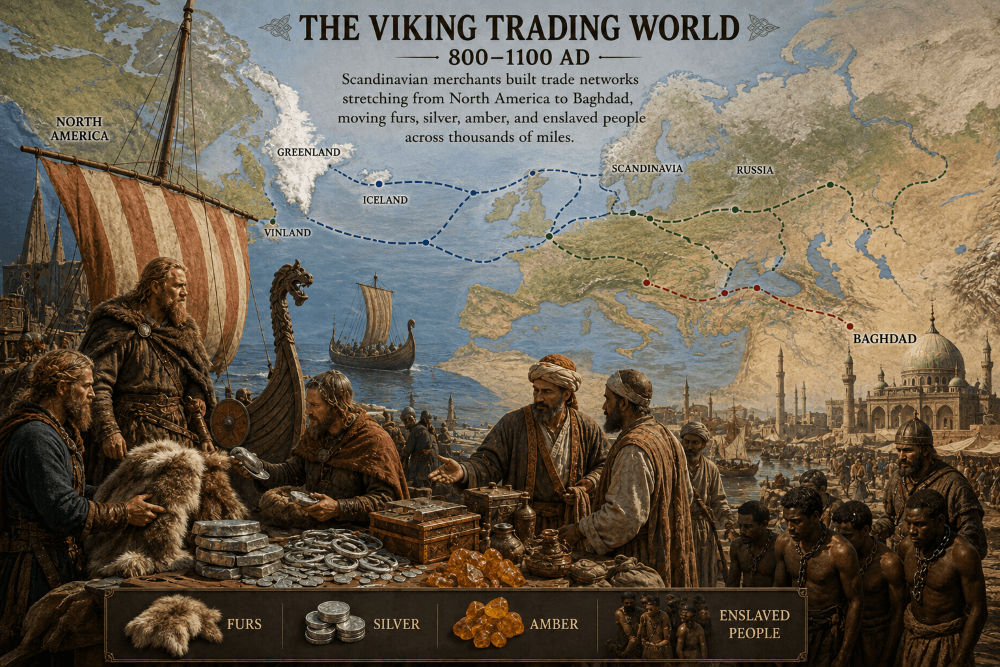
Popular imagination remembers the Vikings for burning monasteries and raiding coastal villages, but Viking trade eventually became far more valuable to Norse society than plunder ever was. Between roughly 800 and 1100 AD, Scandinavian merchants built trade networks stretching from North America to Baghdad, moving furs, silver, amber, and enslaved people across thousands of miles. Their story is a case study in how raiders can evolve into sophisticated, long-distance entrepreneurs once they recognize a better business model.
From Raiding to Trading
Why Raiding Had Limits
Early Viking raids were profitable, but the model had a ceiling. Undefended monasteries and coastal towns were finite targets, and repeated raiding hardened local defenses over time.
- Raiding required constant violence and carried high personal risk.
- Plunder was a one-time extraction, not a repeatable revenue stream.
- As European kingdoms strengthened their defenses, raiding grew more dangerous and less profitable.
Trade, by contrast, offered something raiding never could: repeatable, scalable income.
The Shift Toward Commerce
Viking communities gradually realized that the same ships, navigation skills, and network of contacts used for raiding could support long-term trading relationships instead.
- Longships that once carried raiders now carried cargo.
- Coastal outposts built for staging raids evolved into permanent trading settlements.
- Norse leaders began profiting more consistently from tolls, trade goods, and craft production than from plunder alone.
This transition mirrors a pattern seen across business history: aggressive, high-risk tactics eventually give way to sustainable systems once the market matures.
Building a Viking Trade Network
Key Trade Routes
Viking traders operated across an extraordinary geographic range for the era.
- Western routes connected Scandinavia to the British Isles, Ireland, and eventually settlements in Iceland, Greenland, and North America.
- Eastern routes ran through Russian rivers, connecting the Baltic Sea to the Black Sea and Caspian Sea.
- These eastern routes eventually reached Constantinople and even Baghdad, linking Scandinavia to the wealthy markets of the Byzantine and Islamic worlds.
What Vikings Traded
Viking trade moved a wide range of goods in both directions.
- Exports: furs, walrus ivory, amber, timber, and enslaved captives taken during raids or purchased from other groups.
- Imports: silver coins, silk, spices, wine, and glassware from Byzantine and Islamic markets.
- Archaeologists have found thousands of Arabic silver coins, called dirhams, buried across Scandinavia — strong evidence of just how far Viking trade networks reached.
Trading Hubs and Settlements
Viking trade success depended heavily on strategic settlements that functioned as commercial hubs.
- Hedeby, in modern-day Germany, became one of northern Europe’s busiest trading towns.
- Birka, in Sweden, served as a major marketplace connecting Scandinavia to eastern trade routes.
- Dublin, founded by Norse settlers, grew into a significant trading port and slave market in the Irish Sea.
These settlements gave Viking traders reliable bases for storage, shipbuilding, and negotiation, rather than relying purely on opportunistic raids.
The Business Skills Behind Viking Trade
Viking merchants developed real commercial sophistication over time.
- They used standardized silver weights to ensure fair transactions across different regions.
- They built relationships with local rulers, often trading peacefully in areas they had previously raided.
- They adapted quickly to different markets, adjusting goods and negotiation styles depending on whether they were dealing with Byzantine officials, Islamic merchants, or European nobility.
This adaptability allowed Viking trade networks to function across dramatically different political and cultural systems, from Christian Europe to the Islamic Caliphate.
Lessons from Viking Trade
- Sustainable models outperform extraction. Long-term trade relationships eventually proved more valuable than short-term raiding.
- Infrastructure matters. Permanent trading settlements gave Vikings a lasting commercial advantage over purely opportunistic rivals.
- Adaptability opens markets. Willingness to trade peacefully with former raid targets expanded Viking commercial reach dramatically.
Frequently Asked Questions
Did the Vikings trade as much as they raided? Historical and archaeological evidence suggests that over time, trade became a far larger and more consistent part of Viking economic activity than raiding.
What did the Vikings trade for silver? Vikings traded furs, walrus ivory, amber, and enslaved people for silver coins, particularly Arabic dirhams obtained through eastern trade routes.
How far did Viking trade networks reach? Viking trade networks stretched from North America and Greenland in the west to Baghdad and Constantinople in the east, covering an extraordinary range for the medieval period.
What were the major Viking trading towns? Hedeby, Birka, and Dublin were among the most important Viking trading settlements, each serving as regional commercial hubs.
Related Articles
- The First Entrepreneur: When Did Entrepreneurship Begin?
- The Agricultural Revolution: How Farming Created the First Entrepreneurs
- How Writing Was Invented for Business: The First Accountants
- The First Merchants: How the Sumerians Created Professional Commerce
- The Birth of Money: How Currency Changed Entrepreneurship Forever
- The Indus Valley: Trade, Standardization, and the Mysterious Business Civilization
- Ancient China: Innovation, Markets, and Continuous Improvement
- The Phoenicians: How Maritime Trade Connected the Ancient World
- Ancient Greece: How Competition and Markets Shaped Entrepreneurship
- Ancient Rome: How Infrastructure, Law, and Scale Built an Economic Empire
- The Islamic Golden Age: How Knowledge, Finance, and Global Trade Transformed Entrepreneurship
- The Silk Road Trade: How Ancient Networks Built Global Commerce
- Marcus Licinius Crassus: The Richest Man in Rome
- Indian Ocean Trade: The Ancient World’s Monsoon Economy
About The History of Entrepreneurship
This article is part of The History of Entrepreneurship, an ongoing series exploring how civilizations, merchants, technologies, institutions, and entrepreneurs gradually created the foundations of modern business.
Rather than treating entrepreneurship as a modern invention, the series follows its evolution across civilizations—from the earliest exchanges between prehistoric humans to the global businesses of the modern economy.