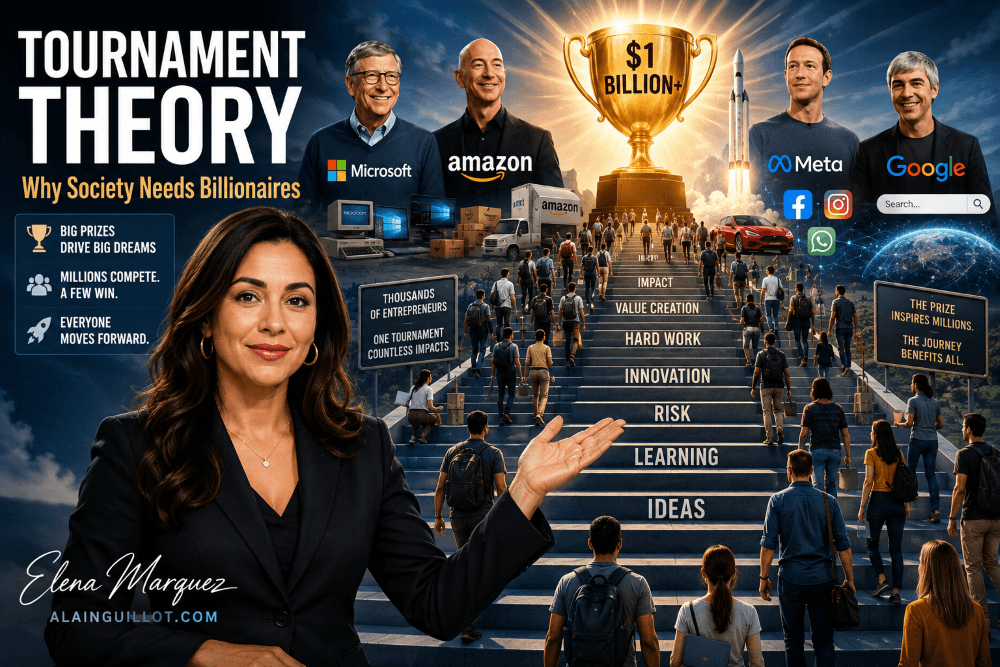
Tournament theory offers an interesting way to understand one of the most controversial features of capitalism: why the people at the very top can earn dramatically more than everyone else.
When economists Edward Lazear and Sherwin Rosen developed tournament theory in 1981, they weren’t primarily trying to explain billionaires. Their model examined compensation inside organizations and showed why large prizes at the top could motivate people throughout the hierarchy.
The idea is surprisingly simple.
In a tournament, the winner doesn’t necessarily receive a prize proportional to how much better he performed than the person who finished second. The winner receives a disproportionately large prize because the size of the prize motivates everyone to compete.
Capitalism sometimes works in a similar way.
The fortunes accumulated by people such as Bill Gates, Jeff Bezos, Elon Musk, Larry Ellison, and Mark Zuckerberg aren’t merely rewards enjoyed by a handful of extraordinarily successful entrepreneurs.
They are also highly visible prizes.
Millions of ambitious entrepreneurs can look at those fortunes and think:
Maybe I can build something too.
That incentive may be one of the most underappreciated benefits billionaires provide to society.
What Is Tournament Theory?
Tournament theory argues that compensation can depend on relative performance rather than absolute productivity.
Consider a professional tennis tournament.
The champion may earn several times what a player eliminated in an earlier round receives, even though the champion isn’t several times better at tennis.
Why?
Because tournaments need meaningful prizes.
The possibility of winning encourages thousands of competitors to train, practice, innovate and improve.
Lazear and Rosen applied a similar idea to corporate organizations. Large differences in compensation between positions can encourage employees to compete for promotions.
The salary attached to the CEO’s office therefore does more than compensate the CEO.
It changes the incentives of everyone who would like to occupy that office someday.
Tournament Theory and Billionaires
Now expand tournament theory beyond a corporation.
Imagine the entire entrepreneurial economy as an enormous tournament.
Millions of people start businesses.
Thousands build successful companies.
Hundreds create major corporations.
A tiny number build businesses worth tens or hundreds of billions of dollars.
The rewards are extremely unequal.
But so are the outcomes.
One entrepreneur might open a restaurant serving several hundred customers each week. Another might create a software platform used by hundreds of millions of people.
The economic value of successful ideas can scale extraordinarily quickly.
This helps explain why capitalism can produce enormous fortunes without requiring that every dollar of wealth represent a dollar taken from someone else.
Entrepreneurs can become wealthy by owning part of something that becomes enormously valuable.
Billionaires Inspire More Than Other Billionaires
One mistake in discussions about inequality is assuming billionaires matter only to other extremely wealthy people.
They don’t.
Successful entrepreneurs influence people throughout society.
A teenager learning programming can read about Bill Gates.
A small online retailer can study Jeff Bezos.
An engineering student can follow Elon Musk.
A software entrepreneur can study Mark Zuckerberg.
A young immigrant can learn how entrepreneurs arrived in new countries with little money and eventually created major companies.
Most of these people will never become billionaires.
That isn’t the point.
Olympic champions inspire millions of people who will never win Olympic medals. Great musicians inspire people who will never perform at Carnegie Hall.
Exceptional achievement expands people’s perception of what is possible.
Entrepreneurship works the same way.
Billionaires Help Create a Culture of Entrepreneurship
The greatest contribution of successful entrepreneurs may not be their personal fortunes.
It may be the culture they help create.
Entrepreneurial societies encourage people to ask:
- What problem can I solve?
- What product could I improve?
- What company could I build?
- What technology could I invent?
- How can I serve customers better?
- How can I turn an idea into a business?
Those questions matter enormously.
A society that celebrates entrepreneurship encourages experimentation.
Most experiments fail.
But occasionally someone creates something extraordinary.
Microsoft.
Amazon.
Google.
Facebook.
Tesla.
Companies like these didn’t simply make their founders wealthy. They changed how millions—or billions—of people work, communicate, shop, learn and live.
Are Billionaires Underpaid?
Saying that billionaires are “underpaid” sounds strange.
Someone worth $50 billion clearly isn’t struggling financially.
But compensation and social value created aren’t necessarily the same thing.
Suppose an entrepreneur develops a technology that saves each of 100 million customers just $100 over their lifetimes.
That’s potentially $10 billion in consumer value.
The entrepreneur doesn’t necessarily capture all $10 billion.
Customers retain some benefits. Employees receive wages. Suppliers earn revenue. Competitors copy the innovation. Other businesses build products on top of it.
Economists call some of the benefit retained by consumers consumer surplus.
This is an important distinction.
An entrepreneur can become extraordinarily wealthy while still capturing only part of the total economic value generated by the company.
That is the stronger argument for appreciating successful entrepreneurs.
It isn’t that every billionaire deserves every dollar.
It’s that wealth alone tells us surprisingly little about the total value an entrepreneur may have helped create.
Five Billionaires Who Created Extraordinary Social Value
Determining exactly which billionaire contributed “more than they were compensated” is impossible because social value cannot be measured precisely.
Nevertheless, these five entrepreneurs provide powerful examples of people whose businesses created enormous benefits beyond their personal fortunes.
1. Bill Gates — Microsoft
Bill Gates helped turn personal computing from a specialist technology into something accessible to businesses and households around the world.
Microsoft’s software became infrastructure for modern commerce.
Word processing, spreadsheets, databases, operating systems and enterprise software dramatically increased workplace productivity.
Gates’ fortune became enormous.
But imagine calculating the cumulative economic value created by billions of hours of increased productivity across several decades.
His personal fortune represents only one piece of that value.
2. Jeff Bezos — Amazon
Jeff Bezos helped transform retail.
Amazon made millions of products accessible from virtually anywhere while forcing competitors to improve prices, logistics, selection and delivery.
The company’s infrastructure also produced Amazon Web Services, which allowed startups to rent computing capacity instead of spending enormous sums building their own infrastructure.
Countless entrepreneurs have been able to launch businesses more cheaply because cloud computing exists.
That multiplier effect is difficult to measure.
3. Elon Musk — Tesla and SpaceX
Elon Musk has played a major role in accelerating investment in electric vehicles and private space exploration.
Tesla demonstrated that electric vehicles could compete as desirable mass-market products, pushing much of the automobile industry toward electrification.
SpaceX dramatically changed expectations about launch costs and reusable rockets.
Whether someone likes Musk personally is irrelevant to the economic question.
Entrepreneurial value should be judged primarily by what gets built.
4. Mark Zuckerberg — Meta
Facebook fundamentally reduced the cost of communicating across geographical boundaries.
Families, communities, businesses and organizations gained the ability to reach enormous audiences at almost zero marginal cost.
The platform has certainly generated legitimate controversies and social costs.
But its scale also demonstrates the central argument behind tournament theory: technology allows a successful entrepreneur to affect billions of people.
Even a small benefit per user can produce enormous aggregate value.
5. Larry Page — Google
Larry Page, together with Sergey Brin, helped organize the rapidly expanding internet into something ordinary people could actually navigate.
Think about the value of finding useful information within seconds.
Directions.
Research papers.
Businesses.
Products.
Medical information.
Academic material.
News.
Technical instructions.
The monetary value of every successful Google search isn’t captured by Google.
Much of it goes directly to the person searching.
That is consumer surplus on an extraordinary scale.
Five Billionaire-Built Businesses Used by Millions
Some of the clearest evidence of entrepreneurial value is simply observing how voluntarily and frequently people use the products entrepreneurs created.
Microsoft
Microsoft helped make computing a basic tool of modern life.
Its products enable businesses, governments, schools and individuals to create documents, analyze information, communicate and operate organizations.
Amazon
Amazon dramatically expanded consumer choice and convenience.
Its logistics infrastructure connects buyers and sellers, while Amazon Web Services provides computing infrastructure to businesses around the world.
Google effectively gave anyone with an internet connection access to an enormous index of human knowledge.
Finding information that might once have required hours in a library can now take seconds.
Meta
Facebook, Instagram and WhatsApp allow billions of people to communicate, publish information, build communities and promote businesses.
For small entrepreneurs in particular, social media dramatically reduced the cost of reaching customers.
Tesla
Tesla helped push electric vehicles into the mainstream.
The company’s success demonstrated that consumers would buy electric vehicles for performance and technology rather than merely environmental considerations.
The Billionaire Prize Creates Millions of Competitors
This is where tournament theory becomes particularly interesting.
The economic benefit of a billionaire may extend beyond the company that created the fortune.
The billionaire becomes an advertisement for entrepreneurship.
Consider how many entrepreneurs were inspired by Steve Jobs.
How many programmers were inspired by Bill Gates?
How many e-commerce entrepreneurs studied Jeff Bezos?
How many engineers became interested in rockets or electric vehicles because of Elon Musk?
We cannot measure these effects precisely.
But incentives matter.
If society tells ambitious people that extraordinary success will be rewarded, more people may attempt extraordinary things.
Most will fail.
Some will create small businesses.
Others will build medium-sized companies employing hundreds of people.
And occasionally someone will build the next Microsoft.
That is the tournament.
The billionaire is simply the most visible winner.
Inequality Isn’t the Only Question That Matters
Critics of billionaires often focus on inequality.
That’s understandable.
Extreme concentrations of wealth raise legitimate questions about taxation, political influence, monopoly power and economic opportunity.
But inequality alone doesn’t tell us whether society is becoming better or worse.
Imagine two societies.
In Society A, everyone has $10.
In Society B, most people have $100 while several entrepreneurs have $10 million.
Society B is vastly more unequal.
But most people are also substantially wealthier.
The important question therefore isn’t simply:
“How much does the billionaire have?”
A better question is:
“How did the billionaire acquire the wealth, and what value was created in the process?”
If wealth comes from political favoritism, corruption, fraud or monopolistic privilege, criticism is justified.
But if wealth comes primarily from creating products that millions of people voluntarily purchase and use, the situation is fundamentally different.
Instead of Attacking Billionaires, Encourage Entrepreneurship
A healthy capitalist society shouldn’t worship billionaires.
But neither should it automatically demonize them.
We should celebrate productive entrepreneurship while maintaining sensible rules against fraud, corruption, anticompetitive conduct and political favoritism.
More importantly, we should encourage the next generation to build.
Start companies.
Invent technologies.
Take risks.
Solve problems.
Compete.
Most aspiring entrepreneurs won’t become billionaires.
They don’t have to.
Tournament theory suggests that large prizes can motivate effort far beyond the handful of people who ultimately receive those prizes.
The possibility of extraordinary success can inspire millions of ordinary successes.
And those millions of attempts create businesses, jobs, technologies, products and ideas.
Tournament Theory Gives Us a Different Way to See Billionaires
A billionaire’s fortune is easy to see.
The value distributed throughout society is much harder to see.
You can see Jeff Bezos’ net worth.
You can’t easily calculate the value of billions of hours consumers saved by ordering products online.
You can see Bill Gates’ Microsoft shares.
You can’t see the cumulative value generated by decades of increased workplace productivity.
You can see the wealth created by Google.
You can’t easily measure the value of billions of questions answered almost instantly.
This is why tournament theory offers such an interesting perspective on capitalism.
The enormous prize at the top isn’t necessarily evidence that the economic system has failed.
Sometimes the enormous prize exists because someone created something enormously valuable.
And perhaps more importantly, everyone can see the prize.
Somewhere today, a teenager is learning to code.
An engineer is designing a prototype.
An immigrant is opening a business.
An entrepreneur is pitching an idea everyone else thinks is ridiculous.
Almost none of them will become billionaires.
But some will create jobs. Some will invent useful products. Some will become millionaires. And a tiny handful may build companies that transform society.
Instead of asking how we can make the prizes smaller, perhaps we should spend more time asking:
How can we enable more people to enter the tournament?
Frequently Asked Questions
What is tournament theory?
Tournament theory is an economic model developed by Edward Lazear and Sherwin Rosen in which rewards depend partly on relative performance. Large prizes for reaching higher positions can motivate competition among participants.
How does tournament theory explain billionaire wealth?
Tournament theory can be extended as an analogy for entrepreneurship. Extremely large financial rewards may encourage many people to take risks, innovate and build businesses even though only a tiny percentage become billionaires.
Do billionaires create more value than their net worth?
In some cases they plausibly can, because founders capture only part of the economic value their businesses generate. Customers, employees, suppliers and other businesses can receive benefits that aren’t reflected in the founder’s personal wealth.
Should society encourage billionaires?
Society should encourage productive entrepreneurship rather than billionaire status itself. The goal should be an economy where people can become extraordinarily successful by creating extraordinary value for others.
Other Personal Development Posts