| 📊 Alain’s Holdings — August 10, 2026 | ||||
|---|---|---|---|---|
| Symbol | Name | Price | Change | Change % |
| VOO | Vanguard S&P 500 ETF | 710.65 | -0.06 | -0.01% |
| QQQ | Invesco QQQ Trust | 720.87 | -2.16 | -0.30% |
| XIU.TO | iShares S&P/TSX 60 ETF | 54.27 | +0.14 | +0.26% |
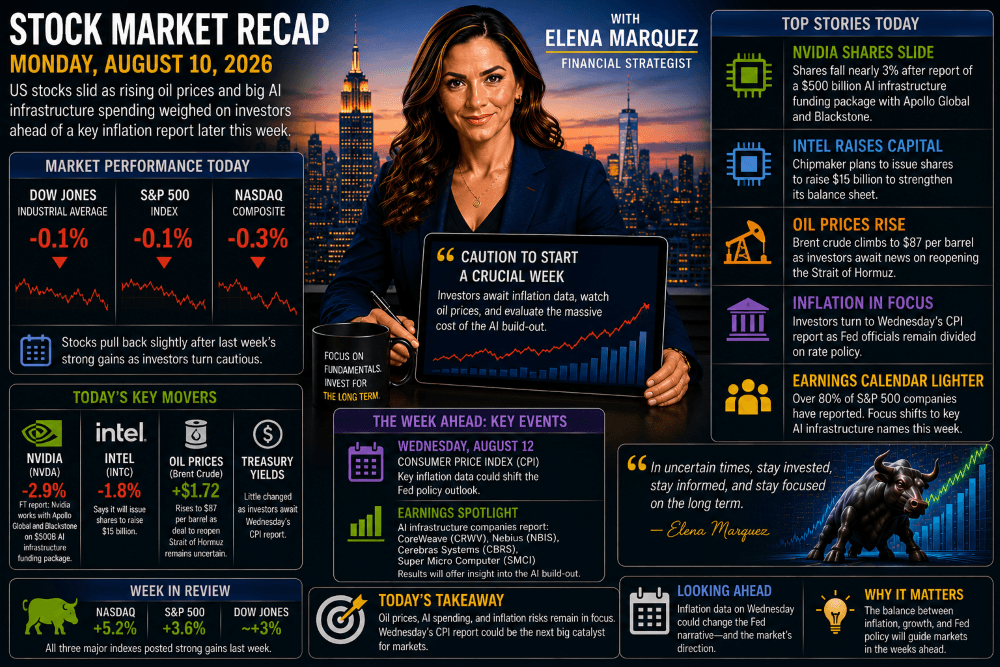
Wall Street started the week slightly lower Monday as investors confronted two familiar questions: How much will the AI boom cost, and will higher oil prices reignite inflation?
After last week’s strong gains, the major indexes pulled back modestly as investors looked ahead to Wednesday’s crucial Consumer Price Index report.
Market Performance
- 📉 Nasdaq Composite: -0.3%
- 📉 S&P 500: -0.1%
- 📉 Dow Jones Industrial Average: -0.1%
The declines were small, suggesting investors are largely in wait-and-see mode rather than abandoning last week’s rally.
Nvidia’s $500 Billion AI Question
The biggest technology story came from Nvidia.
Shares fell nearly 3% following a report that Nvidia is working with Apollo Global and Blackstone on a potential $500 billion AI infrastructure funding package.
The sheer size illustrates how extraordinary the AI infrastructure boom has become.
Data centers require chips, electricity, cooling systems, networking equipment, real estate—and enormous amounts of capital.
But investors are increasingly asking an important question:
How much spending is too much?
Recent earnings have demonstrated that Wall Street remains enthusiastic about AI, but companies must increasingly show that massive investments will eventually translate into sustainable profits.
Intel Turns to the Stock Market
Intel shares also declined after the chipmaker announced plans to raise approximately $15 billion by issuing new shares.
Raising capital can strengthen a company’s balance sheet and fund expansion, but issuing new stock also dilutes existing shareholders.
The announcement comes as semiconductor companies race to finance increasingly expensive manufacturing and AI infrastructure projects.
Once again, the theme is capital.
The AI race isn’t cheap.
Oil Climbs Back to $87
Energy markets added another complication.
Brent crude climbed to approximately $87 per barrel as investors waited for progress toward reopening the Strait of Hormuz.
Iran suggested that an agreement is “very close,” but months of negotiations and renewed military tensions have made markets cautious about assuming a deal is imminent.
Higher oil prices matter far beyond energy stocks.
They increase transportation and production costs, potentially filtering through to consumer prices.
And that brings us to the week’s most important event.
Wednesday’s CPI Could Move the Market
Investors will receive the latest Consumer Price Index on Wednesday.
The report arrives at an unusually important moment for the Federal Reserve.
Friday’s employment report showed that the U.S. unexpectedly lost 23,000 jobs in July, reducing pressure on policymakers to raise rates.
But inflation remains the other half of the equation.
If Wednesday’s CPI comes in hotter than expected, the Fed could once again face pressure to tighten monetary policy.
If inflation continues cooling, the case for keeping rates unchanged becomes considerably stronger.
AI Earnings Aren’t Finished Yet
More than 80% of S&P 500 companies have already reported earnings, so the calendar is becoming quieter.
But this week’s remaining reports could tell investors a great deal about the AI infrastructure boom.
Companies including CoreWeave, Nebius, Cerebras Systems, and Super Micro Computer are scheduled to report.
Unlike the consumer-facing AI story, these businesses sit much closer to the enormous infrastructure buildout powering the technology.
Their results could help answer one of Wall Street’s biggest questions:
Is AI infrastructure demand still accelerating—or are companies beginning to spend more cautiously?
The Bottom Line
Monday’s modest decline looks more like caution than fear.
After a powerful week for stocks, investors have two major issues to evaluate:
AI spending and inflation.
Nvidia’s reported $500 billion financing initiative demonstrates just how much capital may be required to build the AI economy.
Meanwhile, rising oil prices threaten to complicate the Federal Reserve’s inflation fight.
Wednesday’s CPI report could determine which story matters most next.
Other Stock Market blog posts