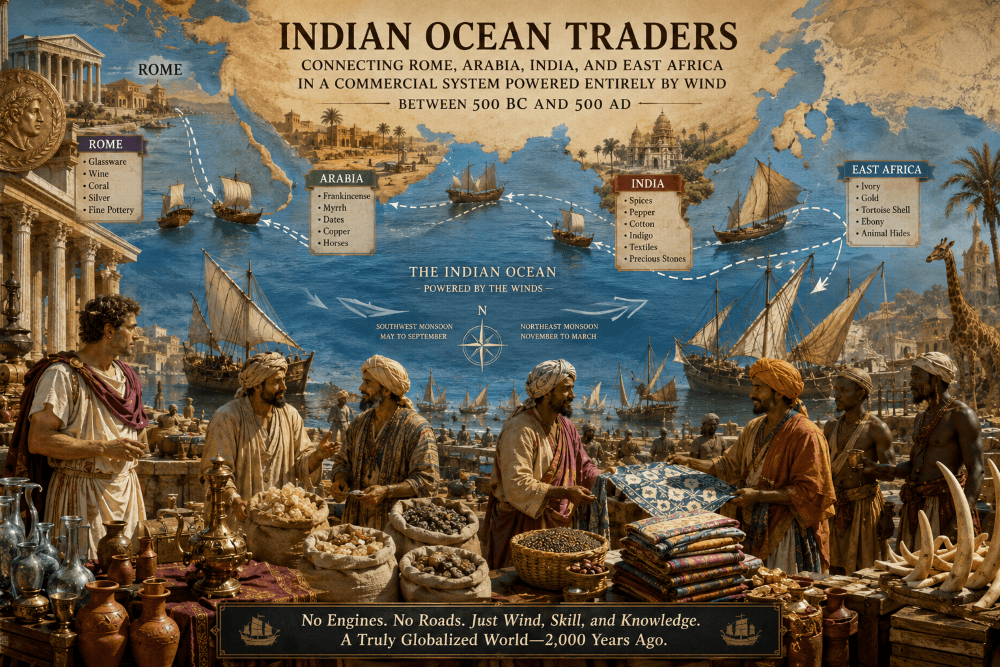
Long before European ships rounded Africa, Indian Ocean trade connected Rome, Arabia, India, and East Africa in a commercial system powered entirely by wind. Between 500 BC and 500 AD, merchants learned to harness seasonal monsoon patterns to sail directly across open water, turning a dangerous, unpredictable sea into one of the ancient world’s busiest and most profitable trade highways. For entrepreneurs, it’s an early lesson in how understanding natural systems can unlock entirely new markets.
What Was Indian Ocean Trade?

Indian Ocean trade was a maritime network linking ports across East Africa, Arabia, Persia, India, and Southeast Asia. Unlike the overland Silk Road, it depended on ships, seasonal winds, and coastal expertise passed down through generations of sailors.
- Goods moved between major hubs like Muziris in southern India, Berenice in Egypt, and ports along the Arabian coast.
- Cargo included spices, cotton textiles, ivory, gemstones, glassware, and eventually Roman gold and silver coin.
- Unlike land caravans, ships could carry far larger volumes of goods per trip, dramatically lowering the cost of long-distance trade.
This combination of scale and speed made Indian Ocean trade one of the most lucrative commercial systems of the ancient world.
The Monsoon Breakthrough
Reading the Wind
The single biggest entrepreneurial innovation in Indian Ocean trade wasn’t a product — it was a discovery about timing.
- Sailors learned that monsoon winds blow reliably from the southwest during summer months.
- During winter, the pattern reverses, blowing from the northeast.
- By timing departures around these predictable shifts, sailors could cross directly from Arabia to India in weeks instead of months.
Greek and Roman sources credit a navigator named Hippalus with popularizing this technique for Mediterranean sailors, though Arab and Indian sailors likely understood monsoon patterns long before.
From Coastal Hugging to Open Water
Before this breakthrough, ships stayed close to shore, adding weeks or months to any voyage. Once sailors trusted the monsoon pattern, they could cut straight across open ocean.
- This shortened travel time dramatically, reducing costs and risk.
- It allowed far more voyages per year, increasing overall trade volume.
- It transformed India into a central hub connecting Roman markets in the west with Southeast Asian and Chinese goods in the east.
Rome’s Insatiable Demand
By the height of the Roman Empire, Indian Ocean trade had become deeply important to the Mediterranean economy.
- Pepper, cinnamon, and other spices became luxury staples in Roman households.
- Fine Indian cotton textiles were highly prized among wealthy Romans.
- Roman writers complained openly about the enormous quantities of gold flowing east to pay for these goods.
This trade imbalance shows just how much value Roman consumers placed on Indian Ocean goods, even at significant cost to the empire’s own bullion reserves.
Key Players in Indian Ocean Commerce
Indian Merchant Communities
Port cities along India’s western coast, especially in the Tamil region, grew wealthy as trade intermediaries. Local rulers often supported and taxed this commerce, recognizing its value to regional economies.
Arab and East African Traders
Arabian and East African merchants controlled crucial legs of the journey, connecting African goods like ivory and exotic animals to the broader network. Port cities along the Red Sea and Horn of Africa became essential waypoints.
Roman and Egyptian Merchants
Once Egypt fell under Roman control, Red Sea ports like Berenice became launching points for direct voyages to India, cutting out several layers of middlemen who had previously controlled the route.
Why Indian Ocean Trade Mattered for Entrepreneurship
- Environmental knowledge as competitive advantage. Understanding monsoon patterns created massive efficiency gains over rivals who didn’t.
- Scale changes economics. Maritime trade could move far more cargo than land caravans, lowering per-unit costs.
- Demand drives expansion. Roman appetite for luxury goods pulled merchants further and further into new markets.
Frequently Asked Questions
What made Indian Ocean trade different from the Silk Road? Indian Ocean trade relied on ships and seasonal monsoon winds rather than overland caravans, allowing merchants to move larger cargo volumes at lower relative cost.
What goods were traded across the Indian Ocean? Spices, cotton textiles, ivory, gemstones, glassware, and precious metals were among the most commonly traded goods between Rome, India, Arabia, and East Africa.
Who discovered the monsoon trade winds? Greek and Roman sources credit navigator Hippalus with popularizing monsoon navigation for Mediterranean sailors, though Arab and Indian sailors likely understood these patterns earlier.
Why was Indian Ocean trade important to Rome? It supplied luxury goods like spices and fine textiles that Roman consumers highly valued, even though the trade drained significant gold and silver from the empire.
Related Articles
- The First Entrepreneur: When Did Entrepreneurship Begin?
- The Agricultural Revolution: How Farming Created the First Entrepreneurs
- How Writing Was Invented for Business: The First Accountants
- The First Merchants: How the Sumerians Created Professional Commerce
- The Birth of Money: How Currency Changed Entrepreneurship Forever
- The Indus Valley: Trade, Standardization, and the Mysterious Business Civilization
- Ancient China: Innovation, Markets, and Continuous Improvement
- The Phoenicians: How Maritime Trade Connected the Ancient World
- Ancient Greece: How Competition and Markets Shaped Entrepreneurship
- Ancient Rome: How Infrastructure, Law, and Scale Built an Economic Empire
- The Islamic Golden Age: How Knowledge, Finance, and Global Trade Transformed Entrepreneurship
- The Silk Road Trade: How Ancient Networks Built Global Commerce
- Marcus Licinius Crassus: The Richest Man in Rome
About The History of Entrepreneurship
This article is part of The History of Entrepreneurship, an ongoing series exploring how civilizations, merchants, technologies, institutions, and entrepreneurs gradually created the foundations of modern business.
Rather than treating entrepreneurship as a modern invention, the series follows its evolution across civilizations—from the earliest exchanges between prehistoric humans to the global businesses of the modern economy.
Each chapter adds another tool to the entrepreneur’s toolkit.