| 📊 Alain’s Holdings — August 13, 2026 | ||||
|---|---|---|---|---|
| Symbol | Name | Price | Change | Change % |
| VOO | Vanguard S&P 500 ETF | 714.95 | +4.78 | +0.67% |
| QQQ | Invesco QQQ Trust | 732.07 | +8.37 | +1.16% |
| XIU.TO | iShares S&P/TSX 60 ETF | 54.88 | +0.30 | +0.55% |
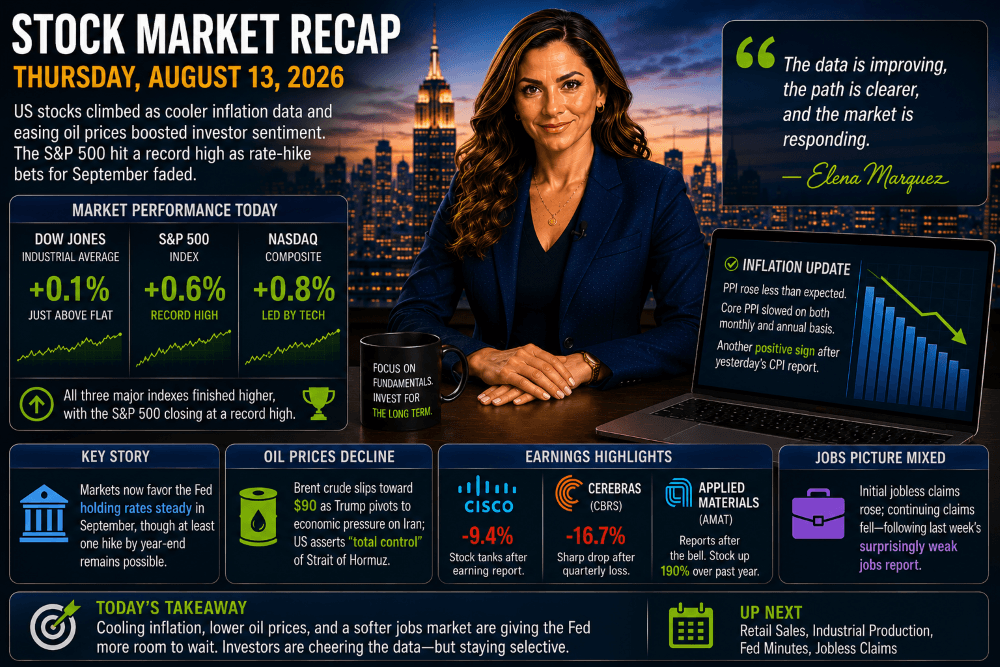
Wall Street moved higher Thursday, with the S&P 500 closing at a record high, as investors received another encouraging inflation report.
After Wednesday’s CPI showed consumer inflation cooling, Thursday’s Producer Price Index added evidence that price pressures may be easing. That pushed investors further away from expecting a Federal Reserve rate hike in September.
Market Performance
- 📈 Nasdaq Composite: +0.8%
- 📈 S&P 500: +0.6% — Record High
- 📈 Dow Jones Industrial Average: +0.1%
The major indexes all finished higher, but beneath the surface, investors continued punishing individual companies that failed to meet increasingly demanding expectations.
Another Encouraging Inflation Report
The biggest market catalyst was the Producer Price Index (PPI), which measures inflation from the perspective of businesses and producers.
Producer prices increased less than economists expected.
Even more encouraging, core inflation readings—which remove some of the more volatile components—showed slower price growth on both a monthly and annual basis.
That followed Wednesday’s CPI report showing annual consumer inflation easing from 3.5% to 3.4% in July.
Two consecutive encouraging inflation reports have changed the conversation on Wall Street.
Investors entered the week worried that another Federal Reserve rate hike could arrive as early as September.
Those expectations are now fading.
Is a September Rate Hike Off the Table?
Not necessarily.
Inflation is moving in the right direction, but it remains above the Federal Reserve’s 2% target.
Fed policymakers also remain divided over how aggressively they should respond.
Markets increasingly expect the Fed to hold rates steady in September, although investors still see the possibility of at least one additional rate hike before the end of 2026.
That makes the next several inflation and employment reports particularly important.
For now, however, the Fed appears to have gained something valuable:
Time.
Oil Prices Finally Provide Some Help
Another encouraging development came from the energy market.
Oil prices declined Thursday as the Trump administration shifted its strategy toward Iran from active military operations toward economic pressure.
That’s potentially important for inflation.
High oil prices have been one of the biggest threats to recent progress on consumer prices. Lower energy costs could reduce pressure on transportation, manufacturing and household budgets.
But the Strait of Hormuz remains a major geopolitical risk.
The U.S. government says it maintains “total control” over the strategically important waterway, though private shipping data has raised questions about how much commercial traffic has actually returned.
For investors, lower oil prices are welcome.
A lasting normalization of shipping through the strait would be considerably better.
Cisco and Cerebras Get Punished
While the broader market rallied, earnings season delivered another reminder of how demanding Wall Street has become.
Cisco and Cerebras Systems fell sharply following their earnings reports.
Both companies are connected to the enormous AI infrastructure buildout, but investors are increasingly unwilling to reward companies simply because they have exposure to artificial intelligence.
Growth must justify valuation.
Spending must eventually generate profits.
And earnings must meet extraordinarily high expectations.
Attention now turns to Applied Materials, one of the world’s most important suppliers of semiconductor manufacturing equipment.
Its shares have gained approximately 190% over the past year, creating extremely high expectations ahead of its earnings report.
Labor Market Still Bears Watching
Thursday’s employment data provided a mixed picture.
Initial jobless claims increased from the previous week, suggesting some continued softening in employment.
However, continuing claims declined.
The figures follow last week’s surprising jobs report showing the U.S. economy lost 23,000 jobs in July.
For the Federal Reserve, this matters enormously.
The combination of cooling inflation and a weakening labor market strengthens the argument for leaving interest rates unchanged.
The Bottom Line
The economic picture improved this week.
Consumer inflation cooled.
Producer inflation came in below expectations.
Oil prices declined.
And the S&P 500 reached another record high.
That’s a favorable combination for investors.
But the market isn’t giving every company a free ride.
Cisco and Cerebras demonstrated that AI exposure alone is no longer enough to impress Wall Street.
The market increasingly wants something more tangible:
Profitable growth.
For the broader market, however, today’s message was encouraging.
If inflation continues cooling while the economy avoids a severe slowdown, the Federal Reserve may be able to keep rates steady and allow economic growth to continue.
That increasingly looks like the scenario Wall Street is betting on.
Other Stock Market blog posts