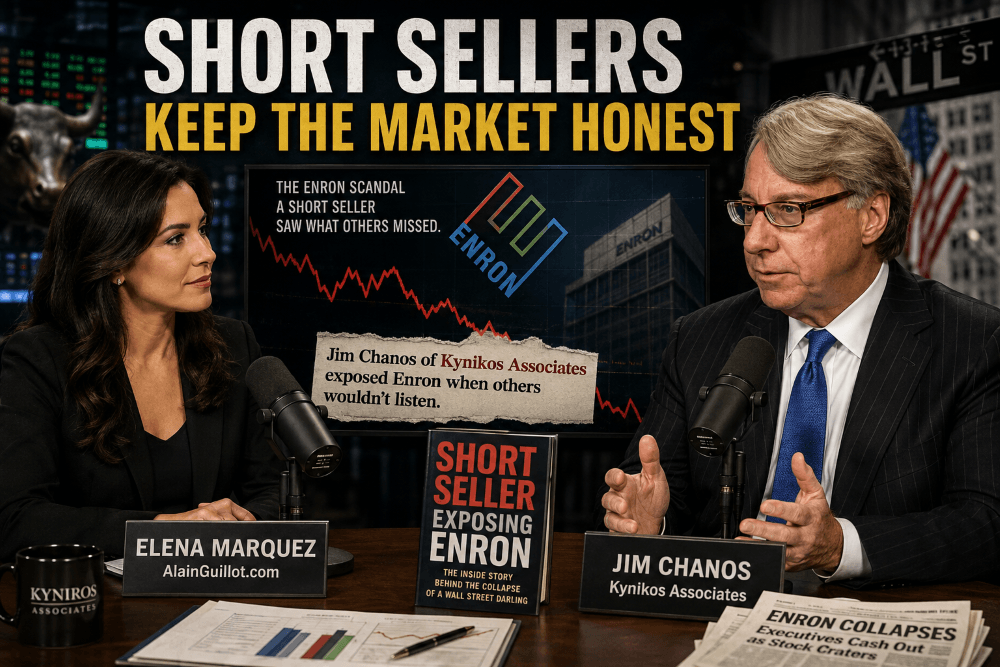
Short sellers have a bad reputation. When investors buy stocks and hope companies become more valuable, we call it investing. When short sellers bet that an overpriced company will eventually fall, people sometimes treat them as villains.
I think that’s unfair.
Short sellers perform an important function in financial markets. They challenge excessive optimism, question questionable accounting, expose fraud, and put their own money behind the belief that the market has gotten something wrong.
And unlike investors who simply criticize a company from the sidelines, short sellers can lose enormous amounts of money when they are wrong—or even when they are eventually proven right.
What Are Short Sellers?
Most investors try to buy low and sell high.
Short sellers attempt to reverse the process: sell high and buy back lower.
A short seller typically borrows shares, sells them at the current market price, and hopes to repurchase those shares later at a lower price.
Imagine a stock trading at $100.
You believe the business is dramatically overvalued, so you short the stock at $100. If the price eventually falls to $60, you can buy it back for $60 and earn approximately $40 per share before borrowing costs, commissions, dividends owed, taxes, and other expenses.
The problem is what happens if you are wrong.
If you buy a $100 stock, the most you can lose is $100. But theoretically, a short seller’s losses are unlimited because there is no limit to how high a stock price can rise.
That asymmetry makes short selling particularly dangerous.
Why Short Sellers Are Useful to the Stock Market
Markets work best when participants are allowed to express both positive and negative opinions.
If investors who believe a company is undervalued can buy its shares, investors who believe a company is severely overvalued should also have a mechanism for expressing that view.
Short sellers provide that mechanism.
They can contribute to the market in several important ways:
- Price discovery: They challenge valuations that appear disconnected from fundamentals.
- Fraud detection: Some short sellers spend enormous amounts of time investigating companies, financial statements, executives, and business practices.
- Market liquidity: Short-selling activity adds buyers and sellers to the marketplace.
- Skepticism: Short sellers provide a counterweight when nearly everyone else is optimistic.
- Accountability: Management teams know that sophisticated investors may investigate questionable claims.
A healthy market needs optimists, but it also needs skeptics.
Short Sellers and Market Efficiency
I believe markets are remarkably efficient over long periods, but that doesn’t mean they are perfectly efficient every minute of every day.
Markets can become irrational.
Investors get excited. Narratives become fashionable. Fear of missing out takes over. Valuations become detached from economic reality.
The opposite happens during panics.
A fundamentally sound company can temporarily trade far below what its business appears to be worth.
Eventually fundamentals tend to matter, but eventually is a dangerous word when money is involved.
The economist John Maynard Keynes is commonly associated with the famous warning:
“Markets can remain irrational longer than you can remain solvent.”
Whether applied to long or short positions, the lesson is powerful.
Being right about value isn’t enough.
You also have to survive long enough for the market to recognize that you are right.
Why Short Sellers Are Often Treated Like Villains
There is also a cultural dimension to short selling, particularly in the United States.
Owning stocks feels optimistic. It means believing in entrepreneurs, companies, economic growth, technological progress, and the future.
Buying stocks can therefore feel almost patriotic.
Short selling feels different.
If you announce that you bought Apple or Microsoft because you believe in the company’s future, few people will object.
But announce that you are shorting a popular company and the reaction can be surprisingly emotional.
People may accuse short sellers of wanting companies to fail, employees to lose their jobs, or shareholders to lose their savings.
But identifying a bad business doesn’t cause it to be a bad business.
If a company is fraudulent, dangerously leveraged, badly managed, or wildly overvalued, suppressing negative opinions doesn’t make the underlying problem disappear.
In fact, allowing skeptical investors to challenge companies can make markets healthier.
Short Sellers Don’t Necessarily Want Companies to Fail
This distinction is important.
A short seller doesn’t necessarily want a company to disappear.
The short seller may simply believe:
The current stock price is too high relative to the company’s actual value.
A wonderful company can be a terrible investment at the wrong price.
Likewise, a mediocre company can sometimes become an attractive investment if the price becomes cheap enough.
Investing isn’t simply about deciding whether a company is “good” or “bad.”
It is about comparing price with value.
Short sellers are making that comparison from the opposite side of the trade.
Famous Case Studies: Companies Exposed by Short Sellers
Enron
- Short Seller: Jim Chanos (Kynikos Associates)
- The Exposure: Chanos identified severe accounting irregularities, aggressive off-balance-sheet vehicles, and inflated earnings. His research helped expose Enron as a massive corporate fraud, leading to its bankruptcy in 2001.
Nikola Motor Corporation
- Short Seller: Nathan Anderson (Hindenburg Research)
- The Exposure: In 2020, Hindenburg released a report accusing the electric truck maker of being “an intricate fraud” built on dozens of lies, notably revealing that a video showing a prototype driving was actually just the truck rolling down a hill. Founder Trevor Milton was later convicted of wire and securities fraud.
Sino-Forest Corporation
- Short Seller: Carson Block (Muddy Waters Research)
- The Exposure: Block published a 2011 report alleging that the Canadian-listed Chinese timber company overstated its assets, timberland holdings, and revenue. The stock plummeted over 70% in days, leading to regulatory investigations, bankruptcy, and criminal charges.
Valeant Pharmaceuticals
- Short Seller: Andrew Left (Citron Research) & Fahmi Quadir (Safkhet Capital)
- The Exposure: Citron Research published a famous report in 2015 questioning Valeant’s relationship with a phantom mail-order pharmacy called Philidor, alleging Valeant used it to artificially inflate sales figures. The revelations caused the stock to collapse over 90%.
Luckin Coffee
- Short Seller: Carson Block (Muddy Waters Research)
- The Exposure: In early 2020, Muddy Waters published an anonymous 89-page investigative report proving the Chinese coffee chain was inflating its sales volume through fake transactions. Luckin later admitted to fabricating $310 million in sales, leading to its Nasdaq delisting.
The Risk That Scares Me Most: Government Intervention
One reason I personally find short selling intimidating has little to do with financial analysis.
It is government intervention.
Imagine doing extensive research and correctly concluding that a company—or perhaps an entire industry—is in serious financial trouble.
You short it.
The business deteriorates exactly as expected.
Then the government intervenes.
During severe financial crises, governments and central banks may decide that allowing major institutions to collapse would threaten the broader economy. The 2008 financial crisis demonstrated just how aggressively governments can intervene when policymakers believe the financial system itself is at risk.
From a public-policy perspective, intervention might be justified.
From the perspective of someone holding a short position, however, it introduces another enormous variable.
A bailout, emergency financing program, regulatory change, trading restriction, merger, or other intervention can dramatically change the outcome.
You can therefore be correct about the business and still lose money on the trade.
That is frightening.
Too Big to Fail: 5 Major Companies Saved by Government Bailouts
- General Motors (GM)
- The Crisis: Suffering from steep sales declines, heavy debt, and high legacy labor costs during the 2008 financial crisis, GM faced imminent liquidation.
- The Bailout: The U.S. government injected approximately $50 billion via TARP (Troubled Asset Relief Program), taking a temporary majority ownership stake to guide GM through a structured bankruptcy reorganization in 2009.
- American International Group (AIG)
- The Crisis: AIG sat at the center of the 2008 collapse due to its massive exposure to Credit Default Swaps (CDS) backing subprime mortgage securities. Its failure threatened to crash the global financial system.
- The Bailout: The Federal Reserve and U.S. Treasury orchestrated a total rescue package worth up to $182 billion, taking an ~80% equity stake to prevent systemic contagion.
- Chrysler
- The Crisis: Like GM, Chrysler ran out of cash in late 2008 due to falling auto sales and a heavily leveraged balance sheet.
- The Bailout: Received over $12 billion in federal loans. The government facilitated a bankruptcy restructuring that eventually allowed Italian automaker Fiat to acquire ownership, fully liquidating the U.S. government’s stake by 2011.
- Citigroup
- The Crisis: Heavily exposed to subprime mortgage-backed assets and bad loans, Citigroup suffered tens of billions in losses in 2008, triggering a sharp decline in its share price and depositor panic.
- The Bailout: The government provided $45 billion in direct cash injections and guaranteed over $300 billion in toxic assets, keeping the global banking giant solvent.
- Fannie Mae & Freddie Mac (Federal National Mortgage Association & Federal Home Loan Mortgage Corp)
- The Crisis: The two government-sponsored enterprises (GSEs) guaranteed roughly half of the $12 trillion U.S. mortgage market. As subprime defaults spiked in 2008, their capital reserves evaporated.
- The Bailout: The U.S. government placed both entities into federal conservatorship, injecting nearly $190 billion to stabilize the housing finance system (which they have since paid back via profits).
The Short Squeeze: When Being Right Isn’t Enough
Short sellers also face the possibility of a short squeeze.
Suppose many investors are short the same company and its stock suddenly begins rising.
Some short sellers decide to limit their losses and buy shares to close their positions.
But buying shares pushes the stock higher.
That higher price forces additional short sellers to cover their positions, creating still more buying.
The cycle can become self-reinforcing:
Stock rises → shorts cover → more buying → stock rises further → more shorts cover.
At that point, the stock price can temporarily become disconnected from the company’s underlying fundamentals.
You could ultimately be correct that the company is worth much less—and still be financially destroyed before the market agrees with you.
Short Selling Requires an Unusual Mindset
There is another difficulty that shouldn’t be underestimated: psychology.
Imagine being bearish during a powerful bull market.
Stocks keep rising.
Financial television is optimistic. Your friends are making money. Social media is filled with people celebrating their gains.
Meanwhile, your short positions keep moving against you.
Maintaining a contrarian position under those circumstances requires tremendous discipline.
You have to continually ask yourself:
Am I early, or am I wrong?
That may be one of the hardest questions in investing.
Conviction is valuable, but stubbornness can be financially devastating.
The successful contrarian needs enough confidence to resist the crowd while maintaining enough intellectual humility to recognize when the crowd actually knows something they don’t.
Why There Are Fewer Short Sellers Than Long Investors
The structure of the stock market naturally favors long-term investors.
Stocks have historically benefited from economic growth, innovation, inflation, productivity, and corporate earnings growth.
A long-term investor therefore has a powerful force working in their favor: time.
Short sellers often have the opposite problem.
They may face:
- Unlimited theoretical losses
- Margin requirements
- Borrowing costs
- Dividend obligations
- Short squeezes
- Forced position closures
- Government or regulatory intervention
- A market with a long-term upward bias
That is a difficult game.
Perhaps we shouldn’t be surprised that relatively few investors choose to specialize in it.
Short Sellers Are Part of a Healthy Market
I don’t think short sellers deserve the hostility they often receive.
Capitalism isn’t strengthened by pretending every company is wonderful.
A functioning market needs people willing to ask uncomfortable questions.
Is the accounting accurate?
Are management’s claims believable?
Is the business sustainable?
Does the valuation make sense?
Is everyone buying because of fundamentals—or simply because everyone else is buying?
Short sellers sometimes get those questions spectacularly wrong.
But so do long investors.
The important thing is that both sides are allowed to make their arguments—and risk their own capital on their conclusions.
Markets need optimists willing to finance tomorrow’s great companies.
They also need skeptics willing to say:
Something here doesn’t make sense.
Sometimes the skeptic is wrong.
Sometimes the skeptic is early.
And sometimes the skeptic is the only person in the room willing to say that the emperor has no clothes.
FAQ About Short Sellers
What is a short seller?
A short seller is an investor who generally borrows shares and sells them because they expect the price to decline. If the price falls, the investor can buy the shares back at a lower price and potentially profit from the difference.
Are short sellers bad for companies?
Not inherently. Short sellers can improve price discovery and sometimes uncover accounting problems, fraud, excessive valuations, or weaknesses that other investors have overlooked.
Can a short seller lose more than 100%?
Yes. Because a stock can theoretically rise indefinitely, losses on an uncovered short position can exceed the amount initially invested. This is one reason short selling is considerably riskier than simply purchasing shares.
Why is short selling so difficult?
Short sellers face borrowing costs, margin requirements, short squeezes, potentially unlimited losses, regulatory risks, and the possibility that an overvalued stock remains overvalued much longer than expected.
Other Stock Market blog posts