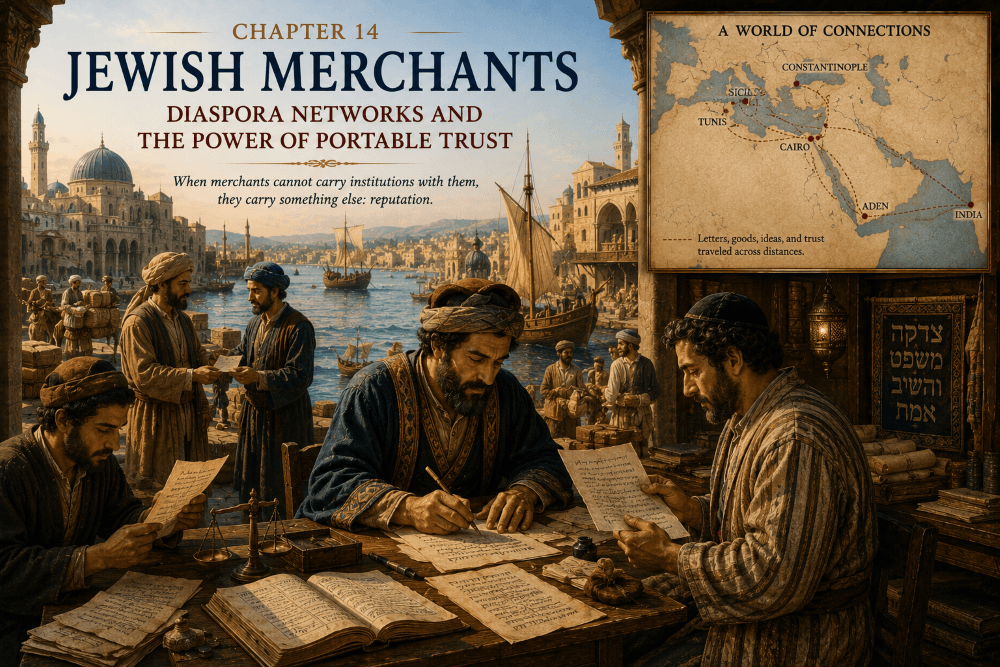
How do you do business with someone hundreds or thousands of kilometers away when there are no telephones, banks with global branches, credit scores, or instant electronic payments?
Medieval Jewish merchants confronted that problem constantly.
Jewish communities were scattered across North Africa, the Middle East, the Mediterranean, and Europe. Their circumstances differed enormously, but this geographic dispersion sometimes created commercially valuable networks.
Merchants could rely on correspondence, introductions, family relationships, community institutions, reputation, literacy, and repeated transactions to establish relationships across great distances.
These networks helped solve one of entrepreneurship’s oldest problems:
How do strangers trust one another?
Their entrepreneurial contribution to our story is something every modern business still needs:
Portable trust.
Jewish Merchants Operated Across a Connected World
The medieval Mediterranean was not one unified political market.
It was divided among kingdoms, empires, cities, religious communities, and legal jurisdictions.
A merchant traveling between cities might encounter:
- Different rulers
- Different currencies
- Different languages
- Different laws
- Different taxes
- Different customs
Yet commerce crossed these boundaries constantly.
Jewish communities existed throughout many of these regions.
That dispersion sometimes allowed merchants to establish relationships across political borders.
A merchant from Egypt might know someone in Tunisia.
Someone in Tunisia might have relatives or business associates in Sicily.
Another contact might operate farther east.
Connections reduced the uncertainty of entering unfamiliar markets.
Diaspora Networks Created Connections
The word diaspora refers to a population dispersed across different geographic regions.
Diaspora often resulted from migration, political upheaval, displacement, and sometimes persecution.
But geographic dispersion could also produce networks.
Imagine that you are a merchant living in Cairo and want to conduct business in Palermo.
You know little about the local market.
Who can be trusted?
Where should you stay?
Who buys your merchandise?
Which shipowner is reliable?
Perhaps someone in your community knows a merchant there.
A letter of introduction can be sent.
A relationship begins.
The network does not eliminate risk.
But it reduces the cost of establishing trust.
And reducing the cost of trust makes more commerce possible.
The Cairo Geniza: An Extraordinary Window Into Medieval Business
Our understanding of this commercial world owes an enormous debt to one remarkable historical discovery:
The Cairo Geniza.
The Geniza associated with the Ben Ezra Synagogue in Old Cairo preserved a vast collection of writings.
Some were religious.
Others were surprisingly ordinary.
Letters.
Legal deeds.
Business accounts.
Contracts.
Lists.
Personal correspondence.
These documents allow historians to reconstruct aspects of everyday Jewish life across the medieval Mediterranean and Red Sea worlds with unusual detail.
The documents are particularly valuable because they do not merely tell us what rulers thought commerce looked like.
They show merchants actually conducting business.
The Cairo Geniza Shows Entrepreneurs at Work
The surviving documents discuss activities modern entrepreneurs would immediately recognize.
Buying.
Selling.
Shipping.
Partnerships.
Accounts.
Debts.
Customs.
Employees.
Family obligations.
Business travel.
The Princeton Geniza Lab’s Indian Ocean project now encompasses hundreds of documents associated with traders operating between roughly the late eleventh and thirteenth centuries. Some merchants traveled through the Red Sea to Aden and as far as India’s Malabar and Konkan coasts, with evidence extending even toward Sumatra.
These were not abstract economic theories.
They were real businesses.
Reputation Was Capital
Suppose two merchants ask you for credit.
You know one by reputation.
Trusted business associates have dealt with him successfully.
The second merchant is completely unknown.
Who receives better terms?
Probably the first.
Why?
Because reputation reduces uncertainty.
A trustworthy merchant might gain:
- Better credit
- More introductions
- Stronger partnerships
- Better information
- More customers
- More opportunities
A dishonest merchant risked losing access to the network.
Reputation therefore behaved like capital.
It took time to accumulate.
It created economic benefits.
And it could be lost.
How Did Jewish Merchants Make Trust Portable?
Normally, trust is local.
You trust a merchant because you have dealt with that person before.
Long-distance commerce creates a different problem.
Nobody knows you.
Jewish merchant networks could sometimes transform:
“Nobody here knows me.”
into:
“Someone here knows someone who knows me.”
That distinction is economically powerful.
Trust could travel through:
- Letters
- Introductions
- Family connections
- Business partners
- Shared acquaintances
- Community institutions
- Commercial reputation
The merchant arrived in a new city carrying something invisible but valuable.
His reputation.
Letters Were Business Technology
Today entrepreneurs send emails and text messages.
Medieval merchants sent letters.
The technology was slower.
The function was remarkably familiar.
Commercial correspondence could contain:
- Prices
- Shipping instructions
- Payment requests
- Credit information
- Market conditions
- Introductions
- Political news
- Partnership details
Historian Jessica Goldberg’s study of the Geniza merchants devotes substantial attention to commercial correspondence, information geography, merchant communities, business relationships, and institutions.
Information was an entrepreneurial advantage centuries before anyone used the phrase market intelligence.
Information Reduced Business Risk
Imagine shipping expensive merchandise to another city without knowing current market conditions.
Perhaps prices have collapsed.
Perhaps competitors already delivered large quantities of the same product.
Perhaps war has interrupted shipping.
Perhaps your intended customer has gone bankrupt.
Information helps entrepreneurs avoid these mistakes.
Merchant networks therefore transported two commodities simultaneously:
Goods and knowledge.
Knowing which products were scarce, which ports were safe, who paid reliably, and where demand was increasing could be as valuable as the merchandise itself.
Family Became Business Infrastructure
Family relationships often supported premodern commerce.
A brother could serve as an agent.
A cousin could make an introduction.
A son could enter the business.
Relatives living in another city could provide:
- Housing
- Information
- Contacts
- Capital
- Recommendations
- Market knowledge
Family relationships reduced some of the uncertainty involved in international commerce.
But family businesses also created familiar problems.
Relatives argued.
Inheritance divided property.
Family members could be incompetent.
Personal disputes could damage business relationships.
The entrepreneurial lesson remains relevant:
Family creates trust. It does not guarantee competence.
Jewish Merchants Were Part of the Islamic Commercial World
Jewish commerce should not be presented as an isolated economic system.
Many merchants documented in the Cairo Geniza operated within the broader Islamic commercial environment.
Jewish and Muslim economic practices interacted in complicated ways, and historians continue debating exactly how Jewish legal and communal institutions related to the wider commercial practices of medieval Islamic society.
That complexity is important.
Commerce does not develop inside sealed civilizations.
People borrow ideas.
They adapt institutions.
They trade with outsiders.
They learn from one another.
Jewish merchants participated in a much larger commercial ecosystem.
Commerce Crossed Religious Boundaries
A Jewish merchant did not necessarily trade only with Jews.
Markets brought together people from different religions, languages, and cultures.
Jewish merchants interacted with Muslim and Christian merchants and participated in broader networks involving shipowners, craftspeople, officials, customers, agents, and financiers.
This does not mean medieval societies were uniformly tolerant.
They certainly were not.
Religious discrimination, persecution, legal inequality, and violence existed.
Yet commerce created incentives for cooperation.
People who disagreed about religion could still discover opportunities for mutually beneficial exchange.
That is one of markets’ remarkable characteristics.
The Radhanites: Early Long-Distance Jewish Merchants
Earlier medieval sources also mention Jewish merchants commonly known as the Radhanites.
A ninth-century geographical account describes Jewish merchants traveling across long distances and possessing useful linguistic abilities.
Their exact identity, scale, and organization remain subjects of historical debate, so we should resist portraying them as a single enormous international corporation.
But their story illustrates an important entrepreneurial advantage:
The ability to cross cultural boundaries expands markets.
A merchant who understands multiple languages and commercial environments can pursue opportunities inaccessible to someone confined to one local market.
Language Was Entrepreneurial Capital
International business requires communication.
A multilingual merchant could:
- Negotiate with more customers
- Understand foreign markets
- Communicate with officials
- Read correspondence
- Work with foreign partners
- Navigate different commercial cultures
Jewish communities often lived within multilingual environments.
Language reduced the friction of exchange.
Today, English frequently functions as an international business language.
In medieval commerce, merchants who could navigate several linguistic worlds possessed a valuable competitive advantage.
Literacy Created Business Leverage
Writing fundamentally changes entrepreneurship.
A spoken instruction disappears.
A written instruction can travel hundreds of kilometers.
Contracts preserve agreements.
Letters transmit information.
Accounts record obligations.
Inventories track merchandise.
Written communication allows entrepreneurs to coordinate people they cannot physically supervise.
Literacy therefore created leverage.
One person’s decisions could influence economic activity far beyond that person’s physical location.
Community Institutions Helped Reduce Uncertainty
Commercial networks also require ways to deal with disputes.
Jewish communities maintained communal and legal institutions whose precise authority differed greatly according to location and period.
Geniza legal documents provide evidence of Jewish commercial partnerships and disputes and of merchants’ interaction with legal norms and courts.
Predictable procedures matter because entrepreneurs need to know:
Who owes what?
What did the partners agree?
Who owns the merchandise?
How should a dispute be resolved?
Institutions reduce uncertainty.
And lower uncertainty makes commerce easier.
Your Name Can Be More Valuable Than Your Inventory
Imagine losing a shipment.
Painful.
Now imagine losing your reputation.
Potentially worse.
Merchandise can be replaced.
A reputation for dishonesty can follow an entrepreneur from transaction to transaction.
Modern businesses understand this intuitively.
Amazon sellers accumulate reviews.
Airbnb hosts receive ratings.
Freelancers collect testimonials.
Companies invest heavily in brands.
Professionals build reputations on LinkedIn.
Technology has changed how reputation is recorded.
The economic function remains similar.
Reputation allows trust to travel.
Portable Trust in the Digital Economy
Imagine buying something online from a complete stranger.
Why would you send that person money?
The platform gives you evidence.
Ratings.
Reviews.
Transaction history.
Verified identities.
Buyer protection.
The system makes reputation portable.
A seller arrives before a new customer carrying evidence from hundreds of previous transactions.
Medieval merchants obviously possessed nothing comparable technologically.
But commercial networks sometimes performed an analogous economic function.
Information about someone’s reliability traveled through correspondence, introductions, community knowledge, and repeated transactions.
The technology changed.
The problem did not.
Networks Become More Valuable as They Grow
Imagine knowing one trusted merchant in one foreign city.
Useful.
Now imagine having reliable connections in ten cities.
Much more useful.
Each connection potentially gives access to:
- Customers
- Suppliers
- Capital
- Transportation
- Credit
- Information
- Introductions
This is the logic behind network effects.
The value lies not only in individual contacts.
It lies in the connections among them.
Networks Can Also Fail
Trust should never become blind trust.
Insiders can commit fraud.
Family members can behave dishonestly.
Reputations can be misleading.
Information can be inaccurate.
Networks can exclude talented outsiders.
They can become cliques.
The strongest commercial systems therefore combine:
Relationships with contracts.
Reputation with records.
Trust with verification.
That principle remains essential for entrepreneurs today.
Minority Status Created Vulnerability as Well as Connections
We should not romanticize diaspora.
Jewish minority communities often faced serious risks depending on the period and government.
These could include:
- Discriminatory taxes
- Occupational restrictions
- Property restrictions
- Political vulnerability
- Violence
- Expulsion
- Confiscation
Conditions varied enormously across regions and centuries.
Mobility and commercial connections could sometimes provide resilience, but they existed alongside real insecurity.
Networks were not merely engines for profit.
Sometimes they were mechanisms for survival.
Geographic Diversification Created Options
Modern investors understand diversification.
Do not put everything into one investment.
Commercial networks offered something similar geographically.
A merchant with connections in several cities was less dependent upon one market.
If one trading route became dangerous, another might remain open.
If one city experienced political instability, opportunities might exist elsewhere.
If demand weakened in one region, another market might compensate.
Networks created options.
And options reduce vulnerability.
The Entrepreneur as Connector
Entrepreneurs do not always manufacture products.
Sometimes their greatest value comes from connecting people.
The connector knows:
Who needs capital.
Who has capital.
Who has merchandise.
Who needs merchandise.
Who knows the market.
Who can transport the goods.
Who can be trusted.
Modern economies contain countless entrepreneurial connectors:
Recruiters.
Brokers.
Marketplaces.
Investment bankers.
Real estate agents.
Consultants.
Digital platforms.
Creating the right connection can itself create enormous economic value.
Social Capital Is Real Capital
Financial capital provides money.
Human capital provides skills and knowledge.
Social capital provides access.
Strong relationships can give entrepreneurs:
- Information
- Customers
- Partners
- Credit
- Advice
- Introductions
- Opportunities
The history of Jewish merchant networks provides a useful example of how relationships could become economically valuable across geographic boundaries.
Trust Is an Economic Technology
When we hear the word technology, we usually imagine machines.
But some of civilization’s greatest inventions are social technologies.
Money.
Contracts.
Corporations.
Accounting.
Insurance.
Reputation.
Trust belongs on that list.
Without trust, every transaction becomes expensive.
Every customer must be investigated.
Every payment must be protected.
Every employee must be watched.
Every promise becomes suspicious.
Trust reduces friction.
Lower friction encourages commerce.
That makes trust economically productive.
A History of Entrepreneurship Without Celebrity Entrepreneurs
This chapter also gives us something different from the Medici story.
There is no single heroic entrepreneur at its center.
Instead, we see thousands of ordinary people conducting thousands of transactions.
No individual created the network.
The network emerged from relationships.
This is important because economic progress does not always come from famous founders.
Entrepreneurship can be decentralized.
A civilization can innovate without anyone deliberately designing the entire system.
Avoiding a Dangerous Historical Myth
Any discussion of Jews and commerce requires historical care.
Antisemitic traditions have long promoted false stereotypes portraying Jews collectively as unusually wealthy, financially powerful, or secretly controlling banking and commerce.
History does not support those claims.
Jewish economic life was extraordinarily diverse.
Depending on location and period, Jews worked as:
- Craftspeople
- Merchants
- Physicians
- Farmers
- Scholars
- Laborers
- Shopkeepers
- Officials
- Bankers
- Traders
The entrepreneurial significance of Jewish merchant networks does not come from some inherent ethnic commercial ability.
It comes from historical circumstances and institutions.
Diaspora.
Literacy.
Languages.
Relationships.
Community institutions.
Geographic dispersion.
Political circumstances.
Commercial opportunity.
That distinction is essential.
Why Jewish Merchants Matter to the History of Entrepreneurship
The great entrepreneurial lesson here is not specifically about Judaism.
It is about a universal economic problem:
How do you establish trust with someone who does not know you?
Medieval merchants used tools including:
Reputation.
Introductions.
Correspondence.
Community institutions.
Relationships.
Repeated transactions.
Modern economies use:
Credit scores.
Online reviews.
Brands.
Professional references.
Audits.
Ratings.
Digital identities.
Payment guarantees.
Different technology.
Same problem.
Can I trust you?
The Entrepreneur’s Toolbox
Portable Trust
The Medici showed how an organization could expand beyond its founder.
Jewish diaspora merchants illustrate how commerce could expand even when no single company or government controlled the network.
Relationships became infrastructure.
Reputation could arrive before the merchant.
Introductions connected strangers.
Letters carried information.
Community connections helped entrepreneurs enter unfamiliar markets.
Trust became portable.
Five Lessons Modern Entrepreneurs Can Learn
1. Reputation Compounds
Every successful transaction can make the next one easier.
Treat reputation as an asset.
2. Relationships Create Opportunity
Networks connect entrepreneurs with customers, suppliers, capital, partners, and information.
3. Your Network Is an Information System
Relationships do more than generate introductions. They tell you what is happening outside your immediate environment.
4. Diversification Creates Resilience
Depending on one customer, supplier, market, or geographic region creates vulnerability.
5. Trust, but Verify
Good relationships should be supported by contracts, accounting, documentation, and oversight.
Frequently Asked Questions
What was the Cairo Geniza?
The Cairo Geniza was a repository associated with the Ben Ezra Synagogue in Old Cairo that preserved a vast collection of manuscripts and documents, including letters, legal deeds, accounts, and other records that illuminate everyday Jewish life and commerce.
What do Cairo Geniza documents tell us about trade?
They provide unusually detailed evidence about buying and selling goods, partnerships, shipping, accounts, customs, correspondence, business travel, family relationships, and commercial disputes. Princeton’s Indian Ocean project currently works with hundreds of such trade-related documents.
Where did medieval Jewish merchants trade?
Geniza evidence documents networks across the Mediterranean and Red Sea, with some merchants traveling through Aden to western India and farther into Indian Ocean commerce.
Did Jewish merchants trade only with other Jews?
No. Jewish merchants participated in the broader economies in which they lived and interacted commercially across religious and cultural boundaries. Scholarship also emphasizes that their relationship to the broader Islamic commercial environment was complex rather than isolated.
What were the Radhanites?
The Radhanites were Jewish long-distance merchants described in medieval sources. They are associated with trade routes crossing different political and linguistic regions, although historians debate the scale and precise nature of their network.
What is portable trust?
Portable trust is our entrepreneurial term for the ability to carry reputation and credibility into new markets through relationships, introductions, institutions, documentation, and previous transactions.
What can modern entrepreneurs learn from Jewish merchant networks?
That reputation, relationships, information, multilingual ability, diversification, and reliable institutions can dramatically reduce the friction involved in doing business across unfamiliar markets.
The Entrepreneur’s Toolkit So Far
| Chapter | Entrepreneurial Contribution |
|---|---|
| Chapter 1 | Exchange |
| Chapter 2 | Surplus |
| Chapter 3 | Accounting |
| Chapter 4 | Professional Merchants |
| Chapter 5 | Money |
| Chapter 6 | Standardization |
| Chapter 7 | Continuous Improvement |
| Chapter 8 | Networks |
| Chapter 9 | Competition |
| Chapter 10 | Scale |
| Chapter 11 | Knowledge & Financial Innovation |
| Chapter 12 | Risk-Sharing & Commercial Institutions |
| Chapter 13 | Organizational Scale |
| Chapter 14 | Portable Trust |
There is an important distinction between Chapters 8 and 14.
The Phoenicians showed us how shipping routes and trading networks connect markets.
The Jewish merchant networks show us how reputation and relationships connect people.
Both are networks.
But they solve different entrepreneurial problems.
Continue the Journey
For thousands of years, merchants had expanded commerce by connecting existing markets.
Then the geography of entrepreneurship changed dramatically.
European sailors pushed farther into the Atlantic and around Africa.
Bartolomeu Dias rounded the Cape of Good Hope.
Vasco da Gama reached India by sea.
Christopher Columbus crossed the Atlantic.
New maritime routes connected markets on an unprecedented scale.
But these voyages were extraordinarily expensive and dangerous.
Ships had to be built.
Crews had to be paid.
Cargo had to be financed.
And investors could lose everything.
The next great entrepreneurial problem became:
How do you finance opportunities so large and risky that no ordinary merchant wants to bear the entire risk?
One answer would transform capitalism.
Investors could purchase shares.
Risk could be distributed.
Ownership could be divided.
Capital could be pooled on an unprecedented scale.
The joint-stock company was coming.
And with it, entrepreneurship would enter an entirely new era.
Related Articles
- The Islamic Golden Age: How Knowledge, Finance, and Global Trade Transformed Entrepreneurship
- Venice: How Merchant Capitalism Built a Commercial Empire
- The Medici Bank: How Banking Became an International Business
- The Phoenicians: How Maritime Trade Connected the Ancient World
- The Rise of the Joint-Stock Company (Coming Soon)
About The History of Entrepreneurship
This article is part of The History of Entrepreneurship, an ongoing series exploring how civilizations, merchants, technologies, institutions, and entrepreneurs gradually created the foundations of modern business.
Rather than treating entrepreneurship as a modern invention, the series follows its development across thousands of years.
Each chapter asks:
What entrepreneurial tool did these people add to the world?
For this chapter, the answer is:
Portable trust.
North Star
Jewish diaspora merchants demonstrate that trust can become portable. Through reputation, correspondence, relationships, community institutions, literacy, and repeated exchange, merchants could cooperate across political and geographic boundaries. Their story reveals one of entrepreneurship’s most enduring truths: markets expand when strangers find reliable reasons to trust one another.