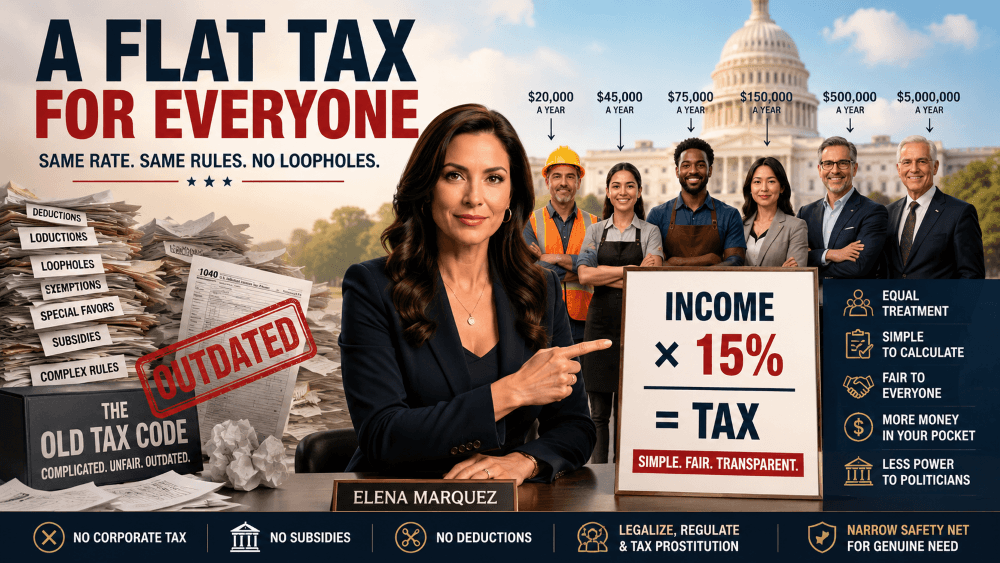
What if filing your taxes required nothing more complicated than a calculator?
Under a flat tax system, the basic calculation could be remarkably simple:
How much did you earn? × 15% = How much you owe.
No tax brackets. No personal exemptions. No mortgage deductions. No charitable deductions. No special treatment for capital gains. No complicated credits. No army of accountants searching for loopholes.
Earn $20,000? Pay $3,000.
Earn $100,000? Pay $15,000.
Earn $1 million? Pay $150,000.
Earn $1 billion? Pay $150 million.
The 15% rate is only an example. Perhaps the correct number is 12%, 18%, or 20%. The important principle is that the same percentage should apply to everyone and every form of personal income.
I believe such a system deserves serious consideration in the United States and Canada.
Why Consider a Flat Tax System?
Today’s tax codes are extraordinarily complicated.
Governments don’t simply collect taxes. They use the tax system to encourage homeownership, retirement savings, charitable donations, certain industries, particular investments, having children, buying particular products, and countless other activities.
Every exception creates another opportunity for lobbying and tax planning.
A flat tax system would start with a different philosophy:
Government collects taxes. Individuals decide how to spend their money.
The tax code should not be an instrument for rewarding politically favored behavior.
Equal Doesn’t Mean Equal Dollars
Critics might argue that taxing a millionaire and a minimum-wage worker at the same percentage is unfair.
But equal percentages don’t mean equal payments.
At 15%:
- Someone earning $20,000 pays $3,000.
- Someone earning $50,000 pays $7,500.
- Someone earning $500,000 pays $75,000.
- Someone earning $10 million pays $1.5 million.
The successful person still contributes enormously more money.
The difference is that government doesn’t impose an increasingly high marginal income-tax rate simply because someone became more successful.
Tax Every Kind of Personal Income at the Same Rate
A genuine flat tax system shouldn’t distinguish unnecessarily between different sources of income.
Wages, business profits distributed to individuals, dividends, interest, realized capital gains, rental profits, and other personal income would generally face the same 15% rate.
Why should someone earning money by working receive one tax treatment while someone earning money by investing receives another?
The objective should be neutrality.
Of course, determining actual economic income still requires accounting. A business receiving $500,000 in revenue while spending $400,000 operating the business hasn’t earned $500,000.
But once actual income has been determined, the tax calculation should be simple.
Income × tax rate = tax owed.
Add a Universal Consumption Tax
I would also consider a 10% national consumption tax.
Again, universality matters.
Instead of politicians deciding which products deserve preferential treatment, the tax would generally apply at the same rate.
Buy something for $10? The consumption tax is $1.
Buy something for $100,000? The consumption tax is $10,000.
This would broaden the tax base and ensure that people contribute not only when they earn money but also when they consume.
There is an important objection: consumption taxes tend to consume a larger percentage of a low-income household’s resources because poorer households generally spend a larger proportion of their income.
I recognize that objection. But the purpose of this proposal is precisely to ask whether simplicity, universality and transparency should take priority over using the tax code to redistribute income.
Eliminate the Corporate Income Tax
One of the more radical components of my proposed flat tax system would be eliminating corporate income taxes.
Corporations are legal entities, but ultimately the economic burden of taxation falls on people.
Depending on economic conditions, corporate taxes can ultimately affect:
- shareholders through lower returns;
- workers through lower compensation;
- customers through higher prices; and
- investment through lower returns on capital.
Economists disagree about exactly how that burden is divided, particularly between shareholders and workers. But corporations cannot literally bear economic costs independently of the human beings connected to them.
Instead of taxing corporate profits and then potentially taxing shareholders again when profits reach them, I would prefer taxation to occur primarily at the individual level.
Let companies reinvest and compete.
Tax the people receiving economic income rather than pretending corporations exist independently from people.
Eliminate Subsidies—Including Subsidies for Business
Tax reform shouldn’t only take benefits away from individuals.
Businesses should lose their special treatment too.
No farm subsidies simply because an industry has political influence. No special subsidies for oil companies, technology manufacturers, automakers, film producers, renewable-energy companies, or whichever industry happens to be politically fashionable.
If a business cannot survive without continually receiving taxpayer money, we should ask whether taxpayers should be forced to keep it alive.
Markets work best when businesses succeed by satisfying customers rather than politicians.
And this principle should apply to wealthy corporations just as strictly as it applies to poor individuals:
No special favors.
Eliminate Tax Deductions
I would eliminate most personal tax deductions.
That includes preferential deductions or exemptions associated with:
- mortgage interest;
- charitable contributions;
- nonprofit organizations;
- religious organizations;
- politically favored investments; and
- other special-interest provisions.
If I want to donate $1,000 to my favorite charity, I should do it because I believe in its mission—not because taxpayers subsidize part of my donation through the tax code.
Likewise, someone who rents shouldn’t effectively subsidize someone else’s decision to buy a house.
Churches and other religious organizations should operate because their members voluntarily support them, not because government provides special economic privileges unavailable to everyone else.
A flat tax system should contain as few exceptions as practically possible.
Legalize, Regulate and Tax Prostitution
Tax reform also raises a larger question: why prohibit economic activities between consenting adults that will occur regardless of prohibition?
Prostitution is an obvious example.
It exists whether governments permit it or not. Criminalization can push the activity underground, where workers may be more reluctant to report violence, exploitation or dangerous working conditions.
I would prefer legalization and regulation of consensual adult sex work.
Income earned through legal prostitution would then be treated exactly like other income:
Income × 15% = tax owed.
Legalization would also make it easier to establish health and safety rules and focus law enforcement resources on coercion, trafficking, exploitation of minors, and violence.
The principle isn’t that government approves of prostitution.
The principle is that government doesn’t need to approve of an activity before allowing consenting adults to engage in it.
Separate Welfare From the Tax Code
If society decides that certain people genuinely require assistance, provide that assistance transparently rather than hiding redistribution throughout the tax code.
I would favor a much narrower safety net focused on genuine need.
Programs could prioritize circumstances such as severe disability, catastrophic hardship, temporary unemployment following employment, and people genuinely incapable of supporting themselves.
Eligibility should be objectively defined and periodically verified when circumstances can change.
Most importantly, benefits should be structured so that working more never makes someone financially worse off.
Benefits should gradually decline as earned income increases rather than disappearing suddenly when someone crosses an arbitrary threshold.
The objective of welfare should be helping people through genuine hardship—not making government dependency an economically attractive long-term alternative to employment.
Make Government Spending Transparent
Tax reform should also change how politicians talk about spending.
Suppose Congress proposes a new $100 billion program.
“$100 billion” sounds abstract.
Instead, taxpayers should be told approximately what the program will cost them.
Better still, major permanent spending increases could include an estimate of the tax rate necessary to finance them.
Imagine seeing:
Current flat income tax: 15%
Proposed program requires approximately: 0.3 percentage points
New required tax rate: approximately 15.3%
Suddenly government spending isn’t free.
Voters can still decide that the program is worth paying for. But politicians would have a harder time promising benefits without discussing their costs.
That is more democratic.
The Goal Isn’t to Punish Poverty
This proposal shouldn’t be interpreted as hostility toward poor people.
The objective is to create rules that don’t punish success or reward dependency.
Someone who works another hour should become wealthier.
Someone who saves should become wealthier.
Someone who starts a successful company shouldn’t face an increasingly punitive marginal income-tax rate simply because the company succeeded.
And corporations shouldn’t receive special treatment merely because they have powerful lobbyists.
The same principle should operate throughout the system:
No special favors for rich people. No special favors for poor people.
Help should exist for genuine hardship, but the normal expectation for people capable of supporting themselves should be self-sufficiency.
A Flat Tax System Would Make Government More Accountable
The greatest advantage of a flat tax system may not actually be lower taxes.
It may be transparency.
The citizen knows the rate.
The billionaire knows the rate.
The politician knows the rate.
If government wants more money, politicians have to explain why the rate needs to increase.
There would be fewer deductions for politicians to distribute, fewer loopholes for lobbyists to fight over, and fewer opportunities for government to manipulate behavior through the tax code.
Perhaps 15% isn’t the correct number. That should be debated.
Perhaps a 10% consumption tax is too high or too low. That should be debated too.
But I think the underlying principle deserves consideration:
Make taxation simple, broad, transparent and equal.
Tax income at the same rate. Tax consumption at the same rate. Eliminate corporate income taxes. Eliminate subsidies. Eliminate most deductions. Legalize and tax economic activity between consenting adults. Reserve welfare for genuine need.
Then let individuals decide what to do with the money they have left.
A tax code shouldn’t need thousands of pages to explain who owes what.
Maybe the fairest tax system is also the one almost everyone can understand.
Frequently Asked Questions
What is a flat tax system?
A flat tax system applies the same tax rate to taxable income regardless of how much an individual earns. Under the proposal discussed here, the illustrative rate is 15% without a basic personal exemption.
Would rich people pay more under a flat tax?
They would pay substantially more dollars but the same percentage. At a 15% rate, someone earning $50,000 would pay $7,500 while someone earning $5 million would pay $750,000.
Why eliminate corporate income taxes?
Corporations ultimately distribute economic gains and losses among people, including shareholders, workers and customers. This proposal would shift taxation toward individuals receiving income rather than taxing corporate profits separately.
Would a flat tax eliminate welfare programs?
Not necessarily. Under this proposal, taxation and welfare would be separated. A narrower safety net could continue helping people facing genuine hardship while benefits would be structured to preserve incentives to work.