How does a city with little farmland, few natural resources, and no great mineral wealth become one of the richest commercial centers in the world?
Venice found the answer centuries ago:
Trade.
Built on islands in a lagoon along the Adriatic Sea, Venice transformed geographic limitations into an entrepreneurial advantage.
Venetian merchants connected European markets with Constantinople, the eastern Mediterranean, and commercial networks extending toward Asia.
But Venice’s greatest contribution to entrepreneurship went beyond buying and selling goods.
Its merchants, investors, shipbuilders, bankers, insurers, and government institutions created an increasingly sophisticated commercial ecosystem.
Capital could be pooled.
Risk could be shared.
Ships could be produced systematically.
Credit could finance transactions.
Information could travel between distant markets.
Venice demonstrated an important entrepreneurial principle:
You do not have to eliminate risk to build a great business. You have to learn how to manage it.
Why Did Venice Become a Trading Power?
Venice was an unlikely place for a great economic power to emerge.
Its location offered limited agricultural land.
The surrounding lagoon did not contain the resources necessary to support a large and prosperous city by itself.
Venice therefore had to look outward.
It needed grain.
Timber.
Metals.
Salt and other commodities.
Luxury goods.
Foreign markets supplied what Venice lacked.
In return, Venetian merchants became specialists in transporting, financing, processing, and reselling goods.
Necessity encouraged commerce.
Venice Occupied an Ideal Trading Location
What Venice lacked in natural resources, it gained through geography.
The city sat near the intersection of several commercial worlds.
To the west were European markets.
To the east stood Constantinople and the Byzantine world.
Beyond them stretched commercial connections toward the Middle East and Asia.
To the north lay continental Europe.
To the south was the Mediterranean.
Venetian merchants became intermediaries.
They bought goods where they were available and transported them to places where customers valued them more highly.
The difference created profit.
Modern international trade still operates according to the same principle.
What Did Venetian Merchants Trade?
Venetian merchants participated in the exchange of an enormous variety of goods.
These included:
- Spices
- Silk
- Cotton
- Sugar
- Grain
- Salt
- Timber
- Metals
- Textiles
- Dyes
- Glass
- Luxury goods
Some products originated thousands of kilometers from Venice.
The Venetian merchant’s competitive advantage was therefore not necessarily manufacturing the product.
It was knowing:
Where can I buy it?
Where can I sell it?
How can I transport it?
How can I finance the transaction?
And is the potential profit worth the risk?
Those remain fundamental entrepreneurial questions.
Venetian Merchants Became Professional Entrepreneurs
The successful Venetian merchant needed many skills.
He might simultaneously operate as:
- Investor
- Negotiator
- Logistics coordinator
- Currency trader
- Risk manager
- Market researcher
- International salesperson
- Partnership manager
Long-distance trade required much more than purchasing goods cheaply and selling them at a higher price.
Merchants needed knowledge of foreign markets, political conditions, currencies, shipping, contracts, and business partners.
Entrepreneurship was becoming a sophisticated profession.
The Commenda Allowed Investors and Merchants to Share Risk
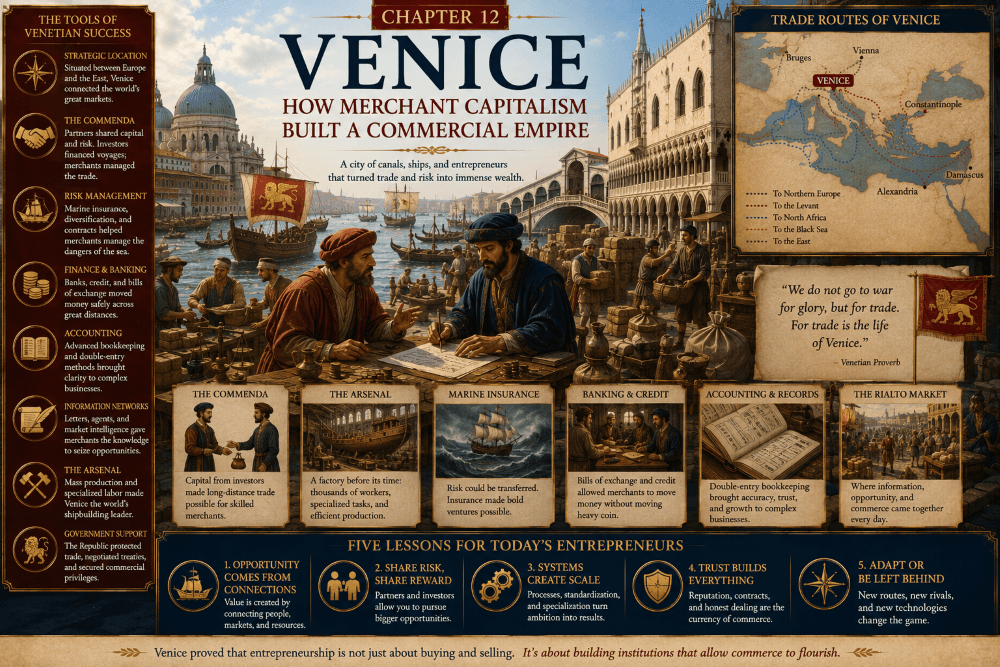
One of the important institutions of medieval Mediterranean commerce was the commenda.
Its precise structure could vary, but the principle was relatively simple.
One party supplied capital.
Another merchant conducted the trading venture.
When the voyage ended, the original capital was returned and profits were divided according to their agreement.
This solved an important entrepreneurial problem.
An investor with money did not need to personally sail across the Mediterranean.
A skilled merchant without sufficient capital could pursue a much larger opportunity.
Money and talent could come from different people.
Was the Commenda the Beginning of Venture Capital?
The comparison should not be taken too literally, but the underlying principle looks remarkably familiar.
Modern venture capital connects:
Investors who possess capital
with
Entrepreneurs who possess ideas, expertise, and execution ability.
Both expect to benefit if the venture succeeds.
The commenda accomplished something conceptually similar in medieval commerce.
It allowed capital and entrepreneurial talent to cooperate.
Importantly, Venice did not invent this principle in isolation.
Related partnership structures existed elsewhere, including the qirad and mudaraba arrangements discussed in our chapter on the Islamic Golden Age.
Commercial ideas moved between civilizations just as products did.
Venice Learned How to Structure Risk
A trading voyage could produce tremendous profits.
It could also end disastrously.
Ships sank.
Pirates attacked.
Wars closed markets.
Cargo spoiled.
Prices changed.
Merchants disappeared.
The solution was not to avoid risk completely.
Doing so would also eliminate opportunity.
Instead, merchants developed ways of distributing and managing risk.
They could:
- Form partnerships
- Invest in multiple ventures
- Use contracts
- Extend or receive credit
- Work through trusted agents
- Insure maritime risks
Risk increasingly became something that could be structured.
That was a major step in the development of entrepreneurship.
Marine Insurance Made Bigger Risks Possible
By the later medieval period, recognizable forms of marine insurance had developed in Italian commercial centers.
The idea was powerful.
A merchant could pay another party to assume specified financial risks associated with a voyage.
If the covered disaster occurred, the insurer absorbed an agreed financial loss.
Insurance did not make the ocean safer.
It made the financial consequences of disaster more manageable.
That encouraged entrepreneurs to pursue opportunities they might otherwise consider too dangerous.
Modern entrepreneurship still depends heavily on insurance for exactly this reason.
The Venetian Arsenal Revolutionized Shipbuilding
Venice needed ships on an enormous scale.
Its answer was the Venetian Arsenal.
The Arsenal developed into one of the largest industrial complexes of the medieval and early modern world.
Thousands of workers could be involved in producing and maintaining ships and naval equipment.
Instead of requiring one craftsman to build an entire vessel, production could be divided among specialists.
Workers produced components such as:
- Hull sections
- Masts
- Oars
- Sails
- Ropes
- Rigging
- Weapons
Organized workflows and increasingly standardized components made production more efficient.
Centuries before modern factories, Venice demonstrated the power of systematic production.
The Arsenal Demonstrated the Power of Processes
A business dependent entirely on one exceptionally talented individual is difficult to scale.
A business built around repeatable processes can grow.
The Venetian Arsenal illustrates this distinction.
Complex work was divided into specialized tasks.
Workers developed expertise.
Materials moved through organized production processes.
The system became more important than any single worker.
Modern factories use the same principle.
So do restaurants, hospitals, airlines, software companies, and logistics businesses.
Systems make scale possible.
The Rialto Became the Heart of Venetian Commerce
The Rialto became Venice’s great commercial center.
Merchants gathered there.
Currencies were exchanged.
Contracts were negotiated.
Goods changed hands.
Financing was arranged.
Information circulated.
The concentration of commercial participants created something modern economists recognize immediately:
Network effects.
Buyers attracted sellers.
Sellers attracted buyers.
Investors attracted merchants.
Merchants attracted financial services.
Commerce attracted more commerce.
The marketplace became increasingly valuable because everyone else was already there.
Banking Became Commercial Infrastructure
International commerce created financial complexity.
Venetian merchants dealt with multiple currencies.
Large payments had to be settled.
Businesses required credit.
Governments borrowed money.
Merchants needed trustworthy financial intermediaries.
Money changers and bankers became increasingly important.
Banking began functioning like infrastructure.
Roads helped move products.
Ships helped move cargo.
Banks helped move capital.
A sophisticated trading economy needed all three.
The Venetian Ducat Became Trusted Money
International trade becomes difficult when merchants cannot trust currency.
Medieval merchants encountered coins from many kingdoms and cities.
Their weight, purity, and value varied.
Venice introduced its famous gold ducat in 1284.
Its reliable gold content helped the ducat become widely respected in international commerce.
That reputation demonstrates something fundamental about money.
A currency becomes useful when people trust it.
Trust reduces the friction of exchange.
Credit Expanded Business Opportunities
Suppose a merchant discovered an excellent opportunity but did not possess enough cash immediately.
Without credit, the opportunity might disappear.
Credit allowed commerce to move faster.
Goods could be purchased today against future payment.
But credit created another problem.
Trust.
Would the borrower repay?
When?
Could the lender verify the merchant’s reputation?
As credit expanded, accounting, contracts, record-keeping, and reputation became increasingly important.
Finance and information became inseparable.
Accounting Became Essential
A small merchant might remember most transactions.
An international merchant could not.
Imagine managing:
- Several voyages
- Multiple investors
- Foreign currencies
- Inventory in different cities
- Debts to suppliers
- Customers owing money
- Investments in other businesses
Without accurate records, the merchant could become wealthy on paper and bankrupt in reality.
Italian commercial centers played an important role in the development and spread of sophisticated bookkeeping practices that eventually became associated with double-entry accounting.
Accounting allowed entrepreneurs to understand what was actually happening inside increasingly complex businesses.
Information Was One of Venice’s Most Valuable Commodities
Venetian merchants constantly needed information.
What was pepper selling for in Alexandria?
Was grain scarce in Constantinople?
Had pirates appeared along a shipping route?
Was war likely?
Had another merchant already flooded a market with competing goods?
Agents and business partners sent commercial correspondence between cities.
News about prices, politics, shipping, and supply became economically valuable.
The entrepreneur who received accurate information first often gained an advantage.
Centuries later, Wall Street traders, commodity merchants, and technology companies still compete partly on the same resource:
Information.
Government and Business Worked Together
The Venetian Republic understood that commerce was the foundation of its prosperity.
Government therefore played an active role in supporting trade.
It:
- Protected shipping routes
- Negotiated treaties
- Maintained the Arsenal
- Regulated markets
- Organized commercial convoys
- Secured trading privileges
- Used diplomacy to open markets
Private entrepreneurship operated inside public commercial infrastructure.
Venice demonstrates that governments and entrepreneurs do not exist in completely separate worlds.
Institutions shape the opportunities businesses can pursue.
Marco Polo Expanded the Entrepreneurial Imagination
Few Venetian merchants became more famous than Marco Polo.
His father Niccolò and uncle Maffeo traveled extensively through Asia, and Marco later joined them.
The account associated with Marco Polo described distant cities, products, customs, wealth, and markets to European readers.
Historians continue debating aspects of the narrative.
Its influence, however, was enormous.
It expanded Europe’s imagination of what existed beyond familiar markets.
Entrepreneurs need information.
But they also need imagination.
You cannot pursue an opportunity you do not know exists.
Venice Was an Early Commercial Platform
One way to understand Venice is to think of it as a platform.
It connected:
- Buyers with sellers
- Investors with merchants
- Europe with eastern markets
- Ships with cargo
- Capital with opportunity
- Manufacturers with customers
- Information with decision-makers
Venice did not need to manufacture every product passing through its markets.
Its value came partly from facilitating transactions between other people.
Modern businesses frequently follow this model.
Amazon connects buyers and sellers.
Payment networks connect merchants and consumers.
Financial markets connect investors and companies.
Digital platforms connect creators with audiences.
Connecting people can itself become an enormously valuable business.
The Dark Side of Venetian Commerce
Venice’s economic achievements should not be romanticized.
Mediterranean commerce also involved:
- Warfare
- Political coercion
- Colonial domination
- Exploitation
- Slavery
Venetian merchants participated in slave trading during different periods, while military and political power sometimes helped secure favorable commercial arrangements.
This reminds us of an important distinction.
Economic efficiency does not automatically produce ethical outcomes.
Entrepreneurship creates powerful tools for organizing people and resources.
Those tools can create prosperity.
They can also facilitate exploitation.
The history of entrepreneurship therefore needs to examine not only how wealth was created, but also who benefited and who paid the costs.
Why Did Venice Decline?
Venice remained an important commercial power for centuries.
But the global economy changed.
Portuguese navigators developed maritime routes around Africa toward India.
Atlantic trade expanded.
Spain and Portugal gained prominence.
Later, the Netherlands and England became major commercial powers.
Venice’s location had not moved.
But the world’s most valuable trade routes had.
This offers entrepreneurs another timeless lesson.
Competitive advantages expire.
Technology changes.
Markets change.
Distribution changes.
Customer preferences change.
A strategy that dominates one era may become obsolete in another.
Why Venice Matters to Modern Entrepreneurs
Venice brought together many tools developed by earlier civilizations.
Phoenician-style commercial networks.
Roman-style infrastructure.
Islamic and Mediterranean partnership traditions.
International finance.
Contracts.
Credit.
Accounting.
Insurance.
Large-scale manufacturing.
Market intelligence.
Government-business cooperation.
The result looked increasingly familiar.
A commercial ecosystem.
Entrepreneurship was no longer merely an individual merchant buying and selling goods.
Entire institutions were developing around entrepreneurs to help them finance, manage, protect, and expand their businesses.
The Entrepreneur’s Toolbox
Risk-Sharing and Commercial Institutions
Great entrepreneurs take risks.
But successful entrepreneurs rarely take every risk personally.
They structure risk.
Partnerships divide it.
Insurance transfers it.
Contracts define it.
Accounting measures it.
Diversification spreads it.
Institutions reduce uncertainty.
Venice demonstrated that entrepreneurship becomes more powerful when risk can be distributed among people and institutions capable of bearing it.
Five Lessons Modern Entrepreneurs Can Learn
1. You Don’t Need to Own Everything
Venice possessed relatively few natural resources but prospered by connecting people who had resources with people who wanted them.
2. Combine Capital With Talent
Investors and entrepreneurs can create opportunities neither could pursue as effectively alone.
3. Build Systems
Repeatable processes allow organizations to grow beyond the abilities of individual workers.
4. Manage Risk
Entrepreneurship does not require reckless risk-taking. It requires understanding, distributing, and pricing uncertainty.
5. Never Assume Your Advantage Will Last
Venice dominated important trade routes for centuries, but new technologies and routes eventually changed the competitive landscape.
Frequently Asked Questions
Why did Venice become wealthy?
Venice became wealthy largely through maritime trade, connecting European markets with the Byzantine world, the eastern Mediterranean, and broader international trading networks.
What was the Venetian commenda?
The commenda was a commercial partnership in which investors could provide capital to merchants conducting trading ventures, with profits divided according to agreed terms.
What was the Venetian Arsenal?
The Venetian Arsenal was a massive shipbuilding and naval complex that used specialization, organized workflows, and standardized production methods to construct and maintain ships efficiently.
Why was the Venetian ducat important?
Introduced in 1284, the gold ducat earned international trust because of its reliable weight and gold content, making it an important currency for long-distance commerce.
Did Venice invent banking?
No. Banking existed thousands of years before medieval Venice. Venice’s importance lies in how financial institutions became integrated into a sophisticated international commercial economy.
Did Venice invent double-entry bookkeeping?
No single city or person can simply be credited with inventing the entire system. Italian merchants played an important role in developing and spreading increasingly sophisticated bookkeeping practices, while Luca Pacioli later published a famous description of double-entry bookkeeping in 1494.
What entrepreneurial lesson does Venice teach?
Venice demonstrates the power of risk-sharing and commercial institutions. Partnerships, banking, insurance, accounting, and government-supported infrastructure allowed merchants to pursue opportunities larger than individuals could manage alone.
Continue the Journey
Venice showed how merchants, investors, shipbuilders, bankers, insurers, and governments could combine their resources within a sophisticated commercial ecosystem.
But another Italian city was about to transform finance.
Florence.
And one family would become synonymous with banking, wealth, politics, art, and power:
The Medici.
They did not invent banking.
Instead, they demonstrated how banking itself could become an international enterprise.
Branches could operate in different cities.
Managers could administer distant offices.
Capital could cross borders.
Information could move between branches.
And profits generated through commerce could finance culture on an extraordinary scale.
In Chapter 13, we’ll explore:
The Medici: How Banking Became an International Business.
The Entrepreneur’s Toolkit So Far
| Chapter | Entrepreneurial Contribution |
|---|---|
| Chapter 1 | Exchange |
| Chapter 2 | Surplus |
| Chapter 3 | Accounting |
| Chapter 4 | Professional Merchants |
| Chapter 5 | Money |
| Chapter 6 | Standardization |
| Chapter 7 | Continuous Improvement |
| Chapter 8 | Networks |
| Chapter 9 | Competition |
| Chapter 10 | Scale |
| Chapter 11 | Knowledge & Financial Innovation |
| Chapter 12 | Risk-Sharing & Commercial Institutions |
The pattern is becoming increasingly recognizable.
Early entrepreneurs needed tools.
Later entrepreneurs needed systems of tools working together.
Venice represents an important transition between the two.
North Star
Venice demonstrated that entrepreneurs become more powerful when surrounded by institutions capable of sharing risk, supplying capital, transmitting information, and facilitating trade. Its greatest achievement was not a single product—it was building a commercial ecosystem in which entrepreneurship itself could scale.
Related Articles
- The Phoenicians: How Maritime Trade Connected the Ancient World
- Ancient Greece: How Competition and Markets Shaped Entrepreneurship
- Ancient Rome: How Infrastructure, Law, and Scale Built an Economic Empire
- The Islamic Golden Age: How Knowledge, Finance, and Global Trade Transformed Entrepreneurship
- The Silk Road Trade: How Ancient Networks Built Global Commerce
- Marcus Licinius Crassus: The Richest Man in Rome
- Indian Ocean Trade: The Ancient World’s Monsoon Economy
- Viking Trade: How Raiders Became Medieval Merchants
About The History of Entrepreneurship
This article is part of The History of Entrepreneurship, an ongoing series exploring how civilizations, merchants, technologies, institutions, and entrepreneurs gradually created the foundations of modern business.
Rather than treating entrepreneurship as a recent invention, the series follows its evolution across thousands of years.
Each chapter asks one central question:
What entrepreneurial tool did this civilization, institution, or entrepreneur add to the world?