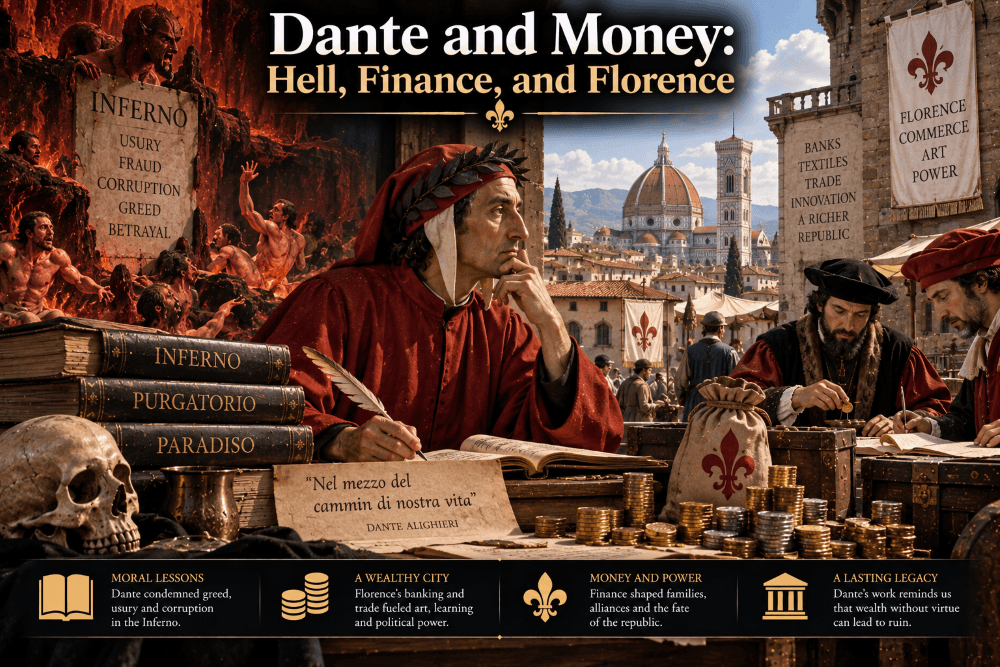
The relationship between Dante and money is far stranger and more revealing than most readers of the Divine Comedy realize. Dante Alighieri (May 1265 – September 14, 1321) lived through one of history’s great financial transformations, watching feudal Florence turn into a booming commercial city built on banking, trade, and credit. His reaction wasn’t admiration. It was fury, fury he channeled into some of the most severe punishments in his entire vision of hell.
Money as a Social Technology
Before examining Dante’s specific grievances, it helps to understand what money actually represented during this period of transformation.
- Money functions as far more than a neutral number on a balance sheet or a simple physical commodity. It operates as a genuine social technology, a shared system enabling cooperation between strangers.
- The rise of sophisticated monetary and credit systems in medieval Italy helped move society away from organization based purely on brute force, as with feudal kings, or purely on religious authority, as with the papacy.
- This shift toward trade-based, credit-enabled commerce represented a genuinely new way of organizing economic and social life.
Understanding this larger shift is essential to understanding why Dante reacted to it with such intensity.
Florence as a Medieval Prototype
A City Transformed
Dante lived in Florence during a period of extraordinary demographic and economic change, as the city shifted from a feudal society toward a free, guild-based, trade-driven commercial hub.
- Florence’s economy increasingly centered on banking, textile manufacturing, and long-distance trade rather than traditional agricultural feudalism.
- Guilds, associations organizing merchants and craftsmen by trade, gained substantial political and economic power within the city.
- Some historians have drawn comparisons between Florence’s rapid commercial transformation during this period and the rise of major modern financial and trading hubs.
A City of Bankers
Florentine banking families developed increasingly sophisticated financial practices during Dante’s lifetime, laying groundwork for banking systems that would influence Europe for centuries.
- Florentine bankers extended credit, financed trade ventures, and developed early accounting practices that supported the city’s commercial expansion.
- This financial sophistication generated enormous wealth for Florence’s merchant and banking class.
- It also generated significant social tension, as traditional feudal and religious authorities watched their influence erode alongside this new commercial power.
Dante, born into a family with modest noble standing rather than mercantile wealth, watched this transformation from a position that likely shaped his deeply ambivalent feelings toward it.
Dante and Money in the Divine Comedy
Financial Sin in the Inferno
Dante’s vision of hell in the Inferno, a work that significantly shaped later Christian concepts of damnation, reserved severe punishment for specific financial behaviors he viewed as corrosive to the social order.
- Dante placed usurers, those who charged interest on lent money, in the seventh circle of hell.
- He placed currency manipulators and counterfeiters even deeper, in the eighth circle, just one circle above Lucifer himself.
- This placement reflects just how seriously Dante regarded these particular financial sins compared to many other transgressions.
Why Usury Troubled Dante So Deeply
Dante’s placement of usurers reflects broader medieval Christian anxieties about lending money at interest.
- Usury was widely viewed by the Church and traditional nobility as a disruptive, almost alchemical force, generating wealth from money itself rather than from land, labor, or legitimate trade.
- This practice appeared to upend a traditional social order that placed inherited land and noble status above commercial wealth.
- Dante’s severe treatment of usurers reflects his broader discomfort with a rapidly changing society where financial cleverness increasingly rivaled traditional aristocratic status.
Why Counterfeiting Ranked Even Worse
Dante’s decision to place currency manipulators deeper in hell than usurers reveals something important about what he considered the ultimate financial betrayal.
- Debasing currency, such as adding copper to Florence’s trusted golden florin, directly threatened the foundational credibility underlying the entire city-state’s commercial system.
- Unlike usury, which exploited the existing system, currency debasement attacked the very trust that made organized commerce possible in the first place.
- This distinction suggests Dante understood, even if he resented it, just how much Florence’s prosperity depended on shared trust in its monetary system.
The Irony Behind Dante’s Outrage
A Moralist Within the System
Despite his fierce moral condemnation of bankers, usurers, and the broader commercialization of Florentine society, Dante’s own life reveals a more complicated relationship with the financial world he criticized.
- Historical records indicate Dante sent his own children to “reckoning schools,” specialized mercantile schools that taught advanced mathematics and practical banking skills.
- These schools existed specifically to train the next generation of merchants and financiers, the very class Dante’s poetry condemned so harshly.
- This choice suggests Dante recognized the practical necessity of financial literacy, even while morally condemning the broader system that made it valuable.
A Familiar Pattern
This tension between moral condemnation and practical participation is a pattern that appears repeatedly throughout economic history.
- Dante’s position resembles a modern critic of powerful financial or technological institutions who nonetheless ensures their own children gain the skills needed to succeed within those very systems.
- This apparent contradiction doesn’t necessarily undermine his critique. It may simply reflect the genuine difficulty of navigating profound social transformation with consistency.
- Understanding this complexity adds important nuance to how we interpret Dante’s harsh literary treatment of medieval finance.
Lessons from Dante and Money
- Financial transformation generates real social anxiety. Dante’s fury reflects genuine unease about a changing social order, not simply abstract moral disapproval.
- Trust is the foundation of monetary systems. Dante’s harsher treatment of counterfeiters over usurers reveals an intuitive understanding that currency integrity underpins all commercial activity.
- Critics often participate in the systems they condemn. Dante’s own choices reveal how difficult it is to fully separate personal practicality from ideological conviction.
Frequently Asked Questions
Why did Dante place usurers in hell? Dante viewed usury, or charging interest on lent money, as a disruptive force that generated wealth from money itself rather than legitimate labor or trade, threatening the traditional social order.
Why did Dante punish currency manipulators more harshly than usurers? Debasing currency directly attacked the trust underlying Florence’s entire commercial system, which Dante appears to have viewed as an even more fundamental betrayal than exploiting existing financial practices.
What were reckoning schools? Reckoning schools were specialized mercantile schools in medieval Florence that taught advanced mathematics and banking skills, training the next generation of merchants and financiers.
Why is Dante’s relationship to money considered ironic? Despite harshly condemning bankers and usurers in his writing, Dante sent his own children to reckoning schools, the very institutions that trained people for the financial world he criticized.