| 📊 Alain’s Holdings — August 17, 2026 | ||||
|---|---|---|---|---|
| Symbol | Name | Price | Change | Change % |
| VOO | Vanguard S&P 500 ETF | 710.27 | -3.44 | -0.48% |
| QQQ | Invesco QQQ Trust | 729.87 | -1.20 | -0.16% |
| XIU.TO | iShares S&P/TSX 60 ETF | 54.68 | -0.14 | -0.26% |
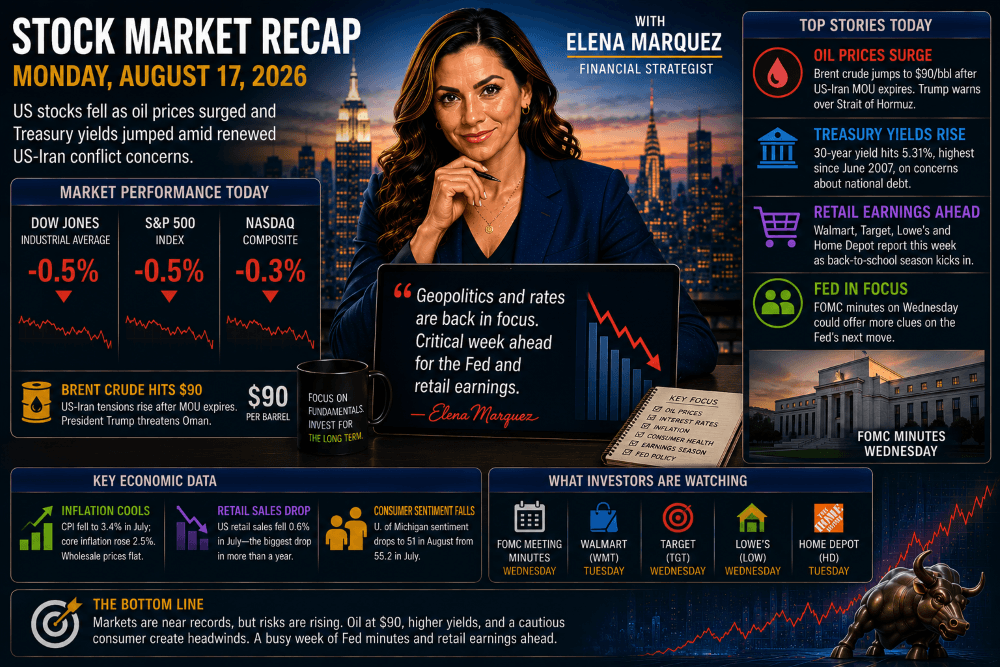
Wall Street started the week in the red Monday as two familiar threats returned to center stage: rising oil prices and rising Treasury yields.
Renewed concerns about the U.S.-Iran conflict pushed Brent crude back to $90 per barrel, while long-term bond yields climbed as investors worried about government debt and the future path of interest rates.
Market Performance
- 📉 Dow Jones Industrial Average: -0.5%
- 📉 S&P 500: -0.5%
- 📉 Nasdaq Composite: -0.3%
The pullback follows three consecutive winning weeks for the S&P 500.
Oil Returns to $90
Geopolitics once again became one of the market’s biggest concerns.
A memorandum of understanding between the United States and Iran expired Monday, raising fears that hostilities could intensify again.
President Trump also indicated that he doesn’t expect the conflict to end soon, adding to uncertainty surrounding the Strait of Hormuz.
Brent crude responded by climbing to approximately $90 per barrel.
That’s particularly important after last week’s encouraging inflation reports.
Consumer inflation eased to 3.4%, while producer prices also came in softer than expected. But another sustained increase in energy prices could threaten that progress.
Higher oil eventually means higher transportation, manufacturing and consumer costs.
And that could complicate the Federal Reserve’s job.
The 30-Year Treasury Yield Hits a 19-Year High
Oil wasn’t the only problem.
Long-term Treasury yields continued rising Monday.
The 30-year Treasury yield climbed to approximately 5.31%, its highest level since June 2007, while the 10-year yield also moved higher.
Investors are increasingly concerned about the enormous supply of government debt required to finance persistent U.S. budget deficits.
Higher Treasury yields matter for stocks because government bonds compete with equities for investor capital.
If investors can earn more than 5% on long-term government debt, expensive stocks become less attractive by comparison.
Higher yields also increase borrowing costs throughout the economy—from mortgages and corporate loans to government financing.
The Fed Is Still a Question Mark
Last week’s economic data gave the Federal Reserve reasons to remain patient.
Inflation cooled.
Employment weakened.
Retail sales declined.
Consumer sentiment deteriorated.
Those developments reduced expectations for an immediate interest-rate increase.
But $90 oil and rising bond yields complicate the picture.
Investors should get another look inside the Fed’s thinking Wednesday when the Federal Open Market Committee meeting minutes are released.
The minutes could reveal how concerned policymakers are about inflation and how seriously officials are considering another rate hike.
Walmart, Target and the American Consumer
This week’s other major story will be retail earnings.
Walmart, Target, Home Depot and Lowe’s are among the major companies reporting results.
Their numbers arrive at an important moment.
Last Friday’s report showed U.S. retail sales declining 0.6% in July, while consumer sentiment fell sharply.
Now investors will get to hear directly from some of America’s largest retailers.
Are consumers trading down?
Are discretionary purchases weakening?
Are higher gasoline prices affecting household budgets?
And how strong is the back-to-school shopping season?
The answers could tell us considerably more about the health of the American consumer than any single economic statistic.
The Bottom Line
Monday’s decline wasn’t dramatic, but the forces behind it deserve attention.
Last week, investors celebrated cooler inflation.
Today, oil returned to $90 per barrel.
Last week, markets increasingly expected the Federal Reserve to remain patient.
Today, the 30-year Treasury yield reached its highest level since 2007.
The market therefore finds itself caught between two competing narratives.
Corporate earnings remain strong and inflation has recently improved.
But geopolitical risk, expensive energy and rising borrowing costs haven’t disappeared.
With the S&P 500 near record territory, investors have little room for unpleasant surprises.
This week’s retail earnings—and Wednesday’s Fed minutes—could tell us whether Monday’s decline was simply another pause in the bull market or the beginning of a more cautious phase.
Other Stock Market blog posts