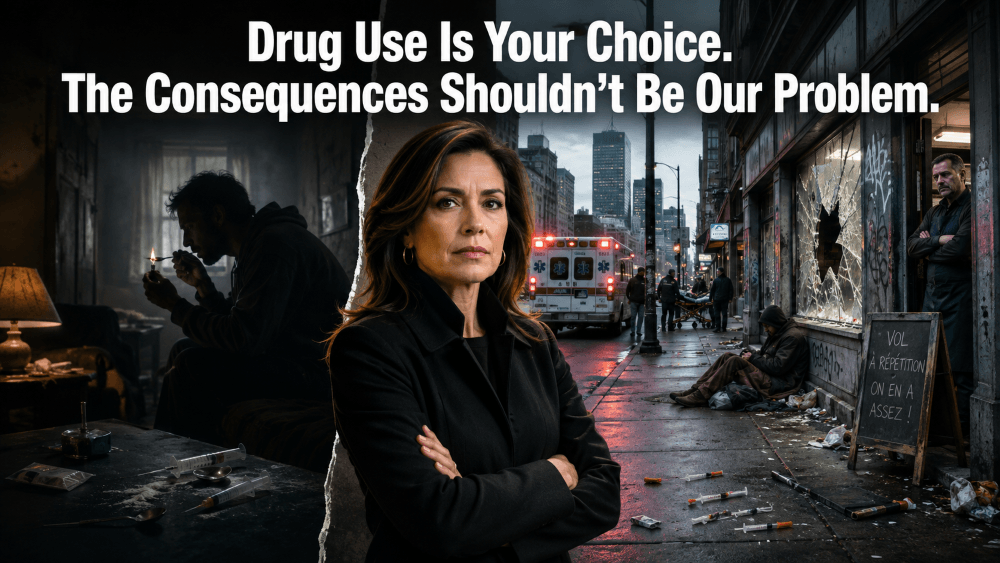
I have a somewhat unusual position on drug policy: I don’t particularly care if adults choose to consume drugs. I don’t even care if you overdose and die. Your body, your choice.
Your body belongs to you. If you want to drink alcohol, smoke marijuana, or put some other substance into your body, I believe you should have considerable freedom to make that decision.
What bothers me is what happens to everyone else.
I don’t want my bicycle stolen because somebody needs money for drugs. I don’t want businesses dealing with theft and vandalism. I don’t want women exploited through prostitution, neighborhoods dominated by dealers, sidewalks covered with discarded needles, or innocent people assaulted by criminals involved in the drug trade.
Drug use may be your choice.
The consequences shouldn’t automatically become our problem.
Drug Policy Should Be About Externalities
Economists have a useful word for this: externalities.
An externality occurs when one person’s decision imposes costs on somebody else.
If you consume cocaine in your home and go to bed, most of the consequences are yours.
But if an addiction becomes so expensive that you start stealing to finance it, somebody else is now paying for your decision.
If drug trafficking creates violent criminal organizations, innocent people pay.
If public spaces become unusable because of open drug consumption, residents and businesses pay.
If addiction contributes to exploitation, emergency-room visits, homelessness and public disorder, taxpayers and communities bear part of the cost.
That changes the nature of the debate.
The question shouldn’t simply be:
Should drugs be legal or illegal?
A better question is:
How can we preserve as much individual freedom as possible while minimizing the harm that drug consumption imposes on everybody else?
We Have Already Done This With Alcohol
Alcohol provides an interesting model.
Alcohol can destroy lives. It contributes to addiction, accidents, violence and disease.
Yet most Western societies decided long ago that prohibition wasn’t a particularly successful solution.
Instead, we created friction.
You generally have to reach a certain age to buy alcohol. Businesses need licenses to sell it. Drinking is prohibited in many public places. Drunk driving can lead to serious criminal penalties.
We don’t say:
“You are addicted to alcohol, therefore it is understandable that you drove drunk.”
We can have compassion for the addiction while still holding the person responsible for endangering everybody else.
That’s an important distinction that should apply to drug policy as well.
Tobacco Shows How Friction Can Change a Culture
Tobacco might provide an even better example.
Canada didn’t eliminate smoking by imprisoning smokers.
Instead, society gradually made smoking less attractive and more difficult.
Governments taxed cigarettes. Advertising was restricted. Smoking disappeared from restaurants, airplanes, offices and many public spaces. Cigarette packages received increasingly graphic health warnings.
At the same time, decades of public-health campaigns changed our perception of cigarettes.
The results have been remarkable.
Health Canada reports that the percentage of Canadians using any tobacco product fell from 29% in 2001 to an estimated 13% in 2024. Adult cigarette smoking was down to about 11% in 2024.
We didn’t have to pretend cigarettes were harmless.
We told people the truth.
Smoking is dangerous. Don’t start. If you already smoke, we will help you quit.
Why shouldn’t some of those principles influence our drug policy?
Marijuana Offers Another Interesting Experiment
Canada took a different approach with cannabis.
Rather than leaving the entire industry to criminals, Canada legalized and regulated recreational marijuana in 2018.
That allows governments to control production and legal distribution, impose age restrictions and product standards, and move at least part of the business away from organized crime while collecting taxes that benefit society.
Cannabis isn’t harmless simply because it’s legal.
Neither is alcohol.
Legalization is simply one tool society can use when the costs of prohibition appear greater than the costs of regulated availability.
But that doesn’t mean the same drug policy necessarily makes sense for every substance.
Heroin, fentanyl, methamphetamine and cocaine can present very different risks.
Make Dangerous Drugs Harder to Use
This is where I believe Western drug policy has sometimes lost its way.
In trying not to stigmatize people suffering from addiction, we risk removing too much stigma from the behavior itself.
Those aren’t the same thing.
We can treat people with dignity while still communicating an extremely strong social message:
Taking heroin, fentanyl or methamphetamine is dangerous. Don’t do it.
We did something similar with cigarettes.
We didn’t need to hate smokers to make smoking socially undesirable.
Schools should provide honest, graphic education about what severe addiction can do to people’s health, finances, relationships and futures.
Public-health campaigns shouldn’t glamorize drugs or sanitize their consequences.
There should be friction.
Lots of it.
Drug Policy Should Distinguish Users From Criminals
At the same time, I don’t think everyone connected with drugs belongs in the same category.
There’s an enormous difference between an addicted person possessing heroin and an organized criminal importing fentanyl.
There’s also a difference between drug consumption and crimes committed to finance it.
My principle would be simple:
Addiction can explain criminal behavior. It shouldn’t automatically excuse it.
If you steal someone’s bicycle, you should be held accountable for stealing the bicycle.
If you rob a convenience store, you should be prosecuted for robbery.
If you assault somebody, you should face consequences for assault.
If you operate an organization that imports and distributes highly dangerous drugs, the penalties should be considerably more serious.
And people who deliberately recruit new customers, sell drugs to children, use violence to control markets or operate large trafficking organizations deserve particularly severe punishment.
Compassion for addiction doesn’t require indifference toward its victims.
What Singapore Can Teach Us About Drug Policy
Singapore sits near the opposite end of the drug-policy spectrum from many Western countries.
Its approach is unapologetically strict.
Singapore’s Central Narcotics Bureau describes its strategy as a combination of preventive education, tough anti-drug laws, rigorous enforcement, rehabilitation, aftercare and international cooperation.
Consumption itself is illegal. Under Singapore’s Misuse of Drugs Act, consumption of controlled drugs can result in imprisonment, while trafficking can result in extremely severe punishment. Singapore also sends some drug users into treatment and rehabilitation programs.
Singapore says its drug situation remains generally under control, although its authorities acknowledge worrying trends involving drugs such as methamphetamine, heroin and cannabis.
There are elements of Singapore’s system that I would not import.
Singapore uses corporal punishment and retains the death penalty for certain serious trafficking offences.
Singapore is well known for taking a tough approach to crime, and that strict enforcement is one reason its streets have relatively low levels of violent crime and theft. Laws are enforced consistently, penalties for many offenses can be severe, and there is a strong expectation that public rules will be respected. The perceived likelihood of being caught and punished can act as a powerful deterrent, making people think twice before committing crimes. Singapore’s safety cannot be attributed to punishment alone—economic prosperity, effective institutions, social stability, policing, and urban design also matter—but strict and predictable law enforcement is an important part of the country’s approach to maintaining public order.
I don’t think Western countries need to adopt the harsher crime punisment measures from Singapore, but we can certainly be less permessive.
The interesting lesson is that Singapore doesn’t regard drug consumption as something society must passively accommodate.
It combines deterrence with prevention, treatment, rehabilitation and enforcement.
And we should be cautious about claiming that Singapore’s low levels of drug-related disorder are caused entirely by drug laws. Singapore is a small country with tight borders, strong institutions, extensive enforcement and social conditions that differ enormously from Canada or the United States.
So perhaps the question isn’t:
Should Canada/U.S. become Singapore?
It should be:
What can Canada/U.S. learn from Singapore?
What About Supervised Consumption Sites?
Government has no business making illegal drug use easier. Its role should be clear: discourage drug use, enforce the law, go after dealers, prevent addiction, and help addicted people recover.
That is why I have a problem with supervised consumption sites, sometimes called safe injection sites.
At these facilities, people bring their own illegal drugs and consume them under supervision. If they overdose, staff can intervene and administer naloxone.
I understand the humanitarian argument. Nobody wants to watch another human being die from an overdose. Saving someone from an overdose today is unquestionably a good thing.
But we also have to ask what happens tomorrow.
If the person walks out, buys fentanyl again, and returns to inject again, have we solved the problem? Or have we simply made it a little easier to continue a destructive addiction?
Harm reduction should eventually lead to recovery
The objective of drug policy shouldn’t simply be to make addiction safer. The objective should be to help people stop using dangerous drugs.
There is an important difference.
If someone is addicted to fentanyl, heroin, or methamphetamine, that person needs help. Treatment, medication when appropriate, rehabilitation, counseling, housing support, and employment opportunities can all be part of that help.
But ultimately, success should mean getting the person away from the drug.
Supervised consumption sites risk turning addiction into something society simply manages indefinitely. The government provides the room, the supervision, clean equipment, and emergency intervention, while the addiction continues.
That strikes me as the wrong goal.
We should look beyond what happens inside the building
Supporters often point out that supervised consumption sites prevent overdose deaths inside the facilities. They can also reduce public injecting and discarded needles in some areas.
Those benefits matter.
But they don’t answer the bigger question.
What happens to the entire community?
We should be asking whether these programs reduce total overdose deaths, reduce addiction, increase meaningful participation in treatment, and make surrounding neighborhoods safer.
Those are much harder questions to answer.
Research on supervised consumption sites has produced evidence of some benefits, but determining their broader effects is complicated. Many studies are observational, and these facilities often operate alongside naloxone programs, needle exchanges, outreach programs, housing services, and addiction treatment.
That makes it difficult to know exactly which intervention is producing which result.
We should therefore be careful about claiming that because nobody died inside a particular facility, the policy itself has solved the addiction problem.
What about the neighborhood?
There is another group that deserves consideration: the people who already live and work around these facilities.
Residents shouldn’t have to accept open drug use, discarded needles, dealers, intimidation, or public disorder as the price of compassion.
The evidence about crime surrounding supervised consumption sites is mixed. Some studies have found little or no increase in certain categories of crime, while residents and businesses in some communities have complained about visible drug activity and disorder.
Those concerns shouldn’t simply be dismissed.
Public policy has to consider both the person suffering from addiction and the family trying to raise children on the same street.
Government resources are limited
Every dollar spent on one policy is a dollar that cannot be spent somewhere else.
I would rather see more resources devoted to addiction treatment, rehabilitation, medications for opioid addiction, mental-health services, recovery programs, prevention, and aggressive enforcement against people who manufacture and sell dangerous drugs.
Naloxone should also be widely available. If somebody is overdosing, we should save that person’s life.
But saving someone’s life during an overdose should be the beginning of the intervention, not the end of it.
The next question should be: How do we help this person escape addiction?
Incentives matter
People respond to incentives.
If society continuously removes the immediate consequences of destructive behavior without creating strong incentives to change that behavior, we shouldn’t be surprised when some people continue doing it.
That doesn’t mean treating addicted people cruelly. Addiction can be extraordinarily difficult to overcome, and people struggling with it deserve dignity and help.
But compassion doesn’t require pretending that continued drug use is acceptable.
Sometimes compassion means making destructive behavior more difficult while making recovery easier.
The goal should be fewer addicts, not safer addiction
This is ultimately where I disagree with much of the philosophy behind supervised consumption sites.
I don’t want government policy to become better at managing addiction.
I want it to become better at reducing addiction.
Save people when they overdose. Give them access to treatment. Provide medications that help them overcome opioid dependence. Help them rebuild their lives. Prosecute the people making fortunes selling fentanyl and other dangerous drugs. Maintain public order so ordinary residents can safely use their streets and parks.
But don’t lose sight of the destination.
The measure of a successful drug policy shouldn’t be how many injections the government can supervise safely.
It should be how many people no longer need to inject illegal drugs at all.
Make Recovery Easier
Here’s the other half of my argument.
If we are going to create more friction around dangerous drugs, we should simultaneously remove friction from recovery.
Someone who decides, “I don’t want to live this way anymore,” shouldn’t encounter a six-month waiting list.
Treatment should be available.
Detoxification should be available.
Mental-health services should be available.
People recovering from addiction should have help finding housing, employment and a path back into ordinary society.
We should be extremely intolerant of destructive behavior while being extremely supportive of someone trying to escape it.
That gives us a simple philosophy:
Make destructive drugs harder to use. Make recovery easier.
Stigmatize the Drug, Not the Person
There is another distinction I consider important.
I don’t want society humiliating people because they’re addicted.
Addiction can destroy judgment and self-control, and people who genuinely want to recover deserve our help.
But eliminating stigma against the person doesn’t require eliminating stigma against drug use.
Society should be comfortable saying that smoking fentanyl is a terrible idea.
We should be comfortable telling teenagers that cocaine can destroy their lives.
We should be comfortable portraying severe drug addiction as something undesirable rather than something society simply has to accept.
There is nothing compassionate about pretending destructive behavior isn’t destructive.
Neither the War on Drugs Nor Surrender
For decades, the drug debate has often been presented as a choice between two extremes.
One side wants a War on Drugs.
The other emphasizes legalization, decriminalization and harm reduction.
I don’t find either extreme particularly satisfying.
I don’t want prisons filled with people whose primary offense was putting a substance into their own bodies.
But I also don’t accept the proposition that compassion requires society to tolerate open-air drug markets, chronic theft, public intoxication, exploitation and neighborhoods deteriorating around addiction.
There is a third possibility.
Respect individual freedom.
Educate people aggressively about dangerous drugs.
Create substantial friction around their consumption.
Punish trafficking and crimes against other people.
Offer treatment.
Help people recover.
Protect public spaces.
And constantly measure whether our policies are actually reducing total harm.
Your Freedom Ends Where Someone Else’s Begins
Ultimately, my position on drug policy comes from a broader belief about freedom.
Freedom and responsibility belong together.
I should have considerable freedom to make choices about my own life—even foolish choices.
But I don’t have the right to force you to pay for those choices.
Drug addiction deserves compassion.
People trying to recover deserve support.
But victims of theft deserve compassion too. So do families afraid to walk through their neighborhoods, shopkeepers dealing with constant crime, women exploited by traffickers and taxpayers financing the consequences of policies that aren’t working.
Their interests matter.
Drug use may be your choice.
The consequences shouldn’t have to become everybody else’s problem.
Frequently Asked Questions
Should drug users be sent to prison?
Not necessarily. Drug policy should distinguish personal consumption from crimes that harm other people. Treatment and rehabilitation may be more appropriate for addiction, while theft, violence and large-scale trafficking should carry meaningful consequences.
What can Canada and the U.S. learn from Singapore’s drug policy?
Singapore combines strict enforcement with prevention, education, rehabilitation and aftercare. Canada and the U.S. don’t need to adopt Singapore’s death penalty or corporal punishment to examine whether stronger deterrence, prevention and treatment could reduce drug-related harm.
Do supervised consumption sites reduce drug deaths?
They can prevent overdose deaths within supervised facilities, but evidence about their effect on population-level overdose mortality is mixed. Regardless, the government should not be in the business of facilitating drug use, and residents of the community should not have to pay the price of having this sort of drug consumption in their neighborhoods.
How can society reduce harmful drug use without punishing addicts?
Society can combine education, restrictions on public consumption, enforcement against trafficking and crime, and strong cultural messages about dangerous drugs with easy access to treatment, rehabilitation and mental-health services.