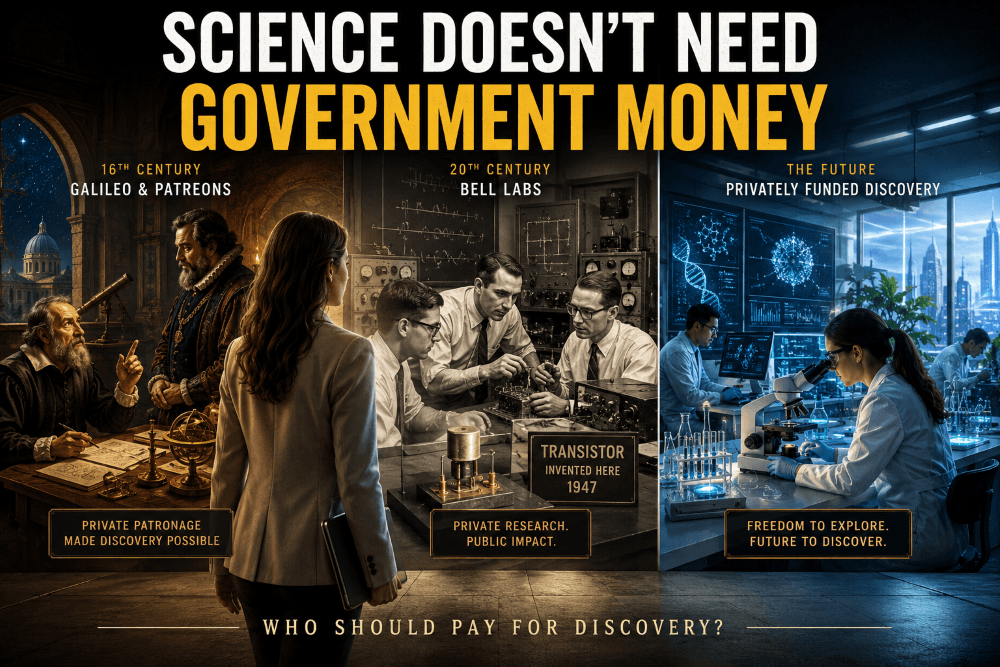
Washington is stoping the gravy train of money for science that made no sense. Governments have funded numerous projects that are ridiculous, frivolous, or pointless.
Perhaps the problem isn’t that Washington is spending too little on science. Perhaps the problem is that we came to expect Washington to fund science in the first place.
Here are well-documented examples that have drawn particular ridicule:
- Shrimp on a treadmill (NSF): Researchers at the College of Charleston received grants totaling around $1.3 million over roughly a decade to study how bacterial infections and environmental stresses affect crustacean metabolism and performance. A custom underwater treadmill was used to exercise shrimp and crabs under controlled conditions. Critics amplified it as “$3 million to put shrimp on treadmills”. It became a viral symbol of “silly science.”
- Robotic squirrel vs. rattlesnakes (NSF): A ~$325,000–$390,000 grant supported development of “Robosquirrel” by researchers at San Diego State University and UC Davis. It tested predator-prey signaling: how ground squirrels use tail-flagging and infrared cues to deter rattlesnakes. The robotic element made it an easy target for mockery.
- Study on why people fall in love (NSF, early Golden Fleece): One of Proxmire’s first awards went to an ~$84,000 NSF grant examining the nature of romantic love. Critics saw it as pure fluff; defenders noted basic social/psychological research.
- Smart toilet / “analprint” camera system (NIH/National Cancer Institute): Stanford researchers received roughly $6.9–$7 million to develop a “smart toilet” that uses cameras, sensors, and AI to analyze urine and stool for health biomarkers. User identification included scanning unique anal morphology (“analprint”) alongside fingerprints. The privacy and optics issues made it highly mockable, though the stated goal was passive, continuous health monitoring.
- Other recurring targets: Mountain lions on treadmills for physiology/ecology instruments; studies of hamster aggression (“Hamster Fight Club”); Swedish massages for rabbits to study post-exercise recovery; CIA “Acoustic Kitty” (1960s attempt to implant surveillance gear in cats—more intelligence than pure science); and various social-science grants on baby-name trends, online dating preferences, or political donation motivations.
Taxpayers should be forced to finance such a wasteful use of money.
Government Funding for Science Is Not the Same as Supporting Science
Opposing government funding for science is not the same thing as opposing science.
I want more scientific discovery. I want better medicines, better computers, cheaper energy, longer lives, more efficient agriculture, better artificial intelligence, and technologies we haven’t even imagined yet.
The question is: who should decide which scientific ideas deserve resources? And why should the taxpayer be stuck with the bill? Taxes are high enough, and there are thousands of programs paid for by the government, but the reality is that all those programs continue squeezing the taxpayer more and more.
When government finances research, politicians and government agencies ultimately decide how taxpayer money gets distributed. Scientists naturally adapt to that system because obtaining grants becomes part of their profession.
But there is another possibility.
Companies, universities, philanthropists, nonprofit organizations, foundations, investors, wealthy individuals and scientific institutions could finance competing ideas with their own money.
Instead of one giant political mechanism allocating resources, thousands of independent organizations could decide which scientific bets they want to make.
Science Existed Before Washington Started Writing Checks
Government research grants did not create science.
For centuries, scientific discovery was supported through a mixture of patronage, universities, scientific societies, commercial interests and personal fortunes.
Galileo received support from wealthy patrons, including the Medici family. European monarchs and merchants financed voyages, astronomy, cartography and navigation because better knowledge had practical and commercial value.
Universities became centers of scholarship.
Scientific societies brought researchers together.
Later, wealthy philanthropists established laboratories, universities, hospitals and research institutes.
Then came one of the most extraordinary institutions in the history of science: the industrial research laboratory.
Companies discovered that scientific knowledge itself could be valuable.
They began paying scientists to explore.
Private Laboratories Have Changed the World
We sometimes talk about fundamental science as if businesses will finance only projects capable of generating a profit next quarter.
History tells a different story.
Bell Labs, originally the research organization of AT&T and Western Electric, employed thousands of scientists and engineers and became one of history’s great centers of scientific discovery.
Researchers working in industrial laboratories have made discoveries that transformed everyday life.
1. The Transistor — Bell Labs
In 1947, John Bardeen, Walter Brattain and William Shockley developed the transistor at Bell Labs.
The transistor became one of the foundations of modern civilization.
Your smartphone, laptop, television, automobile and virtually every modern electronic device contain descendants of this technology.
A private industrial laboratory helped launch the electronics revolution.
2. The Laser — Bell Labs and Hughes Research Laboratories
Arthur Schawlow and Charles Townes developed crucial ideas behind the laser while associated with Bell Labs and Columbia University, and Theodore Maiman demonstrated the first working laser at Hughes Research Laboratories in 1960.
Today lasers are everywhere.
They are used in telecommunications, manufacturing, medicine, barcode scanners, scientific instruments and countless other technologies.
Private companies had powerful incentives to develop the technology because they could imagine applications for it—even when nobody knew how enormous those applications would eventually become.
3. The Cosmic Microwave Background — Bell Labs
Sometimes private research produces something with no obvious product to sell at all.
Bell Labs researchers Arno Penzias and Robert Wilson discovered cosmic microwave background radiation in 1964 while working with a large radio antenna.
Their discovery provided enormously important evidence about the origins of the universe.
What was the immediate consumer product?
There wasn’t one.
Yet fundamental science happened inside a corporate laboratory.
4. The Scanning Tunneling Microscope — IBM
IBM physicists Gerd Binnig and Heinrich Rohrer developed the scanning tunneling microscope in the early 1980s.
The instrument allowed scientists to study surfaces at the atomic scale and became an important tool in nanotechnology and materials science.
Their work earned them the Nobel Prize in Physics.
Once again, groundbreaking science emerged from an industrial laboratory.
5. The Computing Revolution at Xerox PARC
Xerox established its Palo Alto Research Center in 1970 and gave talented researchers extraordinary freedom to experiment.
The results included major advances in Ethernet, graphical user interfaces, laser printing, personal computing, digital graphics and object-oriented programming.
Many of the ideas developed there eventually became fundamental components of modern computing.
These examples don’t prove that government has never contributed to science. It obviously has.
They demonstrate something different and important:
Scientific discovery does not require government to have a monopoly on deciding which ideas deserve funding.
Government Money Politicizes Science
There is an unavoidable problem with government funding.
Government money is political money.
One administration decides climate research deserves more resources. Another administration changes the priorities. Congress changes. Agency leadership changes. Budgets change.
Scientists then find themselves fighting political battles because their laboratories depend upon political decisions.
We shouldn’t be surprised by this.
If government controls the money, government will have influence over how the money is spent.
Reducing government funding for science could ultimately make scientific institutions less dependent on politicians, not more.
Scientists Respond to Incentives Too
Scientists are human beings.
If Washington announces billions of dollars in grants for a particular field, researchers have an incentive to move toward that field.
They learn which research proposals receive grants.
They learn which terminology grant committees favor.
They spend enormous amounts of time preparing applications, satisfying bureaucratic requirements and competing for government funding.
That doesn’t mean scientists are dishonest.
It means incentives work.
A decentralized system would create different incentives because scientists could seek money from many competing sources rather than depending so heavily on government agencies.
Who Is Better at Allocating Capital?
Suppose there are 10,000 scientific projects seeking financing and enough money to finance only 1,000.
Someone must choose.
Why should we automatically assume a government bureaucracy will make better decisions than thousands of investors, companies, universities, charities, foundations and philanthropists risking their own resources?
Markets aren’t perfect.
Neither are governments.
The difference is that decentralized capital allows many people to make different bets simultaneously.
One investor can be wrong without forcing everyone else to make the same mistake.
What About Science That Doesn’t Make Money?
This is the strongest argument for government funding for science, and it deserves to be taken seriously.
Some research may have enormous benefits for humanity but little immediate commercial value.
A mathematician might spend decades studying something that appears useless. Fifty years later, those equations could become essential to computing, cryptography or physics.
Why would a company pay for that?
Sometimes it wouldn’t.
Economists call this a positive externality: society may receive benefits that the person paying for the research cannot capture financially.
But recognizing a market problem doesn’t automatically prove that government funding is the best solution.
There are alternatives:
- University endowments can finance fundamental research.
- Philanthropic foundations can support long-term scientific projects.
- Wealthy individuals can become modern scientific patrons.
- Companies can maintain long-term research laboratories.
- Industry associations can pool research resources.
- Scientific prizes can reward breakthroughs.
- Nonprofit research institutes can specialize in basic science.
- Crowdfunding can allow thousands of individuals to support research they consider valuable.
- Charities can finance research into diseases and other humanitarian problems.
Human beings have financed art, universities, churches, museums, hospitals, expeditions and scientific institutions voluntarily for centuries.
There is no reason to assume that generosity, curiosity and ambition disappear simply because government stops writing the checks.
Imagine a New Generation of Scientific Patrons
This is where I think reducing government funding could create something unexpectedly positive.
Imagine billionaires competing not merely to own bigger yachts but to cure Alzheimer’s disease.
Imagine foundations financing mathematicians for 20 years without demanding commercially useful results.
Imagine technology companies rebuilding institutions resembling the great industrial laboratories of the twentieth century.
Imagine universities competing for private endowments by demonstrating the quality of their research.
Imagine scientific entrepreneurs pitching ambitious research projects to investors and philanthropists.
And imagine thousands of different funding sources instead of researchers worrying about the priorities of Washington.
That ecosystem would certainly look different from today’s system.
Different doesn’t necessarily mean worse.
Failure Is Information
There is another important difference between private and government capital.
Private organizations that repeatedly allocate resources badly eventually lose money, donors or investors.
That feedback mechanism is imperfect, but it exists.
Government programs don’t face the same discipline.
A failed government program can receive another appropriation.
An ineffective agency can argue that its failure proves it needs a larger budget.
Politicians are spending other people’s money, which weakens the feedback mechanism between decisions and consequences.
Scientific research necessarily involves failure. Most experiments won’t transform civilization.
The important question is whether the institutions allocating resources learn from those failures.
Government Should Fund Its Legitimate Responsibilities
I wouldn’t argue that government can never finance scientific research under any circumstances.
There is an important distinction.
Government shouldn’t finance science simply because science is beneficial. It should finance research only when that research is necessary to perform a legitimate function of government.
If national defense is a legitimate government responsibility, military research necessary for national defense can reasonably be part of that responsibility.
The same principle could apply to other narrowly defined government functions.
But “scientific research produces benefits” isn’t enough.
Food produces benefits. Housing produces benefits. Computers produce benefits. Books produce benefits.
We don’t conclude that government therefore needs to produce all food, build all houses, manufacture all computers or publish all books.
Why should science automatically be different?
What Would Happen If Washington Stopped Writing the Checks?
This is ultimately an empirical question.
If Washington dramatically reduced government funding for science, some laboratories would close. Some researchers would lose jobs. Some projects would disappear.
The transition would be painful.
But that isn’t the end of the story.
Resources don’t disappear when government stops taxing and spending them. They remain in the private economy.
Universities would have incentives to seek donors.
Scientists would have incentives to find new patrons.
Companies would recruit researchers.
Foundations would identify neglected fields.
Entrepreneurs would build new research organizations.
Wealthy individuals looking to leave a legacy could finance scientific institutions.
Perhaps we would even witness the rebirth of institutions resembling Bell Labs.
The transition would involve experimentation and failure.
That’s precisely how decentralized systems discover better institutions.
Science Doesn’t Need Government Money
The debate over government funding for science is too often framed as a choice between government funding and scientific ignorance.
I reject that choice.
I believe deeply in science precisely because I believe human curiosity, ambition, generosity and entrepreneurship are stronger than government bureaucracy.
Galileo found patrons.
Scientific societies found members.
Universities built endowments.
Philanthropists created research institutes.
Corporations created industrial laboratories.
Entrepreneurs created entirely new industries.
Human beings wanted to understand the universe long before federal research grants existed, and they will continue wanting to understand it regardless of what happens to Washington’s budget.
So here’s the question worth asking:
If Washington stopped writing the checks, would American science collapse—or would a new ecosystem of private science emerge?
I would like to find out.
Science is too important to depend on politics.
Frequently Asked Questions
Does science need government funding?
Scientific research needs resources, but those resources don’t necessarily have to come from government. Companies, universities, foundations, philanthropists, nonprofit organizations and investors can all finance scientific research.
Has the private sector produced important scientific discoveries?
Yes. Industrial research laboratories have produced major breakthroughs. Bell Labs researchers developed the transistor and made fundamental discoveries including cosmic microwave background radiation, while IBM researchers developed the scanning tunneling microscope.
Who would pay for basic research without government funding?
Possible sources include university endowments, charitable foundations, wealthy philanthropists, corporations, nonprofit research institutes, industry partnerships, scientific prizes and individual donors. The difficult question is whether these sources would finance enough basic research, which is one of the strongest arguments for continued government funding.
Should government ever fund scientific research?
Government research can be justified when it is directly necessary for a legitimate government responsibility. For example, if national defense is a proper function of government, research directly necessary for national defense can logically fall within that responsibility.