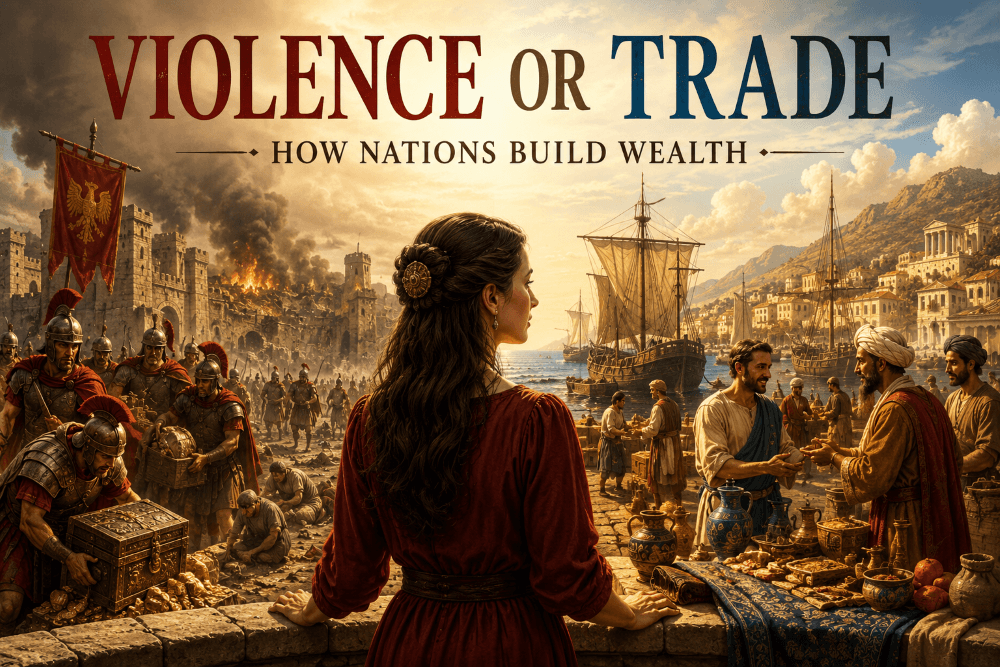
Merchants vs. Conquerors: How Trade Builds Wealth
Throughout history, civilizations have had two basic ways of becoming richer: produce and trade for what they want, or conquer someone who already has it. The history of Merchants vs. Conquerors is therefore much more than a story about businessmen and soldiers. It represents two fundamentally different ways of organizing human civilization.
The conqueror looks across the border and sees land, gold, oil, farmland, labor, or strategic territory worth taking.
The merchant looks across the border and sees a potential customer.
Both have shaped history. But over the long run, trade has one enormous advantage: it can create wealth instead of merely transferring it.
Merchants vs. Conquerors: Two Ways to Acquire Wealth
Imagine two neighboring civilizations.
Civilization A wants something Civilization B possesses. Its ruler raises an army, crosses the border, defeats B’s soldiers and takes the resource.
Civilization A has gained something—but Civilization B has lost it. This is what the Spaniors did when they came to Latin America and murdered a bunch of indian to steal their gold and their labor.
Worse, both societies have consumed enormous resources fighting each other. Soldiers have died. Farms have been destroyed. Cities may have burned. Capital that could have been invested productively has been consumed by war.
Now imagine another possibility.
Civilization A produces wine. Civilization B produces olive oil. They exchange.
A gets oil. B gets wine.
Both voluntarily entered the transaction because each believed it would be better off afterward.
That simple difference may be one of the most important ideas in economic history.
Conquest generally redistributes wealth. Commerce can create it.
The Merchant Must Persuade. The Conqueror Can Force.
The merchant and conqueror operate under very different incentives.
A merchant cannot normally force customers to buy. If people don’t value the product enough, they walk away.
That forces merchants to ask questions such as:
- What do people want?
- How can I produce it more cheaply?
- How can I make it better?
- How can I transport it farther?
- How can I earn people’s trust?
- How can I convince them to trade with me again?
The conqueror faces another set of incentives.
If he is powerful enough, he doesn’t necessarily have to persuade. He can take.
But taking something once is very different from creating a system capable of producing more of it year after year.
The Phoenicians Discovered the Power of Trade
Thousands of years ago, the Phoenicians built one of the ancient world’s great commercial networks.
Their homeland offered limited agricultural territory. Instead of depending entirely on territorial expansion, Phoenician merchants became extraordinary sailors, traders, craftsmen, and commercial intermediaries.
Their ships moved timber, glass, dyes, metals, wine, luxury goods, and other merchandise throughout the Mediterranean.
Their prosperity depended on connections.
A conquered city could produce tribute once. A trading relationship might produce income for generations.
The Silk Road Connected People Who Never Met
The same principle appeared across the Silk Road.
Chinese silk traveled west. Precious metals traveled east. Indian spices, Central Asian horses, textiles, glassware, technologies, religions, languages, and ideas traveled with merchants across enormous distances.
No single ruler created this enormous commercial network.
It emerged because thousands of merchants discovered opportunities to profit by moving goods from places where they were abundant to places where they were scarce.
The merchant’s profit was evidence that he had connected two people who valued something differently.
The Hanseatic League: Cooperation Without an Empire
During the Middle Ages, merchants around northern Europe developed another fascinating model.
The Hanseatic League connected commercial cities around the Baltic and North Seas. Merchants cooperated to protect trade routes, negotiate privileges, standardize commercial practices, and reduce the risks involved in long-distance commerce.
The League certainly pursued its interests aggressively and sometimes became involved in armed conflict. Merchants throughout history were hardly saints.
But its fundamental economic engine was exchange rather than territorial domination.
The objective wasn’t primarily to own Europe.
It was to trade with Europe.
Venice, Amsterdam and the Rise of Commercial Power
Some of history’s wealthiest cities became powerful precisely because they positioned themselves between buyers and sellers.
Venice became a commercial bridge between Europe and the eastern Mediterranean.
Amsterdam later became one of the world’s great centers of shipping, finance, insurance, and international commerce.
These places discovered something conquerors repeatedly underestimated.
You don’t necessarily have to own the resources.
Sometimes it is much more profitable to finance, transport, insure, process, and sell them.
That insight eventually helped transform capitalism.
Conquest Is More Expensive Than It Looks
From Alexander the Great to Napoleon and Hitler, rulers have repeatedly been attracted to territorial expansion.
The logic can appear compelling.
Why buy resources if you can control the territory containing them?
Why negotiate with another country when you can dominate it?
The problem is that conquest comes with enormous hidden costs.
You need armies.
Then you need supply lines.
Then occupation forces.
Then administrators.
Then defenses against rebellion.
Then more soldiers to defend the territory from other conquerors.
And every dollar, pound, franc, mark, or ruble spent maintaining an empire represents resources that cannot simultaneously be invested elsewhere.
Conquest may acquire assets.
But maintaining conquest can become an enormous liability.
Japan Learned the Terrible Cost of Conquest
Imperial Japan offers a dramatic example.
Japan lacked many natural resources required by a modern industrial economy. One possible solution was international trade.
Another was territorial expansion.
Japan increasingly chose the second.
Its leaders sought control over territory and resources throughout Asia, eventually making the catastrophic decision to attack the United States at Pearl Harbor.
The irony was extraordinary.
Japan attempted to solve its resource problem through conquest and eventually found itself fighting an enemy with vastly greater industrial capacity.
America didn’t simply have soldiers.
It had factories.
Shipyards.
Oil.
Railroads.
Capital markets.
Entrepreneurs.
Engineers.
Manufacturing expertise.
The economic machine behind the military eventually mattered enormously.
Merchants Create Networks. Conquerors Create Enemies.
There is another important difference in Merchants vs. Conquerors.
Successful merchants have an incentive to create relationships.
Successful conquerors often create resentment.
If I make money selling you something you value, I want you to remain prosperous enough to buy from me tomorrow.
Your success can contribute to my success.
Trade can therefore create networks of mutual economic interest.
The conqueror faces the opposite problem.
The people he dominates may spend generations waiting for an opportunity to throw him out.
Empires frequently discover that acquiring territory is much easier than permanently controlling the people who live there.
The Greatest Resource Isn’t Oil or Gold
For much of history, political leaders obsessed over physical resources.
Gold.
Silver.
Farmland.
Coal.
Oil.
Iron.
Ports.
Territory.
Those resources certainly matter.
But modern economic history suggests that another resource may matter far more:
human creativity.
Look at companies such as Google, Microsoft, Apple, Amazon, or countless smaller businesses.
Their greatest source of wealth isn’t territory captured by an army.
It is ideas.
Software can be duplicated millions of times. Knowledge can spread. A successful invention can improve the productivity of millions of people simultaneously.
The economic possibilities become dramatically larger when societies focus on creating new value rather than fighting over existing resources.
Entrepreneurship Is the Merchant Model Taken Further
This is why entrepreneurship deserves a central place in the history of civilization.
The entrepreneur asks essentially the same question merchants have asked for thousands of years:
What can I offer another person that they will voluntarily give me something in exchange for?
That requirement changes behavior.
To become wealthy through commerce, you generally need customers.
And customers can say no.
That little word—no—is extraordinarily powerful.
It forces businesses to compete.
It forces entrepreneurs to improve.
It forces merchants to negotiate.
It forces producers to consider what other people want.
The conqueror’s ultimate instrument is force.
The entrepreneur’s ultimate instrument is persuasion.
Trade Isn’t Morally Perfect
None of this means merchants have always behaved honorably.
History contains slavery, colonial monopolies, exploitation, fraud, piracy, political corruption, and companies that used government power to suppress competitors.
The British East India Company, for example, demonstrates how easily commerce and conquest can become intertwined.
Nor does trade eliminate war.
Countries still have strategic interests that cannot always be resolved through markets.
But these exceptions actually reinforce an important distinction.
When merchants obtain wealth through political privilege, monopoly, coercion, or military force, they begin behaving less like merchants and more like conquerors.
The important distinction isn’t simply businessman versus soldier.
It is voluntary exchange versus coercive extraction.
The World Became Richer When We Learned to Trade
For most of human history, wealth was closely connected to land.
If a ruler wanted more wealth, acquiring more territory seemed logical.
But capitalism gradually changed the equation.
We discovered that wealth could be created.
A farmer could increase yields.
An inventor could create a machine.
A manufacturer could produce goods more efficiently.
A merchant could connect distant markets.
A banker could direct savings toward productive investments.
An entrepreneur could create a product that had never existed before.
Suddenly, becoming richer didn’t necessarily require making someone else poorer.
That is an extraordinary development in human civilization.
From Conquering Territory to Winning Customers
Look at the world’s largest companies today.
They don’t generally become powerful by planting flags on foreign territory.
They enter foreign countries looking for customers.
The battlefield has become the marketplace.
Samsung competes with Apple.
Toyota competes with Volkswagen.
Microsoft competes with Google.
Thousands of smaller companies compete for our money every day.
Of course, companies can lobby governments, seek monopolistic privileges, or abuse market power. Those behaviors deserve scrutiny.
But competitive commerce gives society an enormously productive alternative to conquest.
If you want what another person possesses, you can offer them something better in return.
Merchants vs. Conquerors Is Still a Choice
The conflict between Merchants vs. Conquerors isn’t confined to ancient history.
Countries still face this choice.
They can spend resources acquiring territory and controlling populations.
Or they can build universities, factories, ports, businesses, technologies, financial institutions, and trading relationships.
One path asks:
What can we take?
The other asks:
What can we create?
History contains plenty of examples of both.
But the societies that helped produce the extraordinary increase in human prosperity over the past several centuries increasingly learned how powerful the second question could be.
Perhaps the greatest economic achievement of civilization wasn’t discovering how to conquer more territory.
It was discovering that we didn’t have to.
We could trade.
Frequently Asked Questions
What does Merchants vs. Conquerors mean?
Merchants vs. Conquerors describes two approaches to acquiring wealth. Conquerors primarily use political or military power to control existing resources, while merchants rely primarily on voluntary exchange to create mutually beneficial economic relationships.
Does trade always create wealth?
Not every transaction creates lasting social value, and fraud, coercion, monopoly, and external costs complicate the picture. However, voluntary trade generally occurs because both participants expect to benefit from the exchange.
Were merchant civilizations always peaceful?
No. Commercial powers such as Venice, the Dutch Republic, Britain, and the Hanseatic League sometimes used military force. History frequently mixes commerce and conquest, which is why the more useful distinction is between voluntary exchange and coercive extraction.
Why is entrepreneurship important to civilization?
Entrepreneurship encourages people to discover new products, technologies, services, and methods of production. Instead of simply competing for existing wealth, entrepreneurs can expand the amount of value available to society.