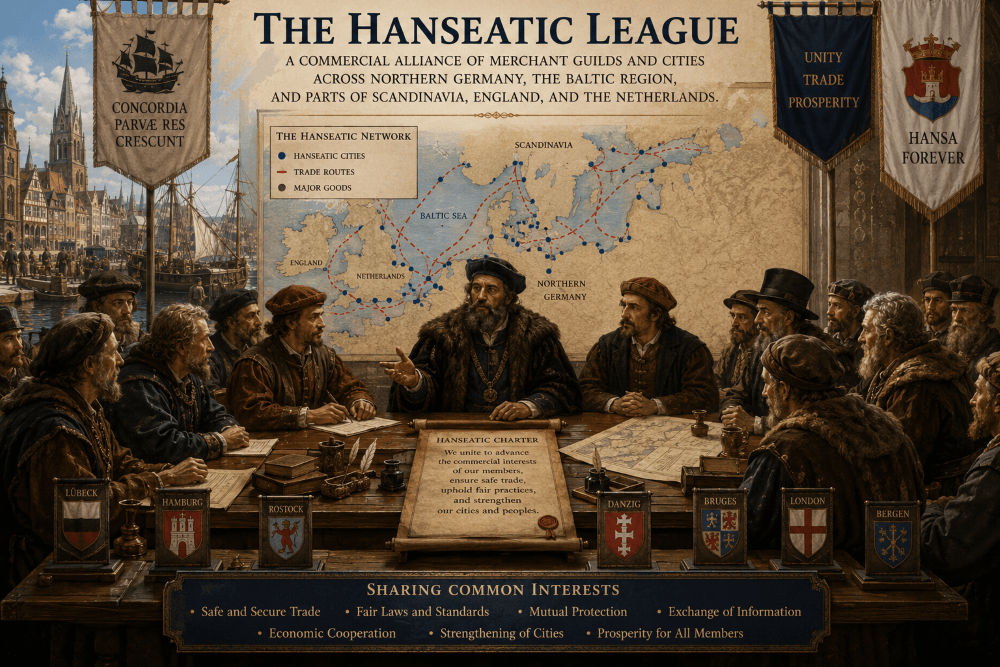
Centuries before modern trade agreements and economic unions existed, the Hanseatic League proved that independent merchants and cities could achieve far more by cooperating than by competing alone. Formed in the 12th century and thriving for nearly 300 years, this alliance of northern European trading cities created shared legal protections, standardized commercial practices, and a collective bargaining power no single city could match. It stands as one of history’s earliest and most successful examples of entrepreneurial cooperation at scale.
What Was the Hanseatic League?
The Hanseatic League was a commercial alliance of merchant guilds and cities across northern Germany, the Baltic region, and parts of Scandinavia, England, and the Netherlands.
- At its height, the League included well over 100 cities, though membership shifted constantly over its history.
- Member cities weren’t ruled by a central government — the League operated more like a loose confederation than a unified state.
- Its core purpose was protecting and promoting the shared commercial interests of its merchant members.
Unlike empires that expanded through conquest, the Hanseatic League expanded through economic cooperation and mutual benefit.
Why Merchants Needed the Hanseatic League
The Problem of Fragmented Power
Medieval northern Europe was politically fragmented, with dozens of small territories, each imposing its own tolls, laws, and risks on traveling merchants.
- Individual merchants had little leverage when negotiating with local rulers.
- Piracy and banditry made long-distance trade routes dangerous for lone travelers.
- Inconsistent legal systems made resolving disputes across borders difficult and unpredictable.
Merchants realized that banding together solved problems no individual trader could handle alone.
Strength Through Collective Bargaining
By presenting a united front, League cities gained negotiating power far beyond what any single city could achieve independently.
- They secured trading privileges and reduced tariffs from foreign rulers.
- They established protected trading posts, called kontors, in key foreign cities like London, Bruges, and Novgorod.
- They coordinated naval patrols and convoys to reduce the threat of piracy along major shipping routes.
How the Hanseatic League Operated
A Federation, Not an Empire
The League had no king, no army in the traditional sense, and no formal capital. Instead, it functioned through:
- Regular assemblies, called Hansetags, where city representatives met to coordinate policy.
- Shared legal standards, making contracts and trade disputes easier to resolve across different cities.
- Economic sanctions, including trade embargoes against cities or rulers who violated League interests.
This structure meant member cities retained independence while still benefiting from collective strength — a balance many modern trade organizations still strive to replicate.
Key Trade Goods and Routes
The Hanseatic League built its wealth primarily around Baltic and North Sea trade.
- Exports included grain, timber, furs, and fish, particularly herring from the Baltic Sea.
- Imports included cloth, wine, and manufactured goods from western Europe.
- Major hub cities like Lübeck, Hamburg, and Bruges became central nodes connecting eastern raw materials to western manufacturing centers.
The Power and Limits of the Hanseatic League
At its peak in the 14th century, the League could pressure kings and even wage limited wars to protect its trading interests. It defeated Denmark militarily in 1370, securing valuable trading rights as a result.
However, the same loose structure that gave the League flexibility eventually contributed to its decline.
- Rising nation-states began asserting stronger centralized control over trade within their own borders.
- Competing trade networks, including Dutch and English merchants, gradually eroded the League’s dominance.
- Without a strong central authority, the League struggled to adapt quickly to shifting economic and political realities.
By the mid-17th century, the Hanseatic League had effectively dissolved, though its influence on European commercial law and cooperative trade models lasted far longer.
Lessons from the Hanseatic League
- Collective power beats isolated effort. Merchants achieved more negotiating together than any city could alone.
- Shared standards reduce friction. Common legal and commercial practices made cross-border trade dramatically more efficient.
- Flexibility has trade-offs. The League’s loose structure enabled rapid growth but also made long-term adaptation difficult.
Frequently Asked Questions
What was the purpose of the Hanseatic League? The Hanseatic League existed to protect and promote the shared commercial interests of merchant cities across northern Europe, particularly around Baltic and North Sea trade.
Which cities were part of the Hanseatic League? Major members included Lübeck, Hamburg, and Bruges, though the League’s membership included well over 100 cities at various points in its history.
Why did the Hanseatic League decline? The rise of centralized nation-states and competing trade networks gradually undermined the League’s loose, decentralized structure, leading to its eventual dissolution by the mid-17th century.
How was the Hanseatic League different from an empire? Unlike an empire, the Hanseatic League had no central ruler or army. It functioned as a cooperative alliance of independent merchant cities working toward shared trade interests.
Related Articles
- The First Entrepreneur: When Did Entrepreneurship Begin?
- The Agricultural Revolution: How Farming Created the First Entrepreneurs
- How Writing Was Invented for Business: The First Accountants
- The First Merchants: How the Sumerians Created Professional Commerce
- The Birth of Money: How Currency Changed Entrepreneurship Forever
- The Indus Valley: Trade, Standardization, and the Mysterious Business Civilization
- Ancient China: Innovation, Markets, and Continuous Improvement
- The Phoenicians: How Maritime Trade Connected the Ancient World
- Ancient Greece: How Competition and Markets Shaped Entrepreneurship
- Ancient Rome: How Infrastructure, Law, and Scale Built an Economic Empire
- The Islamic Golden Age: How Knowledge, Finance, and Global Trade Transformed Entrepreneurship
- The Silk Road Trade: How Ancient Networks Built Global Commerce
- Marcus Licinius Crassus: The Richest Man in Rome
- Indian Ocean Trade: The Ancient World’s Monsoon Economy
- Viking Trade: How Raiders Became Medieval Merchants
About The History of Entrepreneurship
This article is part of The History of Entrepreneurship, an ongoing series exploring how civilizations, merchants, technologies, institutions, and entrepreneurs gradually created the foundations of modern business.
Rather than treating entrepreneurship as a modern invention, the series follows its evolution across civilizations—from the earliest exchanges between prehistoric humans to the global businesses of the modern economy.