| 📊 Alain’s Holdings — August 21, 2026 | ||||
|---|---|---|---|---|
| Symbol | Name | Price | Change | Change % |
| VOO | Vanguard S&P 500 ETF | 703.71 | +2.70 | +0.39% |
| QQQ | Invesco QQQ Trust | 713.44 | +2.51 | +0.35% |
| XIU.TO | iShares S&P/TSX 60 ETF | 54.36 | +0.38 | +0.70% |
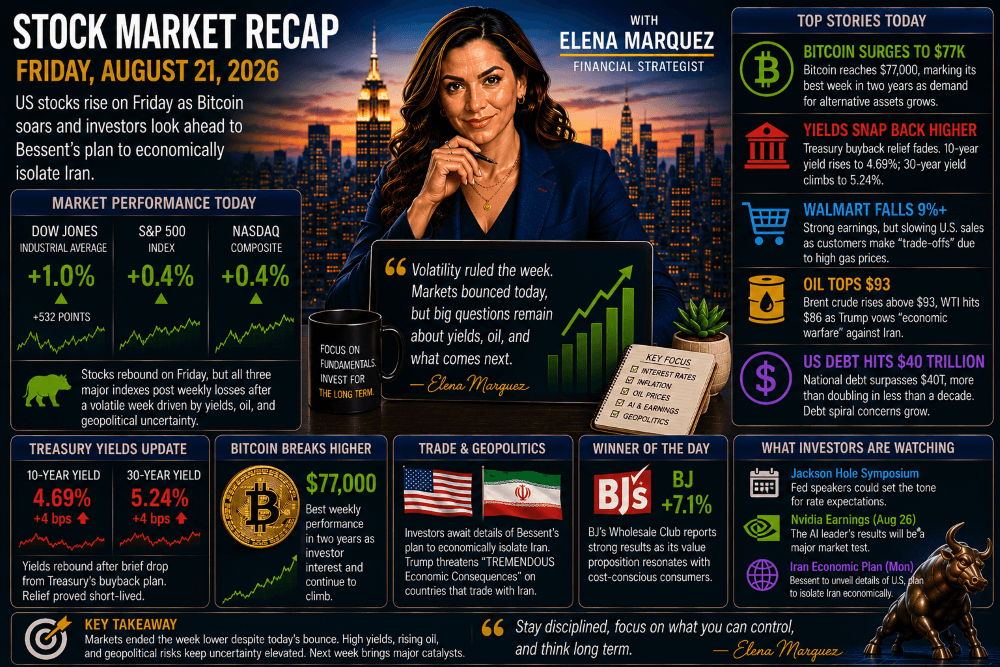
Wall Street ended a turbulent week on a positive note Friday as stocks rebounded and Bitcoin surged to $77,000, capping its best week in two years.
But Friday’s rally wasn’t enough to erase the week’s losses. Rising Treasury yields, concerns about U.S. government borrowing, expensive oil, and uncertainty surrounding the next phase of the U.S.-Iran conflict kept pressure on markets.
Market Performance
- 📈 Dow Jones Industrial Average: +1.0%
- 📈 S&P 500: +0.4%
- 📈 Nasdaq Composite: +0.4%
All three indexes nevertheless finished lower for the week.
Bitcoin Explodes to $77,000
One of Friday’s biggest stories wasn’t a stock at all.
Bitcoin climbed to approximately $77,000, extending a rally that has produced the cryptocurrency’s strongest weekly performance in two years.
The timing is particularly interesting.
This week, the U.S. national debt surpassed $40 trillion, while long-term Treasury yields climbed to levels not seen in nearly two decades.
At the same time, the Treasury Department intervened in the bond market by expanding purchases of long-dated government debt.
That backdrop inevitably renews the debate around Bitcoin’s role as an alternative asset.
Whether Bitcoin can truly function as “digital gold” over the long term remains debatable.
But this week investors certainly wanted it.
Treasury’s Bond-Market Intervention Has Limited Effect
Treasury Secretary Scott Bessent’s attempt to bring down long-term borrowing costs produced only temporary relief.
The Treasury announced plans to increase its purchases of long-dated government securities, with Bessent saying the program could expand beyond $4 billion per issue.
Initially, it worked.
Bond prices rallied and yields dropped Wednesday.
But by Thursday, yields had largely snapped back toward their previous levels.
That’s significant.
The Treasury can influence demand at the margin, but the enormous U.S. bond market ultimately determines the interest rate investors require to lend money to the government.
With federal debt above $40 trillion and deficits requiring continued borrowing, investors remain focused on whether Treasury yields will remain structurally higher.
Wall Street Turns Its Attention Back to Iran
The next major geopolitical catalyst could arrive Monday.
Bessent is expected to reveal details of the administration’s plan to economically isolate Iran.
President Trump has threatened major economic consequences for countries that continue trading with Tehran.
That puts particular attention on China, a major buyer of Gulf oil.
The implications extend well beyond foreign policy.
Aggressive restrictions on Iranian trade could disrupt global energy supplies, push oil prices higher, and potentially reignite inflation.
That would put the Federal Reserve in an even more difficult position.
The Consumer Is Trading Down
BJ’s Wholesale Club provided another useful window into the American consumer.
The warehouse retailer’s results showed continued demand from cost-conscious shoppers seeking value.
That’s consistent with several signals we’ve seen recently.
Retail sales have weakened.
Consumer sentiment has deteriorated.
Walmart says customers are making spending trade-offs.
And gasoline prices have placed additional pressure on household budgets.
Consumers aren’t necessarily stopping spending.
But they’re becoming considerably more selective about where and how they spend their money.
Next Week: Nvidia and Jackson Hole
Two enormous events now move into focus.
First comes the Federal Reserve’s Jackson Hole Economic Policy Symposium.
Investors will scrutinize comments from policymakers for clues about whether another interest-rate increase remains likely.
Then comes Nvidia’s second-quarter earnings on August 26.
Few companies matter more to today’s market.
After months of debate about hundreds of billions of dollars being invested in AI infrastructure, Nvidia’s results could provide the clearest indication yet of whether underlying demand remains strong enough to justify the extraordinary spending.
Expectations will be enormous.
And as we’ve repeatedly seen this earnings season, strong numbers aren’t always enough when expectations are even stronger.
The Bottom Line
Friday gave investors a welcome rebound.
But this wasn’t an easy week.
The bond market pushed back against attempts to lower long-term yields.
U.S. government debt crossed $40 trillion.
The U.S.-Iran conflict remained unresolved.
Consumers showed additional signs of financial pressure.
And all three major stock indexes finished the week lower.
Meanwhile, Bitcoin surged to $77,000.
Next week could be even more consequential.
Jackson Hole will test the interest-rate narrative.
Nvidia will test the AI narrative.
And the administration’s new Iran strategy could test the oil and inflation narrative.
Three of the market’s biggest stories are about to collide.