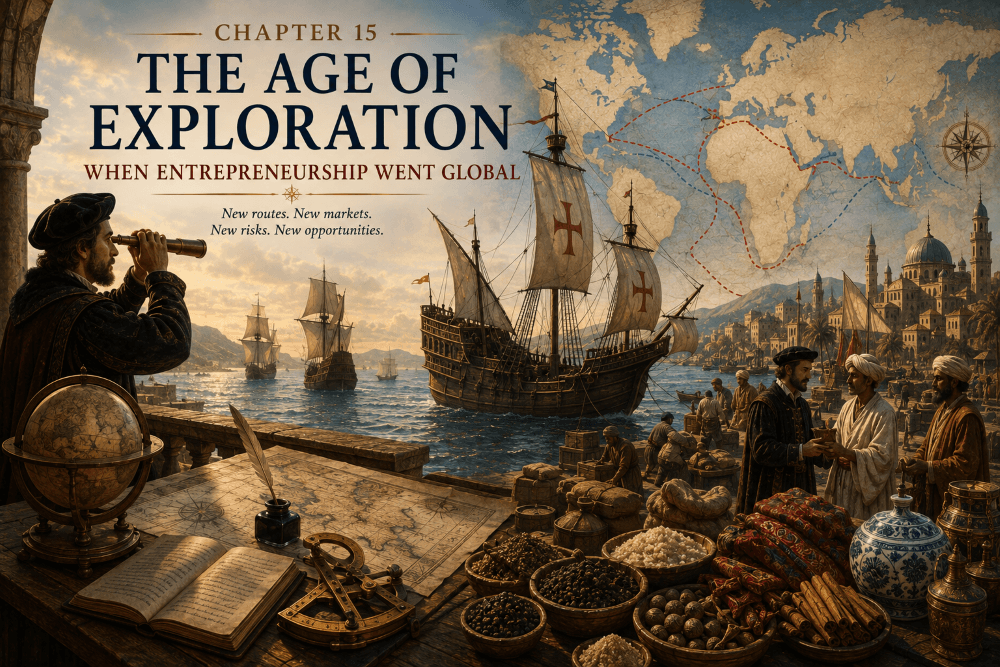
Imagine investing your entire fortune in a ship.
It sails beyond the horizon.
And then you wait.
There are no phones.
No GPS.
No weather forecasts.
No satellite tracking.
For months—perhaps years—you may hear nothing.
If the ship returns carrying pepper, cloves, nutmeg, silk, porcelain, or other valuable goods, you might make a fortune.
If it sinks, you might lose everything.
This was the extraordinary entrepreneurial gamble created by the Age of Exploration.
Beginning in the fifteenth century, European sailors established new ocean routes connecting Europe more directly with Africa, Asia, and eventually the Americas.
The commercial possibilities became enormous.
But so did the cost.
Ships had to be built.
Crews hired.
Cargo financed.
Food purchased.
Ports negotiated.
And investors might wait years before seeing a return.
Entrepreneurship had encountered a new problem:
The opportunities were becoming too large—and too risky—for individual merchants to finance alone.
The solution would eventually transform capitalism.
Pool the capital. Share the risk.
Global Trade Existed Before the Age of Exploration
The phrase “Age of Exploration” can create a misleading impression.
Europeans did not invent global trade.
Long before Portuguese ships sailed around Africa, sophisticated commercial networks connected much of Africa, Europe, the Middle East, India, China, and Southeast Asia.
Chinese merchants participated in extensive Asian commerce.
Indian merchants crossed the Indian Ocean.
Arab and Persian traders connected markets stretching from East Africa toward Asia.
African merchants operated regional and long-distance trading networks.
The Silk Roads connected overlapping markets across Eurasia.
The Mediterranean linked Europe, North Africa, and the Middle East.
The Indian Ocean had been a commercial highway for centuries.
What changed during the European Age of Exploration was something more specific:
European maritime powers established direct ocean routes into existing international trading systems and across the Atlantic.
That distinction is important.
Europe did not discover commerce.
It entered—and eventually transformed—a commercial world that already existed.
Why Did Europeans Search for New Trade Routes?
European consumers wanted Asian goods.
Especially spices.
Pepper.
Cinnamon.
Cloves.
Nutmeg.
But these products often passed through several intermediaries before reaching European markets.
Every intermediary expected a profit.
European merchants and monarchs saw an opportunity.
What if they could reach Asian markets more directly?
They might bypass some intermediaries.
Lower acquisition costs.
Gain greater control over distribution.
Capture larger profits.
The entrepreneurial logic would be familiar to any modern company:
Remove the middleman.
The problem was figuring out how.
Portugal Became a Maritime Laboratory
Portugal emerged as an early leader in European Atlantic exploration.
Throughout the fifteenth century, Portuguese expeditions traveled progressively farther down Africa’s western coast.
There was no single voyage that suddenly solved the problem.
Instead, knowledge accumulated.
Sailors learned about:
- Winds
- Ocean currents
- Coastlines
- Harbors
- Navigation
- Ship design
- Distances
One expedition built upon information gathered by earlier expeditions.
Exploration became a process of continuous improvement.
That is an entrepreneurial principle we have already encountered in this series.
Innovation often happens incrementally before it happens dramatically.
Henry the Navigator and the Infrastructure of Exploration
Prince Henry of Portugal, commonly known as Henry the Navigator, became closely associated with Portugal’s early maritime expansion.
Despite the nickname, Henry was primarily a patron and organizer rather than the sailor personally conducting most of the famous voyages.
And that may actually make him more interesting from an entrepreneurial perspective.
Exploration required an ecosystem.
Capital.
Ships.
Sailors.
Navigational knowledge.
Maps.
Political support.
Information.
Entrepreneurship is often portrayed as the work of one heroic individual.
In reality, breakthroughs usually require networks of people and resources.
Portugal was gradually building such a network.
Bartolomeu Dias Proves the Route Exists
In 1488, Portuguese navigator Bartolomeu Dias rounded the southern tip of Africa.
This was an enormous breakthrough.
Dias did not reach India.
But he proved something enormously valuable:
A maritime route from the Atlantic into the Indian Ocean existed.
That changed the entrepreneurial calculation.
Sometimes the most important entrepreneur is not the person who finishes the journey.
It is the person who proves the journey can be completed.
Once possibility becomes demonstrated reality, capital becomes easier to attract.
Someone else can take the next step.
Vasco da Gama Reaches India
That next major step came with Vasco da Gama.
Da Gama departed Portugal in 1497, rounded the Cape of Good Hope, crossed the Indian Ocean with crucial navigational help in East Africa, and reached Calicut on India’s Malabar Coast in 1498.
Europe now had a direct maritime route to the Indian Ocean trading world.
But da Gama did not arrive at an undeveloped marketplace waiting to be discovered.
He encountered sophisticated commercial systems involving merchants from India, Arabia, Persia, East Africa, and elsewhere.
European merchants were newcomers.
The entrepreneurial opportunity came from gaining direct access to this enormous existing marketplace.
Christopher Columbus Looks West
Portugal looked east by sailing around Africa.
Christopher Columbus proposed sailing west.
Columbus believed Asia could be reached across the Atlantic.
His calculations dramatically underestimated the size of the Earth and the distance involved.
He was wrong.
But another landmass stood in the way.
In 1492, sailing under the Spanish Crown, Columbus reached islands in the Caribbean.
He believed he had reached regions near Asia.
Instead, his voyages initiated sustained European contact with the Americas.
The consequences would transform the global economy—and produce immense human prosperity.
Entrepreneurs Can Be Wrong and Still Discover Something
Columbus illustrates an uncomfortable entrepreneurial principle.
You can be wrong about your original hypothesis and still discover something important.
His geographical assumptions were incorrect.
Yet his voyages demonstrated the feasibility of repeated Atlantic crossings.
Entrepreneurs experience this constantly.
The original customer may not want the product.
Another customer does.
The original business model fails.
A better one emerges.
The intended discovery never occurs.
An unexpected discovery does.
Entrepreneurship operates under uncertainty.
The critical question often becomes:
What do you do when reality contradicts your plan?
The Atlantic Becomes a Commercial Highway
Before Columbus’s voyages, the Atlantic largely separated the major economic systems of Afro-Eurasia from the Americas.
Afterward, it increasingly connected them.
Ships transported:
People.
Plants.
Animals.
Diseases.
Technologies.
Capital.
Goods.
Ideas.
The resulting movement is often called the Columbian Exchange.
Products originating in the Americas eventually spread around the world, including:
- Potatoes
- Maize
- Tomatoes
- Cacao
- Tobacco
Other crops, animals, and commodities moved toward the Americas, including:
- Wheat
- Sugarcane
- Horses
- Cattle
- Pigs
The consequences reached far beyond merchants.
Agriculture changed.
Diets changed.
Populations changed.
Entire economies changed.
Globalization was accelerating.
Silver Helped Create a Global Economy
One commodity became especially important:
Silver.
Enormous quantities of silver were extracted from mines in Spanish America, particularly Potosí.
American silver crossed the Atlantic toward Europe.
But the story did not end there.
Large quantities eventually flowed toward Asia, where Chinese demand for silver played a major role in international commerce.
Silver also crossed the Pacific.
This created something remarkable.
A commodity extracted in South America could travel through European-controlled trading networks and ultimately purchase products made in China.
The world economy was becoming increasingly interconnected.
Manila Connected America With Asia
After establishing Manila in the Philippines in 1571, Spain developed a remarkable trans-Pacific commercial route.
The Manila galleons sailed between Manila and Acapulco.
American silver moved west.
Asian products moved east.
Silk.
Porcelain.
Spices.
Luxury goods.
Some of those products then traveled across Mexico and onward toward European markets.
Think about the supply chain.
Silver mined in the Americas.
Transported across the Pacific.
Used to purchase Chinese and other Asian goods.
Goods transported back across the Pacific.
Then potentially across the Atlantic.
This was globalization centuries before container ships.
Information Became an Entrepreneurial Asset
Global commerce created an enormous demand for information.
What was pepper selling for in Lisbon?
Where was silver most valuable?
Which ports were safe?
Which rulers were at war?
Where were pirates operating?
When would winds change?
Which ocean currents shortened a voyage?
Which crops could grow in another climate?
Better information could produce enormous profits.
Maps became commercially valuable.
Navigational knowledge became commercially valuable.
Political intelligence became commercially valuable.
Governments sometimes attempted to protect maps and navigational knowledge as strategic secrets.
Information had become capital.
Navigation Technology Changed Commerce
The Age of Exploration did not result from one magical invention.
Several technologies and bodies of knowledge came together.
Improved ship designs.
Better cartography.
The magnetic compass.
Astronomical navigation.
Knowledge of currents.
Knowledge of wind systems.
Accumulated maritime experience.
This is a recurring pattern in entrepreneurship.
Transformative innovation often occurs when several existing technologies become useful together.
No single technology creates the revolution.
The combination does.
Ships Became Expensive Capital Assets
A long-distance merchant ship represented a significant investment.
It required:
Timber.
Labor.
Sails.
Rope.
Equipment.
Weapons.
Maintenance.
Crew.
Cargo.
Food.
The ship could generate profits over repeated voyages.
But it could also disappear in one storm.
That created a financial problem.
How should entrepreneurs finance valuable assets exposed to catastrophic risk?
One increasingly attractive answer was:
Share the ownership.
Why Oceanic Trade Required More Capital
Imagine financing an expedition.
Before earning a single dollar of revenue, you need money for:
- Ships
- Repairs
- Crew wages
- Food
- Water
- Cargo
- Weapons
- Insurance
- Port fees
- Taxes
- Agents
Then you wait.
Perhaps for months.
Perhaps for years.
And after all that?
The ship might never return.
Oceanic commerce combined three difficult characteristics:
High upfront costs.
Long waiting periods.
Extreme uncertainty.
The financial tools of small merchants were becoming insufficient for the scale of the opportunity.
Pooled Capital Changed the Equation
Imagine an expedition requiring $10 million in today’s purchasing power.
One investor finances everything.
If the voyage fails, that investor could lose everything.
Now imagine 100 investors contributing $100,000 each.
The voyage can still fail.
But the loss is distributed.
Now suppose each investor also puts money into several different voyages.
One ship sinks.
Another breaks even.
A third produces spectacular profits.
Risk becomes manageable through diversification.
This simple principle would transform entrepreneurship:
Many people can collectively finance risks that would be irrational for one person to bear alone.
Governments and Entrepreneurs Became Partners
European oceanic expansion was not simply private entrepreneurship.
Governments played enormous roles.
Monarchies financed expeditions.
Granted privileges.
Protected ships.
Issued monopolies.
Claimed territories.
Negotiated agreements.
Built forts.
Used military force.
Commercial expansion and political expansion increasingly reinforced one another.
The result created opportunities for merchants.
But it also blurred the line between entrepreneurship and empire.
Monopoly Became a Business Strategy
Many early global merchants did not want free competition.
They wanted exclusive rights.
If a ruler granted a merchant or company a monopoly over trade with a particular region, competitors could be legally excluded.
That could dramatically increase profits.
But it introduces an important distinction in our history of entrepreneurship.
There is a difference between:
Creating value by serving customers better
and
Extracting value by using political power to restrict competition.
Both can make entrepreneurs rich.
They are not economically or morally equivalent.
Commerce Became Entangled With Conquest
European maritime expansion did not remain peaceful.
Portuguese forces seized strategic positions and attempted to control maritime trade.
Spanish conquistadors destroyed Indigenous empires.
Other European powers followed.
Commercial ambition and military power became deeply intertwined.
Markets could be entered through exchange.
They could also be captured through violence.
This makes the Age of Exploration one of the most complicated chapters in the history of entrepreneurship.
The same organizational skills that enable commerce can also enable exploitation.
The Catastrophe for Indigenous Peoples
European contact produced devastating consequences for Indigenous populations of the Americas.
Diseases such as smallpox spread among populations without previous exposure.
The demographic collapse was enormous.
War.
Forced labor.
Displacement.
Conquest.
Social disruption.
All compounded the disaster.
European commercial expansion cannot be separated from this human cost.
A history focused only on ships, trade, and profits would tell a dangerously incomplete story.
How wealth is created matters.
The Atlantic Slave Trade and Commercial Expansion
The expanding Atlantic economy also became deeply intertwined with the transatlantic slave trade.
Millions of Africans were forcibly transported across the Atlantic over the following centuries. Slavery had existed for centuries. Africans were practicing slavery and selling those slaves to the Europeans.
Human beings were treated as property, as they had been for centuries.
Enslaved labor generated commodities including sugar, tobacco, and later cotton.
Merchants profited.
Shipowners profited.
Plantation owners profited.
Insurers and financial institutions participated in the wider system.
Governments collected revenues.
This produced wealth.
But it was not entrepreneurship based on voluntary exchange.
It was wealth extraction through coercion.
That distinction is fundamental.
Value Creation vs. Wealth Extraction
This may be one of the most important lessons in our entire History of Entrepreneurship series.
There are different ways to become wealthy.
Value creation
Build something useful.
Improve a product.
Reduce costs.
Invent something.
Connect willing buyers and sellers.
Solve a customer’s problem.
Wealth extraction
Seize resources.
Use forced labor.
Obtain political privileges.
Use violence.
Prevent competition through coercion.
Capture wealth created by someone else.
Both can produce enormous fortunes.
But only one reliably expands prosperity through voluntary exchange.
Profit alone does not tell us whether an entrepreneur created value.
Sugar Became an Early Global Industry
Sugar provides a powerful example.
European demand expanded enormously.
Large-scale sugar production required:
Land.
Capital.
Processing equipment.
Transportation.
Distribution.
Labor.
Plantations became sophisticated commercial enterprises.
But much of their profitability became dependent upon enslaved labor.
Sugar therefore demonstrates both sides of scalable enterprise.
The extraordinary ability of business systems to organize production.
And the extraordinary harm those same systems can inflict when built upon coercion.
Global Supply Chains Were Emerging
By the sixteenth and seventeenth centuries, increasingly complex supply chains connected continents.
Consider Atlantic sugar.
Capital might come from Europe.
Enslaved people were forcibly transported from Africa.
Production occurred in the Americas.
Ships transported sugar across the Atlantic.
European merchants distributed it.
Consumers purchased it thousands of kilometers from where it had been produced.
Capital.
Labor.
Production.
Transportation.
Distribution.
Consumption.
The basic architecture of the modern global supply chain was emerging.
Entrepreneurship Becomes Global
Earlier merchants often thought regionally.
Oceanic trade encouraged entrepreneurs to think globally.
Where can I buy cheapest?
Where is demand strongest?
Where can I raise capital?
Which government offers favorable privileges?
Which shipping route is faster?
Which port gives me access to another market?
The entrepreneur’s potential marketplace expanded dramatically.
It was no longer simply the city.
Or the kingdom.
Increasingly, it was the world.
The Entrepreneur’s Toolbox
Pooled Capital
The Age of Exploration transformed the scale of entrepreneurial opportunity.
Ships became more expensive.
Voyages became longer.
Potential profits became larger.
Risks became more extreme.
Individual fortunes were often insufficient.
The solution was pooled capital.
Many investors could finance one enterprise.
Risk could be distributed.
Ownership could be divided.
Investors could diversify.
This idea would soon help create one of the most important institutions in economic history:
The joint-stock company.
Five Lessons Modern Entrepreneurs Can Learn From the Age of Exploration
1. New Distribution Channels Can Transform Industries
Ocean routes disrupted established commercial networks much as railroads, automobiles, airplanes, and the internet later changed distribution.
2. Big Opportunities Require New Financing
When opportunities grow beyond the resources of individual entrepreneurs, financial innovation becomes necessary.
3. Information Is Capital
Maps, market prices, political intelligence, and navigational knowledge created competitive advantages.
Modern data serves a similar function.
4. Diversification Makes Big Risks Investable
Sharing risk across investors and ventures allows capital to pursue opportunities that would otherwise be dangerously concentrated.
5. Profit Is Not the Same as Value Creation
An enterprise can be profitable because it solves problems—or because it uses coercion, monopoly privilege, or exploitation.
Understanding the difference is essential.
Frequently Asked Questions
What was the Age of Exploration?
The Age of Exploration generally refers to the period beginning in the fifteenth century when European maritime powers established new long-distance ocean routes, particularly around Africa and across the Atlantic, dramatically expanding European participation in global trade.
Why was trade important during the Age of Exploration?
Demand for valuable goods, particularly Asian spices and luxury products, provided strong incentives for European merchants and governments to seek more direct maritime routes to existing international markets.
Did Europeans invent global trade?
No. Extensive trading systems already connected Africa, the Middle East, India, China, Southeast Asia, and Europe. European maritime expansion entered and eventually transformed these older commercial networks.
How did Vasco da Gama change global trade?
Vasco da Gama’s voyage reached India by sea in 1498 after rounding Africa, establishing a direct maritime connection between Portugal and the Indian Ocean commercial world.
How did Columbus affect global commerce?
Columbus’s Atlantic voyages beginning in 1492 initiated sustained European contact with the Americas, contributing to massive exchanges of products, people, diseases, capital, and eventually extensive colonial commercial systems.
What was the Columbian Exchange?
The Columbian Exchange describes the large-scale movement of plants, animals, diseases, people, technologies, and commodities between the Americas and Afro-Eurasia following sustained European contact.
Why was pooled capital important?
Long-distance maritime ventures could require enormous upfront investments while exposing investors to catastrophic losses. Pooling money from multiple investors made increasingly ambitious ventures financially possible while distributing risk.
The Entrepreneur’s Toolkit So Far
| Chapter | Entrepreneurial Contribution |
|---|---|
| Chapter 1 | Exchange |
| Chapter 2 | Surplus |
| Chapter 3 | Accounting |
| Chapter 4 | Professional Merchants |
| Chapter 5 | Money |
| Chapter 6 | Standardization |
| Chapter 7 | Continuous Improvement |
| Chapter 8 | Networks |
| Chapter 9 | Competition |
| Chapter 10 | Scale |
| Chapter 11 | Knowledge & Financial Innovation |
| Chapter 12 | Risk-Sharing & Commercial Institutions |
| Chapter 13 | Organizational Scale |
| Chapter 14 | Portable Trust |
| Chapter 15 | Pooled Capital |
Look at what has happened to our entrepreneur.
At the beginning of the book, entrepreneurship involved two people exchanging something.
Now we have:
International banking.
Insurance.
Accounting.
Global supply chains.
Professional managers.
Commercial networks.
International information systems.
Risk sharing.
And investors pooling capital.
We are getting remarkably close to the architecture of modern capitalism.
One enormous piece is still missing.
Continue the Journey: The Birth of the Corporation
Oceanic commerce presented investors with a problem.
A voyage was expensive.
It was dangerous.
And eventually merchants wanted to finance more than a single expedition.
What if hundreds of investors could own pieces of the same enterprise?
What if ownership could be divided into shares?
What if investors could sell those shares to other people?
And what if the enterprise could continue operating even when individual investors came and went?
In 1602, the Dutch established an organization that brought these ideas together on an extraordinary scale:
The Dutch East India Company — the VOC.
Investors supplied capital.
Shares represented ownership.
Those shares could be traded.
The company operated across continents.
And Amsterdam developed a sophisticated market where investors could buy and sell financial claims.
Entrepreneurship was about to undergo another revolution.
Businesses could raise capital far beyond the wealth of their founders.
Ownership itself could become a tradable product.
In Chapter 16, we’ll explore:
The Dutch East India Company
The Corporation, the Stock Market, and the Financial Scaling of Entrepreneurship
But the VOC also presents us with the moral question introduced in this chapter in an even more dramatic form.
It was commercially innovative.
It was also imperial, coercive, and violent.
That tension will be central to understanding what the corporation made possible—for better and for worse.
Related Articles
- Double-Entry Bookkeeping: The Idea That Built Modern Business
- Jakob Fugger: The Banker Who Financed Emperors
- Marco Polo: The Merchant Who Reopened East-West Trade
- Jewish Merchants: Diaspora Networks and the Power of Portable Trust
- The Islamic Golden Age: How Knowledge, Finance, and Global Trade Transformed Entrepreneurship
- Venice: How Merchant Capitalism Built a Commercial Empire
- The Medici Bank: How Banking Became an International Business
- The Phoenicians: How Maritime Trade Connected the Ancient World
About The History of Entrepreneurship
This article is part of The History of Entrepreneurship, an ongoing series exploring how civilizations, merchants, technologies, institutions, and individual entrepreneurs gradually created the foundations of modern business.
Each chapter asks one central question:
What entrepreneurial tool did this period add to the world?
For the Age of Exploration, the answer is:
Pooled capital.
As oceanic commerce made opportunities larger, more expensive, and more dangerous, entrepreneurs increasingly needed ways to combine resources and distribute risk.
That financial pressure helped prepare the way for the corporation.
North Star
The Age of Exploration transformed entrepreneurship by expanding the commercial horizon from regional markets to the globe. Oceanic trade created opportunities too large, expensive, and risky for individual merchants to pursue alone, accelerating the development of pooled capital and shared risk. But it also teaches a crucial distinction: creating profit is not necessarily the same as creating value. The greatest entrepreneurial systems expand prosperity through voluntary exchange rather than coercion and extraction.