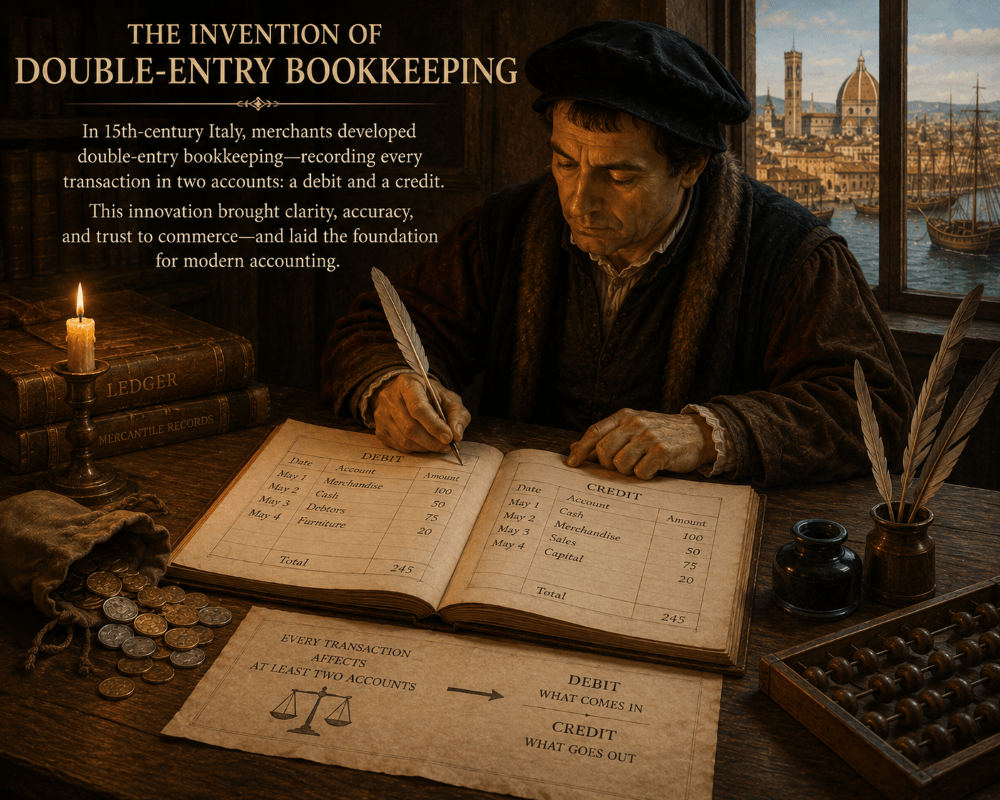
Few innovations in business history are less glamorous, and more important, than double-entry bookkeeping. Developed and refined by Italian merchants during the medieval and early Renaissance periods, this simple accounting method gave entrepreneurs something they had never reliably had before: an accurate, verifiable picture of their own financial position. Without it, much of the complex trade, banking, and partnership structures explored throughout this series would have been far riskier, or simply impossible.
What Is Double-Entry Bookkeeping?
Double-entry bookkeeping is an accounting system in which every financial transaction is recorded in two places: as a debit in one account and a corresponding credit in another.
- This dual recording ensures that a business’s books always stay balanced.
- It allows merchants to track assets, liabilities, income, and expenses simultaneously rather than in isolation.
- Errors and fraud become far easier to detect, since the two entries must always match.
Compared to earlier single-entry methods, which simply listed transactions in a running list, this approach gave merchants a far more complete and trustworthy financial picture.
Why Medieval Merchants Needed Better Accounting
The Limits of Single-Entry Records
Before double-entry bookkeeping spread widely, merchants relied on simpler record-keeping methods that worked reasonably well for small, local transactions but broke down at scale.
- Single-entry records made it difficult to see a business’s true financial position at any given moment.
- Errors were hard to catch, since there was no built-in system for cross-checking entries.
- As trade grew more complex, involving partnerships, loans, and multi-region operations, these limitations became serious liabilities.
Merchants engaged in long-distance trade, banking, and multi-partner ventures needed something more reliable.
Italian City-States as the Birthplace
Double-entry bookkeeping developed primarily among merchants in Italian trading cities like Venice, Genoa, and Florence during the 13th and 14th centuries.
- These cities were hubs of complex commercial activity, including international trade, banking, and partnerships.
- Merchants needed accurate records to manage multiple simultaneous ventures and satisfy business partners and investors.
- The system likely evolved gradually through practical merchant experience rather than being invented by a single individual.
Luca Pacioli and the Codification of Double-Entry Bookkeeping
The Father of Modern Accounting
While Italian merchants developed the practice over generations, it was Luca Pacioli, a Franciscan friar and mathematician, who formally documented and popularized the system.
- In 1494, Pacioli published Summa de Arithmetica, a comprehensive mathematics text that included a detailed section on double-entry bookkeeping.
- His work didn’t invent the method but systematized it clearly enough that merchants across Europe could learn and apply it consistently.
- Pacioli is often called the “Father of Accounting” because of this contribution.
Why Documentation Mattered
Pacioli’s decision to formally write down and publish accounting practices had an outsized impact on European commerce.
- It allowed merchants outside Italy to adopt the same reliable system.
- It standardized terminology and methods, making cross-border business dealings easier to understand and trust.
- The printing press, invented decades earlier, helped Pacioli’s work spread far more widely than earlier handwritten merchant guides could have.
How Double-Entry Bookkeeping Transformed Business
Enabling Complex Partnerships
Accurate accounting made it possible for merchants to safely enter into more sophisticated business arrangements.
- Partners could verify profit and loss shares with far greater confidence.
- Investors gained a clearer picture of a venture’s financial health before committing capital.
- Banking families, including institutions like the Medici, relied heavily on rigorous accounting to manage multi-city operations.
Building Trust at Scale
Perhaps most importantly, double-entry bookkeeping helped solve one of commerce’s oldest problems: trust between people who didn’t know each other well.
- Clear, verifiable records reduced disputes between business partners.
- They gave lenders more confidence when extending credit to merchants.
- They created a paper trail that supported more complex, long-distance economic relationships.
Lessons from Double-Entry Bookkeeping
- Systems create scale. Reliable accounting allowed businesses to grow far beyond what informal tracking could support.
- Documentation multiplies impact. Pacioli’s decision to publish existing practices helped spread the system across an entire continent.
- Trust requires transparency. Verifiable records made complex partnerships and lending relationships possible.
Frequently Asked Questions
Who invented double-entry bookkeeping? No single person invented double-entry bookkeeping. It developed gradually among Italian merchants, and was later formally documented by Luca Pacioli in 1494.
Why is double-entry bookkeeping important? It allows businesses to track their full financial position accurately, making it easier to detect errors, manage partnerships, and build trust with lenders and investors.
What did Luca Pacioli contribute to accounting? Pacioli published the first widely circulated, detailed description of double-entry bookkeeping, helping standardize and spread the practice across Europe.
How did double-entry bookkeeping impact medieval trade? It enabled more complex partnerships, safer lending, and better financial oversight, supporting the growth of banking and long-distance commerce during the medieval and Renaissance periods.
Related Articles
- Jakob Fugger: The Banker Who Financed Emperors
- Marco Polo: The Merchant Who Reopened East-West Trade
- Jewish Merchants: Diaspora Networks and the Power of Portable Trust
- The Islamic Golden Age: How Knowledge, Finance, and Global Trade Transformed Entrepreneurship
- Venice: How Merchant Capitalism Built a Commercial Empire
- The Medici Bank: How Banking Became an International Business
- The Phoenicians: How Maritime Trade Connected the Ancient World
About The History of Entrepreneurship
This article is part of The History of Entrepreneurship, an ongoing series exploring how civilizations, merchants, technologies, institutions, and entrepreneurs gradually created the foundations of modern business.