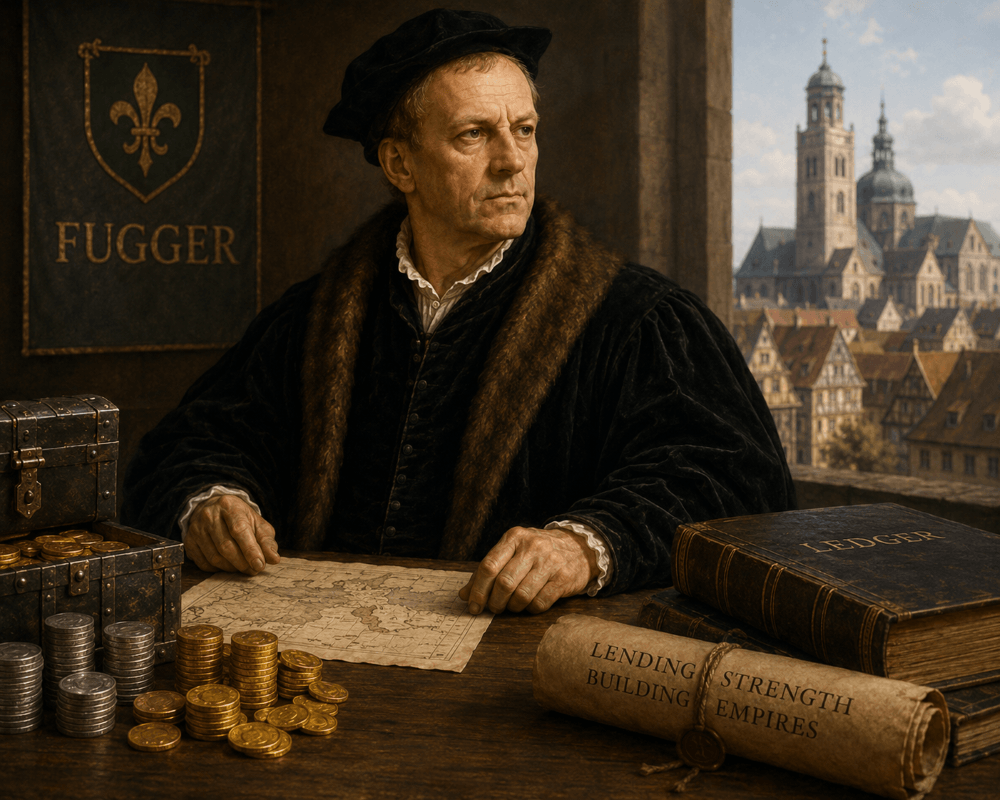
Jakob Fugger built one of the largest fortunes in human history not through conquest or inheritance alone, but through banking, mining, and a willingness to lend to the most powerful rulers in Europe. Operating out of Augsburg in the late 15th and early 16th centuries, Fugger created a financial empire so vast that some historians consider him the richest man who ever lived, adjusted for the size of the economies he operated in. His story marks a turning point where finance itself became one of history’s most powerful entrepreneurial tools.
Who Was Jakob Fugger?
Jakob Fugger was born in 1459 into a German merchant family already active in the textile trade. Rather than simply continuing the family business, he transformed it into something far more ambitious.
- He trained partly in Venice, absorbing sophisticated Italian banking and accounting practices.
- He took over leadership of the family firm in the 1480s, steadily shifting its focus from trade goods toward finance and mining.
- By the early 1500s, the Fugger family had become the dominant banking house in Europe.
His nickname, “Jakob Fugger the Rich,” reflected just how extraordinary his fortune became during his lifetime.
How Jakob Fugger Built His Empire
Mining as a Foundation
Long before he became known primarily as a banker, Fugger built substantial wealth through mining operations.
- He secured control over silver and copper mines across Central Europe, particularly in Tyrol and Hungary.
- He modernized extraction techniques, increasing output and profitability significantly.
- These mining profits gave him the capital base needed to expand aggressively into banking.
Controlling raw material production gave Fugger a financial foundation that pure merchants and traders often lacked.
Banking and Loans to Royalty
Fugger’s most consequential business decision was lending directly to Europe’s most powerful rulers.
- He financed the Habsburg family, including loans that helped secure the imperial election of Charles V in 1519.
- He extended credit to the Catholic Church, including financing related to the sale of indulgences.
- His loans came with real leverage, often securing mining rights, trade privileges, or political influence in return.
This strategy transformed Fugger from a wealthy merchant into a figure whose financial decisions could directly shape European politics.
The Fugger Banking Network
A Truly International Operation
Under Jakob Fugger’s leadership, the family firm expanded into a genuinely international financial network.
- The firm maintained trading posts and banking relationships across major European cities.
- It developed sophisticated accounting systems to track complex, multi-region financial transactions.
- This scale of organization was unusual for the era and helped set standards for modern banking practices.
Financing an Empire’s Election
One of Fugger’s most striking demonstrations of financial power came in 1519, when Charles V sought election as Holy Roman Emperor.
- Securing the position required substantial bribes to the electors who would decide the outcome.
- Fugger personally financed a significant portion of these payments.
- Without this financing, historians widely agree Charles V’s election would have been far less certain.
Few private individuals in history have had this direct a financial hand in determining who ruled an empire.
Jakob Fugger’s Broader Business Ventures
Beyond mining and banking, Fugger diversified his interests across multiple industries.
- He invested in spice trading, connecting his financial network to broader European commerce.
- He funded artistic and architectural projects, including the Fuggerei in Augsburg, an early social housing project for the poor that still operates today.
- He carefully documented and protected his business records, some of which survive and provide valuable insight into early modern finance.
Lessons from Jakob Fugger
- Control your inputs. Owning mining operations gave Fugger a capital advantage most rivals couldn’t match.
- Lending creates leverage. Financing powerful clients gave Fugger influence far beyond his direct business interests.
- Diversify deliberately. Mining, banking, trade, and even social projects all strengthened Fugger’s overall position.
Frequently Asked Questions
Was Jakob Fugger really the richest man in history? Many historians and economists rank Jakob Fugger among the wealthiest individuals ever, particularly when his fortune is measured against the size of the European economy at the time.
How did Jakob Fugger make his money? He built his fortune primarily through silver and copper mining, combined with large-scale banking and lending to powerful European rulers and the Catholic Church.
Why did Jakob Fugger finance Charles V’s election? Financing Charles V’s election as Holy Roman Emperor secured Fugger significant political influence and protected his extensive business interests across the empire.
What is the Fuggerei? The Fuggerei is a social housing complex in Augsburg founded by Jakob Fugger for the city’s poor, and it remains in operation today as one of the world’s oldest social housing projects.
Related Articles
- Marco Polo: The Merchant Who Reopened East-West Trade
- Jewish Merchants: Diaspora Networks and the Power of Portable Trust
- The Islamic Golden Age: How Knowledge, Finance, and Global Trade Transformed Entrepreneurship
- Venice: How Merchant Capitalism Built a Commercial Empire
- The Medici Bank: How Banking Became an International Business
- The Phoenicians: How Maritime Trade Connected the Ancient World
About The History of Entrepreneurship
This article is part of The History of Entrepreneurship, an ongoing series exploring how civilizations, merchants, technologies, institutions, and entrepreneurs gradually created the foundations of modern business.