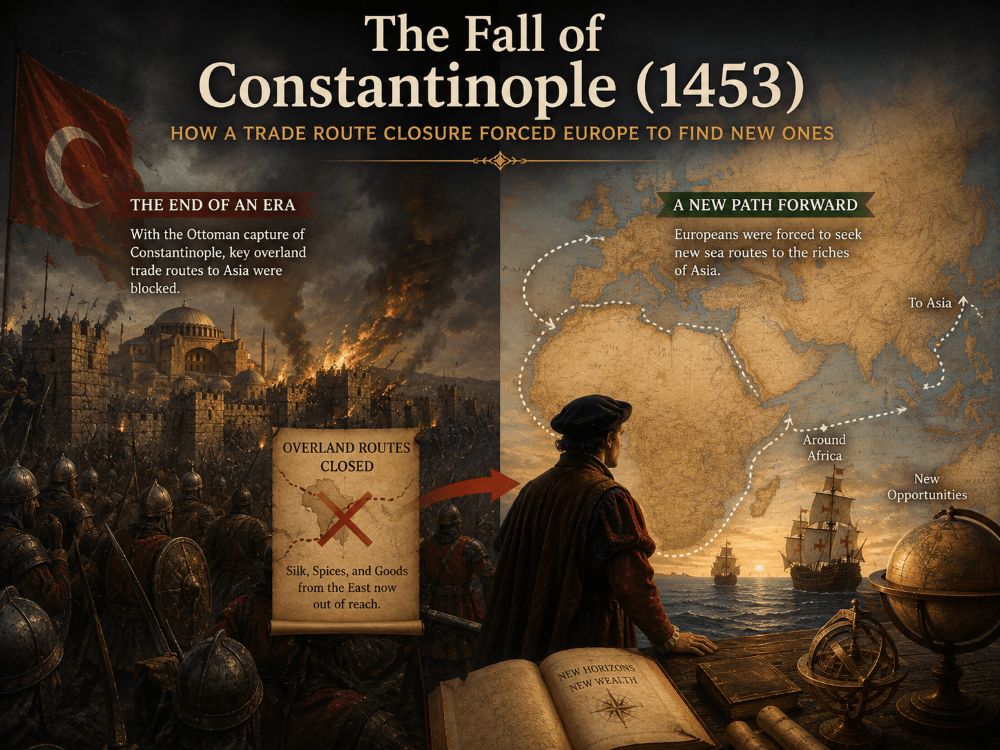
The Fall of Constantinople in 1453 wasn’t just a military and political turning point — it was a supply chain disruption that reshaped the global economy for centuries. When Ottoman forces captured the city, they didn’t just end the Byzantine Empire; they gained control over one of the most valuable trade chokepoints connecting Europe to Asia. The commercial fallout pushed European merchants and monarchs toward a bold and risky solution: finding entirely new routes to the wealth of the East.
What Happened at the Fall of Constantinople?
Constantinople had served for over a thousand years as a critical link between European and Asian trade networks. Its position controlled access between the Mediterranean and Black Seas, making it one of history’s most strategically valuable trading cities.
- In 1453, Ottoman forces under Sultan Mehmed II besieged and captured the city after weeks of intense fighting.
- This ended the Byzantine Empire, which had ruled from Constantinople for over a millennium.
- The Ottoman Empire immediately gained control over trade routes that had funneled goods between Asia and Europe for centuries.
For European merchants who had relied on this route, the change in control created immediate and serious commercial uncertainty.
Why This Trade Disruption Mattered So Much
A Critical Link in Global Commerce
Before 1453, Constantinople functioned as a crucial gateway for goods moving along extensions of the old Silk Road and other Eastern trade networks.
- Spices, silk, and other valuable Asian goods regularly passed through the city on their way to European markets.
- Italian merchant states, particularly Venice and Genoa, had built extensive trading relationships tied to access through this region.
- European economies had grown dependent on relatively stable, predictable access to these Eastern luxury goods.
Losing reliable access to this established pathway threatened profits that had been consistent for generations.
Rising Costs and Restricted Access
Ottoman control didn’t necessarily mean trade stopped entirely, but conditions changed significantly for European merchants.
- Higher tariffs and taxes increased the cost of goods passing through Ottoman-controlled territory.
- Political tensions between European powers and the Ottoman Empire created additional uncertainty and risk.
- European merchants increasingly felt the strategic vulnerability of depending on a single, now less favorable, overland route.
This combination of higher costs and political risk created exactly the kind of pressure that pushes entrepreneurs toward radical alternatives.
How the Fall of Constantinople Fueled the Age of Exploration
A Direct Motivation for New Routes
The disruption caused by the fall of Constantinople is widely considered one of the key motivations behind Europe’s push to find alternative paths to Asia.
- Portuguese exploration efforts, already underway under Prince Henry the Navigator‘s earlier program, gained renewed urgency and support.
- Investors and monarchs became more willing to fund risky, long-term exploration ventures in search of alternative trade access.
- The search for new routes eventually led to major breakthroughs, including Vasco da Gama‘s sea route to India and Columbus‘s westward voyages.
Turning Crisis into Opportunity
European powers responded to this trade disruption not by accepting reduced access, but by aggressively pursuing entirely new commercial pathways.
- Portugal intensified its focus on finding a sea route around Africa to bypass Ottoman-controlled territory entirely.
- Spain eventually funded westward exploration, partly motivated by similar goals of finding alternative access to Asian trade.
- This period of intense exploration fundamentally reshaped global trade patterns away from traditional overland routes.
The Long-Term Economic Impact
Shifting Power Toward Atlantic Europe
The search for alternative trade routes gradually shifted economic power away from Mediterranean trading cities toward Atlantic-facing nations.
- Venice and Genoa, previously dominant in Eastern trade, saw their commercial influence gradually decline relative to Portugal and Spain.
- New sea routes reduced dependence on any single overland chokepoint controlled by a rival power.
- This shift laid the groundwork for the colonial trading empires that would dominate the following centuries.
A Lesson in Strategic Vulnerability
The fall of Constantinople offers a clear historical example of what happens when businesses or economies depend too heavily on a single, vulnerable supply route.
- Overreliance on one trade path left European economies exposed to a single political and military event.
- The resulting scramble for alternatives ultimately produced far more diversified and resilient global trade networks.
- This diversification, while commercially transformative, also carried enormous human costs through colonization efforts explored elsewhere in this series.
Lessons from the Fall of Constantinople
- Concentration creates vulnerability. Relying on a single trade route left European economies exposed to sudden disruption.
- Crisis can accelerate innovation. The urgency created by this disruption helped fund and justify extremely risky exploration ventures.
- Diversification builds resilience. The eventual development of multiple trade routes reduced dependence on any single chokepoint.
Frequently Asked Questions
Why was the Fall of Constantinople significant for trade? It gave the Ottoman Empire control over a critical trade route connecting Europe and Asia, increasing costs and uncertainty for European merchants who had relied on it for centuries.
Did trade stop completely after the Fall of Constantinople? No, trade continued under Ottoman control, but higher tariffs, taxes, and political tensions made the route significantly less favorable for European merchants.
How did the Fall of Constantinople lead to the Age of Exploration? The disruption pushed European monarchs and investors to fund alternative routes to Asia, directly motivating expeditions like Vasco da Gama’s sea route to India and Columbus’s westward voyages.
Which European trade centers were most affected by the Fall of Constantinople? Italian trading powers, particularly Venice and Genoa, were significantly affected as their established Eastern trade routes became less accessible and reliable.
Related Articles
- Vasco da Gama: Building the Portuguese Spice Monopoly
- Christopher Columbus: Exploration as a Business Pitch
- Prince Henry the Navigator: The First Venture Capitalist
- The Age of Exploration: When Entrepreneurship Went Global
About The History of Entrepreneurship
This article is part of The History of Entrepreneurship, an ongoing series exploring how civilizations, merchants, technologies, institutions, and individual entrepreneurs gradually created the foundations of modern business.