| 📊 Alain’s Holdings — August 24, 2026 | ||||
|---|---|---|---|---|
| Symbol | Name | Price | Change | Change % |
| VOO | Vanguard S&P 500 ETF | 701.83 | -1.88 | -0.27% |
| QQQ | Invesco QQQ Trust | 706.32 | -7.12 | -1.00% |
| XIU.TO | iShares S&P/TSX 60 ETF | 54.47 | +0.11 | +0.20% |
Wall Street started the week with a major rotation out of technology.
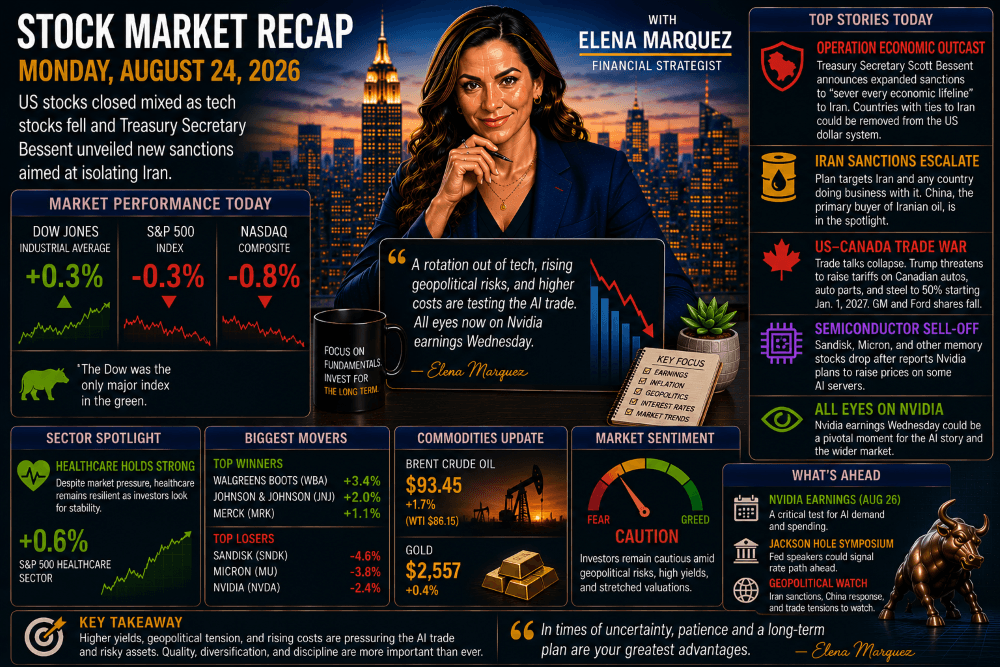
The Nasdaq fell 0.8% as semiconductor stocks came under pressure ahead of Nvidia’s highly anticipated earnings. At the same time, investors digested a significant escalation in U.S. economic pressure on Iran and a renewed trade confrontation with Canada.
Market Performance
- 📈 Dow Jones Industrial Average: +0.3%
- 📉 S&P 500: -0.3%
- 📉 Nasdaq Composite: -0.8%
The Dow was the only major index to finish higher, suggesting investors weren’t abandoning stocks altogether. Instead, money appeared to be rotating away from technology.
Semiconductor Stocks Take Another Hit
The weakness in technology was concentrated once again in semiconductors.
Sandisk, Micron and other memory-related stocks declined following reports that Nvidia plans to increase prices on some AI servers.
That’s interesting because higher prices can be interpreted in two very different ways.
On one hand, Nvidia’s ability to raise prices could signal that demand remains extraordinarily strong.
On the other, increasingly expensive AI infrastructure could put additional pressure on companies spending hundreds of billions of dollars building data centers.
Last week’s sell-off already demonstrated that investors are becoming more sensitive to the cost of financing the AI boom.
Now the cost of the hardware itself could be rising too.
“Operation Economic Outcast”
The day’s biggest geopolitical development came from Treasury Secretary Scott Bessent.
Bessent announced “Operation Economic Outcast,” a new sanctions campaign intended to isolate Iran from the global economy.
The administration says it intends to target not only Iran but also countries that continue doing business with the regime, potentially removing them from access to the U.S. dollar system.
That creates an obvious question:
What happens with China?
China is a major buyer of Iranian oil. Aggressive enforcement against countries trading with Tehran could therefore turn the Iran conflict into another source of economic friction between Washington and Beijing.
For investors, the biggest immediate risk remains energy.
Anything that further restricts Iranian oil exports could tighten global supplies and put renewed upward pressure on crude prices and inflation.
The U.S.-Canada Trade War Returns
Iran wasn’t the only geopolitical problem.
U.S.-Canada trade negotiations broke down over the weekend, and Canada suspended talks while preparing retaliatory tariffs.
President Trump then threatened to increase tariffs on Canadian automobiles, auto parts and steel to 50% beginning January 1, 2027.
Shares of General Motors and Ford moved lower.
This matters because the North American automobile industry is extraordinarily integrated.
Vehicles and components can cross the U.S.-Canada border multiple times during production.
A 50% tariff therefore wouldn’t simply affect Canadian manufacturers. It could significantly increase costs throughout the North American automotive supply chain.
Everything Now Comes Down to Nvidia
Despite tariffs, Iran and trade tensions, Wall Street’s attention is increasingly turning toward one company:
Nvidia.
Nvidia reports earnings Wednesday.
And this may be one of its most important reports yet.
Investors are no longer simply asking whether demand for AI chips is growing.
We already know enormous amounts of money are flowing into AI.
The harder question is:
Can the extraordinary level of AI investment generate sufficient returns to justify the spending?
Last week provided a warning.
The Philadelphia Semiconductor Index fell 5.5%, while Nvidia lost more than 4.5% as higher Treasury yields raised concerns about the cost of financing AI infrastructure.
Expectations for Wednesday are therefore extremely high.
A good quarter may not be enough.
Nvidia may need to deliver an exceptional quarter—and convince investors that demand remains exceptional too.
The Bottom Line
Monday’s market wasn’t a broad sell-off.
It was a rotation.
The Dow rose while the Nasdaq fell sharply, suggesting investors were reducing exposure to technology rather than abandoning equities altogether.
But the pressure on AI stocks deserves attention.
AI infrastructure is becoming more expensive.
Financing is becoming more expensive.
Semiconductor valuations remain high.
And investors increasingly want evidence that trillions of dollars of investment will eventually produce equally extraordinary profits.
At the same time, geopolitical risks are multiplying.
Iran sanctions could collide with China.
U.S.-Canada trade tensions are escalating.
And energy markets remain vulnerable.
Then, on Wednesday, Nvidia steps onto the stage.
For much of this bull market, Nvidia has represented the promise of artificial intelligence.
This week, Wall Street wants to see the receipts.
Other Stock Market blog posts