It was an unusually turbulent late-summer week on Wall Street.
Stocks fell, oil climbed, Treasury yields remained near multi-year highs, and the U.S. national debt crossed $40 trillion for the first time. Together, those forces raised an increasingly important question for investors:
Is the price of money becoming a threat to the AI boom?
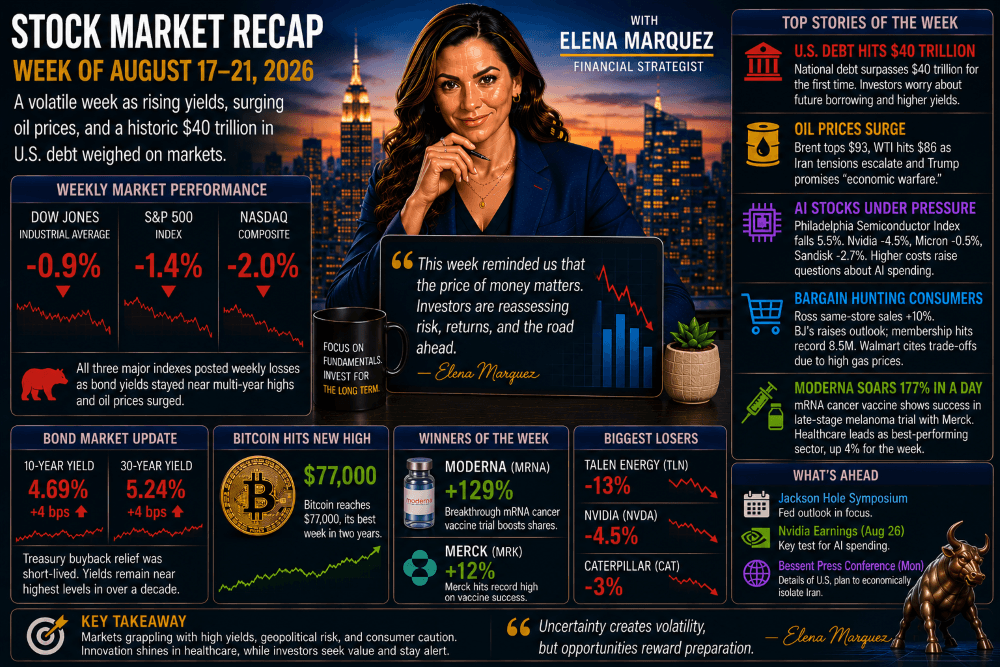
Weekly Market Performance
- 📉 Nasdaq Composite: -2.0%
- 📉 S&P 500: -1.4%
- 📉 Dow Jones Industrial Average: -0.9%
All three major indexes finished lower, with technology suffering the biggest losses.
The $40 Trillion Elephant in the Room
The biggest long-term story of the week may have come from the bond market rather than the stock market.
The U.S. national debt surpassed $40 trillion.
Investors expect Washington will need to continue issuing enormous quantities of debt to finance deficits and refinance existing obligations.
At the same time, the conflict with Iran has pushed energy prices higher, keeping inflation risks alive.
Bond investors are responding by demanding higher returns to lend their money for long periods.
Treasury Secretary Scott Bessent attempted to relieve some of that pressure by increasing government purchases of long-dated Treasurys.
Yields initially fell.
Then they bounced right back.
That sends an important message: the bond market is becoming increasingly difficult to ignore.
Is the AI Boom Running Into the Bond Market?
Artificial intelligence was one of the biggest casualties.
The Philadelphia Semiconductor Index fell 5.5% for the week.
Among individual companies:
- Nvidia: -4.5%
- Micron: -0.5%
- Sandisk: -2.7%
- Talen Energy: -13%
- Caterpillar: -3%+
At first glance, these companies have very different businesses.
But they’re increasingly connected by one enormous investment cycle:
AI infrastructure.
Building the AI economy requires data centers, semiconductors, memory, networking equipment, electricity, generators and billions of dollars in financing.
According to the figures you provided, nine major technology companies have made roughly $3 trillion in off-balance-sheet commitments, much of it related to AI.
And companies are increasingly turning to debt markets to finance those ambitions.
That creates an interesting paradox.
The AI boom has been one of the biggest forces pushing stocks higher.
But financing the AI boom creates additional demand for capital—which can contribute to higher borrowing costs.
And higher borrowing costs make the AI boom itself more expensive.
The Consumer Wants a Bargain
Retail earnings delivered another important message this week:
Americans are still spending, but they’re becoming much more selective.
Ross Stores reported a remarkable 10% increase in same-store sales, with stronger customer traffic and new shoppers coming from multiple income groups.
Yet Ross shares finished the week 2.6% lower, although they’re still up about 27% this year.
BJ’s Wholesale Club told a similar story.
Membership reached a record 8.5 million, sales increased across income groups, and management raised its profit outlook.
BJ’s shares finished the week more than 3% higher.
The pattern is becoming difficult to miss.
Consumers haven’t disappeared.
They’re hunting for value.
Walmart Sends a Warning
Walmart offered the other side of the consumer story.
The retailer said higher gasoline prices and years of accumulated inflation are forcing some lower-income customers to make increasingly difficult trade-offs between necessities.
Meanwhile, large discretionary purchases are being postponed.
Home Depot and Lowe’s are seeing consumers favor smaller projects rather than expensive renovations.
This matters far beyond retail stocks.
Consumer spending is one of the largest engines of the U.S. economy.
If households remain cautious but continue spending, the economy can probably keep growing.
If caution turns into outright retrenchment, corporate earnings could eventually suffer.
For now:
Consumers are still opening their wallets. They’re simply becoming much more careful about where.
Moderna’s Extraordinary 177% Day
Amid all the week’s turmoil, healthcare delivered an extraordinary bright spot.
Moderna surged 177% Wednesday, reportedly the biggest single-day gain for an S&P 500 stock in 25 years.
The catalyst could potentially be much more important than the stock move itself.
Moderna and Merck announced successful late-stage trial results for an experimental personalized mRNA cancer vaccine targeting high-risk melanoma.
The treatment uses the same underlying mRNA technology that became famous through Moderna’s COVID-19 vaccine.
But this time, the objective is cancer.
The successful trial offers potentially important validation that mRNA technology could have applications far beyond infectious diseases.
Moderna finished the week approximately 129% higher, while Merck gained about 12% and reached a record high.
Healthcare became the best-performing S&P 500 sector, gaining more than 4%.
Bitcoin Was Another Winner
There was another notable escape from the week’s turmoil.
Bitcoin surged to roughly $77,000, recording its strongest week in two years.
The timing was interesting.
Treasury yields remained elevated.
Government debt crossed $40 trillion.
And policymakers intervened in the Treasury market.
Bitcoin’s long-term role as an alternative to traditional financial assets remains debated, but this week investors clearly wanted exposure.
The Bottom Line
This week provided an important reminder that capital isn’t free.
For years, investors have focused on the extraordinary potential of artificial intelligence.
But building that future requires staggering amounts of money.
When Treasury yields rise, the cost of financing data centers, semiconductor factories, power infrastructure and virtually everything else rises with them.
At the same time, $90+ oil is squeezing consumers and threatening the recent improvement in inflation.
Yet the week wasn’t entirely negative.
Consumers are still spending.
Value retailers are thriving.
Healthcare delivered a potentially historic scientific breakthrough.
And Bitcoin had its strongest week in two years.
The market’s leadership may simply be changing.
Next week brings two major tests: the Federal Reserve’s Jackson Hole symposium and Nvidia’s earnings on August 26.
One could tell us where the price of money is heading.
The other could tell us whether the AI boom remains strong enough to pay for it.
Other Stock Market blog posts