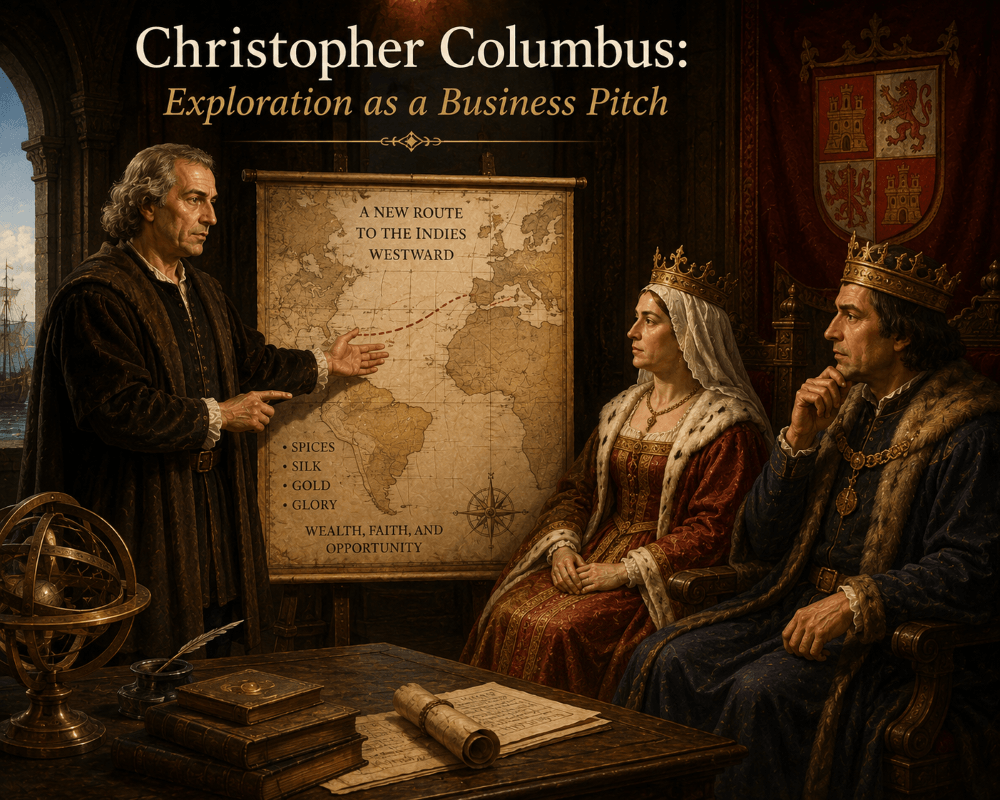
Christopher Columbus is remembered as an explorer, but his voyages began as something far more familiar to modern entrepreneurs: a business pitch. For nearly a decade, Columbus shopped a bold, risky proposal to European royal courts, seeking funding for a westward route to Asia. His story reveals as much about persistence, negotiation, and deal-making as it does about navigation, and it remains one of history’s most consequential — and most damaging — examples of speculative investment.
Who Was Christopher Columbus?
Christopher Columbus was born around 1451 in Genoa, a city with a long maritime and trading tradition. Before pursuing his famous voyage, he built genuine seafaring experience across the Mediterranean and Atlantic.
- He worked as a sailor and merchant, gaining firsthand navigational experience on multiple voyages.
- He studied existing maps, navigational theories, and calculations about the size of the Earth, some of which were significantly inaccurate.
- He became convinced that sailing west across the Atlantic offered a shorter route to Asia than the routes Portuguese explorers were developing around Africa.
This conviction, based partly on flawed calculations, became the foundation of a proposal he would spend years trying to sell.
Pitching the Voyage: Christopher Columbus as Fundraiser
Years of Rejection
Long before Columbus ever set sail, he faced the very modern entrepreneurial challenge of securing funding for an unproven, high-risk venture.
- He first pitched his westward route proposal to King John II of Portugal, who rejected it after his advisors judged Columbus’s distance calculations unrealistic.
- He then approached Spain, England, and France, facing rejection or prolonged delays at each court.
- It took years of persistence, and a favorable shift in Spanish politics, before Queen Isabella and King Ferdinand of Spain finally agreed to fund his expedition in 1492.
This drawn-out fundraising process mirrors what many entrepreneurs still experience when pitching unconventional ideas to skeptical investors.
Negotiating the Terms
Columbus didn’t simply accept whatever funding was offered. He negotiated specific terms in exchange for taking on the voyage’s risk.
- He secured the title of Admiral of the Ocean Sea, along with hereditary rights to the title.
- He negotiated a share of any wealth, trade, or resources discovered during the expedition.
- He was granted authority to govern any lands he claimed on Spain’s behalf.
These terms functioned much like an early modern equity and royalty agreement, tying his personal reward directly to the venture’s success.
The Voyage and Its Immediate Impact
Crossing the Atlantic
In August 1492, Columbus set sail with three ships: the Niña, the Pinta, and the Santa María. After roughly ten weeks at sea, his expedition reached land in the Caribbean in October 1492.
- Columbus believed he had reached islands near Asia, a miscalculation that shaped how the “New World” was understood for years afterward.
- His return to Spain with news of newly discovered lands triggered immediate excitement and further investment in exploration.
- Columbus completed three additional voyages across the Atlantic in the years that followed.
A Devastating Human Cost
The commercial success of Columbus’s voyages came at an enormous and undeniable human cost.
- His expeditions led directly to the colonization of Caribbean islands, accompanied by violence, forced labor, and disease that devastated Indigenous populations.
- Columbus himself implemented brutal policies, including forced labor and tribute systems, against Indigenous peoples under his governance.
- These consequences remain a central and inseparable part of his historical legacy, distinct from any framing of his voyages as a business success story.
Christopher Columbus and the Business of Exploration
Turning Discovery into Ongoing Investment
Columbus’s initial voyage triggered a much larger pattern of European investment in transatlantic exploration.
- Spain rapidly expanded funding for further voyages and colonization efforts following his reports.
- Other European powers accelerated their own exploration programs in response, fearing they would fall behind Spain and Portugal.
- This competitive dynamic reshaped global trade patterns for centuries afterward.
Lessons in Persistence and Negotiation
Setting aside the devastating consequences of colonization, Columbus’s fundraising and negotiation process offers clear entrepreneurial lessons.
- Persistence can overcome repeated rejection. Columbus faced years of refusal before finally securing funding.
- Negotiate terms before committing. He secured meaningful upside for himself before accepting the venture’s risk.
- Timing and circumstance matter. Spain’s political situation in 1492 finally aligned in his favor after years of failed attempts elsewhere.
Frequently Asked Questions
How did Christopher Columbus fund his voyage? After years of rejection from Portugal and other courts, Columbus secured funding from Spain’s Queen Isabella and King Ferdinand in 1492, along with negotiated titles and a share of future profits.
Did Christopher Columbus know he reached a new continent? No, Columbus believed until his death that he had reached islands near Asia, never fully recognizing that he had encountered a previously unknown-to-Europeans continent.
What did Columbus negotiate before his voyage? He negotiated the title Admiral of the Ocean Sea, a share of wealth discovered, and governing authority over any lands claimed on Spain’s behalf.
What was the human cost of Columbus’s voyages? His voyages led to colonization marked by violence, forced labor, and disease that devastated Indigenous Caribbean populations, a consequence widely recognized as one of history’s great tragedies.
Related Articles
- Prince Henry the Navigator: The First Venture Capitalist
- The Age of Exploration: When Entrepreneurship Went Global
- Double-Entry Bookkeeping: The Idea That Built Modern Business
- Jakob Fugger: The Banker Who Financed Emperors
- Marco Polo: The Merchant Who Reopened East-West Trade
- Jewish Merchants: Diaspora Networks and the Power of Portable Trust
- The Islamic Golden Age: How Knowledge, Finance, and Global Trade Transformed Entrepreneurship
- Venice: How Merchant Capitalism Built a Commercial Empire
- The Medici Bank: How Banking Became an International Business
- The Phoenicians: How Maritime Trade Connected the Ancient World
About The History of Entrepreneurship
This article is part of The History of Entrepreneurship, an ongoing series exploring how civilizations, merchants, technologies, institutions, and individual entrepreneurs gradually created the foundations of modern business.