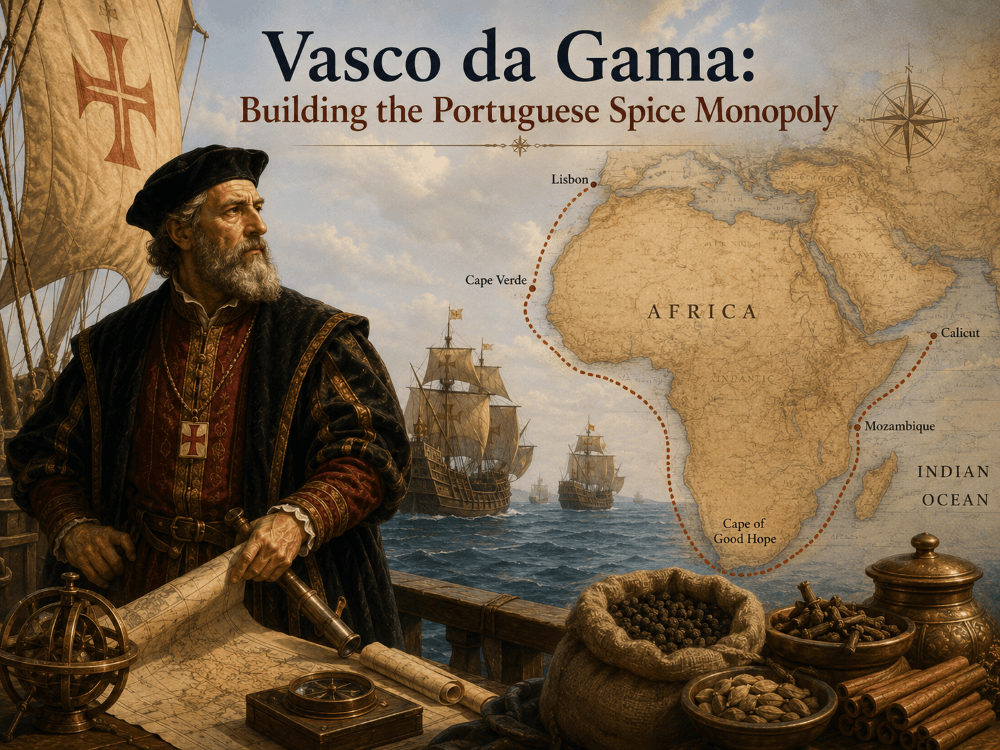
Vasco da Gama did what decades of Portuguese exploration had been building toward: he found a direct sea route from Europe to India, and in doing so, opened the door to one of history’s most ruthless trade monopolies. His 1498 voyage didn’t just prove a route was possible — it launched a Portuguese strategy of controlling the spice trade through naval force rather than negotiation. His story shows how exploration, once successful, quickly turned into aggressive market control.
Who Was Vasco da Gama?
Vasco da Gama was born around 1460 in Sines, Portugal, into a family with some standing at court. He built his early reputation through naval service before being selected for one of history’s most consequential voyages.
- King Manuel I of Portugal chose da Gama in 1497 to lead an expedition seeking a direct sea route to India.
- This mission built directly on decades of exploration funded and organized under Prince Henry the Navigator’s earlier program.
- Da Gama’s fleet of four ships set out with the explicit commercial goal of reaching India’s spice markets by sea.
Unlike Columbus, who sailed west based on flawed assumptions about the Earth’s size, da Gama followed a route grounded in accumulated Portuguese navigational knowledge gathered over generations.
The Voyage That Reached India
Rounding Africa
Da Gama’s expedition followed the African coastline south, then turned east around the Cape of Good Hope, a route Portuguese sailors had spent decades preparing to attempt.
- His fleet successfully rounded the Cape of Good Hope in late 1497.
- It continued north along Africa’s eastern coast, stopping at trading ports already connected to Indian Ocean commerce.
- In May 1498, da Gama’s ships reached Calicut, on India’s southwestern coast, becoming the first European expedition to arrive in India by sea.
This achievement finally delivered what Prince Henry the Navigator’s program had spent decades pursuing: a direct maritime path to Asian trade, bypassing overland routes controlled by Middle Eastern and Italian intermediaries.
A Difficult First Encounter
Da Gama’s arrival in India didn’t go smoothly. Local rulers and merchants, already embedded in established Indian Ocean trade networks, were unimpressed by the modest trade goods he brought to offer.
- His gifts were considered too low in value for serious trade negotiations.
- Existing Arab and Indian merchants viewed the Portuguese as unwelcome new competitors.
- Da Gama returned to Portugal in 1499 having secured only limited trade agreements, despite the historic nature of the voyage itself.
From Exploration to the Portuguese Spice Monopoly
A Different Approach on Return
Portugal’s response to this lukewarm first outcome revealed a critical shift in strategy. Rather than negotiating harder, they escalated with force.
- Subsequent Portuguese expeditions arrived with substantially greater naval firepower.
- Portugal began attacking rival merchant ships and coastal cities to assert dominance over trade routes.
- Da Gama himself led a more heavily armed second voyage in 1502, during which Portuguese forces committed brutal acts of violence against Indian Ocean shipping and coastal communities.
This shift transformed Portugal’s presence in the region from cautious trading partner to aggressive military and commercial power.
Controlling the Spice Trade by Force
Portugal’s approach to building its spice monopoly relied heavily on naval control rather than fair competition.
- Portuguese forces seized key ports and strategic chokepoints along Indian Ocean trade routes.
- They imposed a system requiring local ships to purchase Portuguese trading licenses or face attack.
- This system allowed Portugal to tax and control a large share of the enormously profitable spice trade flowing into Europe.
Pepper, cinnamon, and other spices, once distributed through complex multi-party trade networks, increasingly flowed through Portuguese-controlled channels.
The Economic Impact of Portuguese Control
Profits for the Crown
The Portuguese spice monopoly generated enormous wealth for the crown and its merchant class.
- Spices purchased cheaply in Asia sold at dramatically higher prices in European markets.
- Portugal’s control over key routes allowed it to limit competition and set favorable terms.
- Lisbon became one of Europe’s wealthiest trading cities as a direct result of this controlled trade.
A Monopoly Built on Violence
This commercial success came at a steep cost to existing trade communities across the Indian Ocean.
- Established merchant networks that had operated for centuries faced violent disruption.
- Coastal communities experienced attacks, extortion, and forced trade arrangements.
- Portugal’s monopoly, while commercially effective, represented a stark departure from the more cooperative trade patterns explored earlier in this series.
Lessons from Vasco da Gama and the Spice Monopoly
- First movers gain leverage, but not automatically. Da Gama’s initial voyage succeeded technically but achieved little commercially until backed by force.
- Control of chokepoints creates market power. Portugal’s naval dominance over key routes let it effectively tax existing trade networks.
- Monopoly strategies carry lasting costs. Portugal’s approach generated enormous short-term profit while inflicting serious, lasting harm on established communities.
Frequently Asked Questions
What did Vasco da Gama accomplish? Vasco da Gama led the first European sea voyage directly to India in 1498, opening a maritime trade route that bypassed overland routes controlled by other intermediaries.
How did Portugal build its spice monopoly? Portugal used naval force to control key Indian Ocean trade routes and ports, requiring local ships to purchase trading licenses or face attack, allowing Portugal to dominate spice exports to Europe.
Why was Vasco da Gama’s first voyage considered a commercial disappointment? Local merchants in Calicut viewed his trade goods as too modest for serious negotiation, resulting in only limited agreements despite the historic nature of reaching India by sea.
What was the economic impact of the Portuguese spice monopoly? It generated enormous profits for Portugal by allowing cheaply purchased Asian spices to be sold at high prices in European markets, making Lisbon one of Europe’s wealthiest trading cities.
Related Articles
- Christopher Columbus: Exploration as a Business Pitch
- Prince Henry the Navigator: The First Venture Capitalist
- The Age of Exploration: When Entrepreneurship Went Global
- Double-Entry Bookkeeping: The Idea That Built Modern Business
- Jakob Fugger: The Banker Who Financed Emperors
- Marco Polo: The Merchant Who Reopened East-West Trade
- Jewish Merchants: Diaspora Networks and the Power of Portable Trust
About The History of Entrepreneurship
This article is part of The History of Entrepreneurship, an ongoing series exploring how civilizations, merchants, technologies, institutions, and individual entrepreneurs gradually created the foundations of modern business.