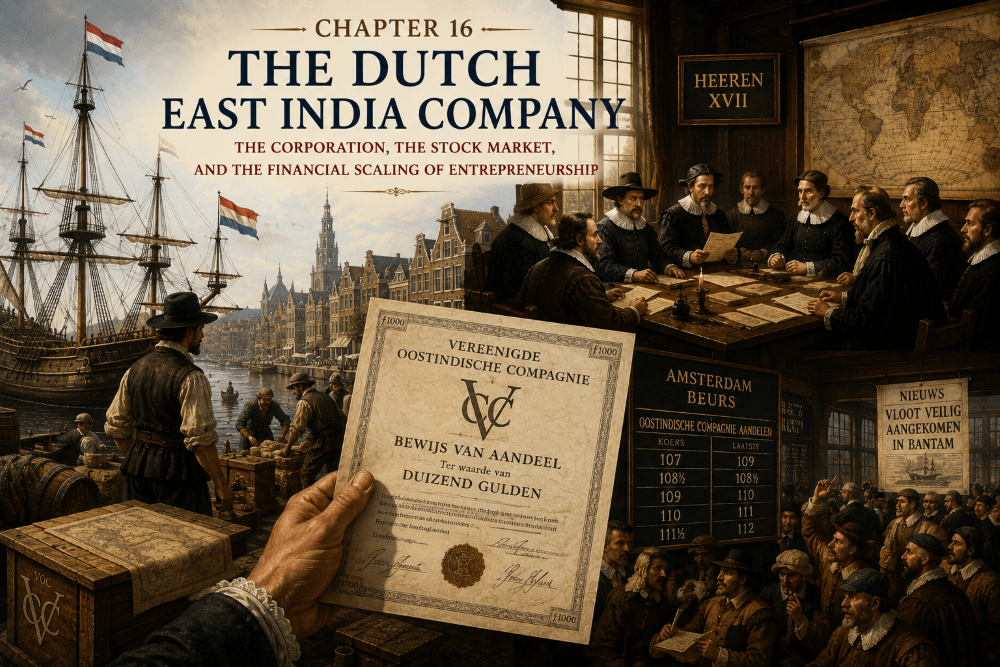
Amsterdam, 1602.
Imagine handing over your savings to a business.
You aren’t buying spices.
You aren’t buying a ship.
You aren’t financing one particular voyage.
Instead, you’re buying something far more abstract:
A piece of the company.
Your money will be combined with capital from other investors.
The company will use that money to finance ships, sailors, cargo, warehouses, trading posts, and voyages across the world.
Professional managers will run the enterprise.
And eventually, if you want to leave?
The company doesn’t necessarily have to give your money back.
You can try to sell your ownership interest to another investor.
The company keeps the capital.
You get your money.
The new investor gets your ownership.
This deceptively simple idea helped change capitalism.
Ownership became tradable while capital could remain inside the business.
At the center of this transformation was the Dutch East India Company, better known by its Dutch initials:
VOC.
What Was the Dutch East India Company?
The Dutch East India Company—Vereenigde Oostindische Compagnie—was established in 1602 after the Dutch government consolidated several competing trading ventures.
Its purpose was primarily to conduct Dutch commerce in Asia.
But calling the VOC simply a “company” understates what it became.
It operated ships.
Warehouses.
Trading posts.
Military forces.
Administrative offices.
It negotiated treaties.
Built forts.
Conducted warfare.
Exercised political authority in parts of Asia.
The VOC was therefore something unusual by modern standards:
Part corporation. Part commercial network. Part military organization. Part instrument of empire.
That combination would make it extraordinarily powerful.
It would also make its history extraordinarily violent.
Why Was the VOC Created?
The answer begins with spices.
European consumers wanted Asian products such as:
- Pepper
- Cloves
- Nutmeg
- Mace
- Cinnamon
The potential profits could be enormous.
Portuguese merchants had already established a maritime route around Africa into the Indian Ocean.
Dutch merchants wanted their share.
Beginning in the 1590s, different Dutch merchant groups organized voyages to Asia.
But there was a problem.
They competed against the Portuguese.
They also competed against each other.
Dutch expeditions arriving in Asian markets could bid against one another for spices.
Back in Europe, multiple ships carrying similar cargo could compete to sell those products.
The Dutch government wanted to reduce this internal competition.
The solution was consolidation.
In 1602, several trading ventures were brought together into the VOC.
The VOC Received a Government Monopoly
The VOC was not a modern startup competing in a completely free market.
The Dutch States General granted it powerful privileges, including a monopoly over much Dutch trade east of the Cape of Good Hope and through the Strait of Magellan.
The company also received quasi-governmental powers.
It could:
Build forts.
Maintain armed forces.
Negotiate treaties.
Make agreements with foreign rulers.
Conduct military operations.
This is critical to understanding the VOC.
Its success did not come simply from entrepreneurial innovation.
It also came from political privilege and coercive power.
That distinction will become important later.
The Financial Problem Behind the Dutch East India Company
Trading with Asia required enormous amounts of capital.
A company needed money for:
Ships.
Crews.
Food.
Weapons.
Cargo.
Warehouses.
Repairs.
Administrators.
Trading posts.
And investors might wait years for returns.
Worse, a ship could simply disappear.
Storms.
Disease.
War.
Piracy.
Navigation errors.
An investor could lose everything.
The Age of Exploration had created an entrepreneurial opportunity larger than the fortunes of many individual merchants.
The solution was:
Pool the capital.
Investors Could Buy Pieces of the Business
Instead of requiring one merchant to finance the entire enterprise, the VOC raised money from numerous investors.
Investors subscribed capital.
In return, they received claims on the enterprise.
Ownership became divided.
One investor might own a small piece.
Another might own more.
Together, however, their capital could finance something none of them could easily finance alone.
This fundamentally changed the relationship between entrepreneurship and wealth.
You no longer needed to personally possess all the money required to pursue a massive opportunity.
From Pooled Capital to Permanent Capital
Pooling money was not entirely new.
Merchants had financed voyages collectively before the VOC.
But many earlier arrangements revolved around individual expeditions.
Investors supplied money.
The voyage occurred.
The ship returned.
Cargo was sold.
Profits were calculated.
Capital was distributed.
The venture ended.
The VOC increasingly operated differently.
Capital supported a continuing enterprise.
Instead of thinking:
“Finance this voyage.”
investors were helping finance:
“Build this organization.”
That distinction is enormous.
Why Permanent Capital Changed Entrepreneurship
Imagine building a company when investors demand their capital back after every project.
You complete one voyage.
Liquidate.
Raise money again.
Complete another.
Liquidate.
Raise money again.
Now imagine capital remains available to the organization.
The company can:
Build warehouses.
Hire permanent employees.
Maintain ships.
Establish overseas operations.
Develop supply networks.
Plan years ahead.
Permanent capital gives entrepreneurs something incredibly valuable:
Time.
And time allows organizations to compound.
What Happened When an Investor Wanted to Leave?
Permanent capital creates an obvious problem.
Suppose you invest in the VOC.
A few years later, you need your money.
But the company has already used your capital to finance ships and operations.
Should it sell a ship because you want to leave?
No.
There is a much better solution.
Sell your ownership to someone else.
The buyer pays you.
The buyer receives your ownership interest.
The company keeps operating.
Its capital remains intact.
This separates two things that previously tended to be connected:
The lifespan of the investor
and
the lifespan of the business.
That is one of the great financial breakthroughs in entrepreneurial history.
VOC Shares Became Tradable
Once ownership interests could be transferred, investors could trade them.
Amsterdam developed an increasingly sophisticated market for VOC shares and other financial claims.
People bought.
People sold.
Prices changed.
Information moved markets.
Speculators appeared.
Brokers emerged.
Financial strategies developed.
Something remarkably modern was taking shape.
People were no longer merely trading products.
They were trading:
Ownership of future profits.
Did the VOC Create the First Stock Market?
You’ll often hear that the VOC created the world’s first stock market.
The reality is more nuanced.
Markets for financial claims and forms of transferable ownership existed earlier.
Likewise, the VOC did not invent every component of the modern corporation from scratch.
Its historical importance comes from scale and combination.
The VOC brought together:
- Large-scale pooled capital
- Long-term enterprise
- Divided ownership
- Transferable shares
- Professional management
- International operations
- An active secondary market
Together, these features made the VOC look strikingly familiar to modern investors.
Was the VOC the World’s First Public Company?
The VOC is also frequently described as the world’s first publicly traded company.
Again, some historical qualification is useful.
Earlier enterprises had multiple investors and forms of divided ownership.
But the VOC’s 1602 subscription represented an unusually large public capital raising for a continuing enterprise whose ownership interests subsequently became actively traded.
Calling it an early predecessor of the modern public company is therefore more accurate than pretending the entire concept suddenly appeared in 1602.
History rarely works that neatly.
Innovation usually evolves.
The VOC and the World’s First IPO
You’ll also see the VOC’s 1602 fundraising described as the world’s first IPO, or initial public offering.
That comparison is useful.
A modern IPO works roughly like this:
A company needs capital.
Investors provide money.
Investors receive ownership.
The business uses the money to expand.
The shares can later trade between investors.
The VOC capital subscription performed many of those economic functions.
What we recognize today as the public equity market was beginning to emerge.
Amsterdam and the Birth of Modern Securities Trading
Once VOC shares could change hands, Amsterdam became a center for increasingly sophisticated financial activity.
Investors needed a place to meet.
Information needed to circulate.
Buyers needed sellers.
Sellers needed buyers.
Brokers connected them.
The result was a market.
And markets produce something valuable:
Liquidity.
Why Liquidity Matters
Imagine owning 10% of a private warehouse.
You need money tomorrow.
Finding someone willing to purchase your exact stake could take months.
That’s an illiquid investment.
Now imagine owning shares traded in an active marketplace.
Finding a buyer may be much easier.
That’s liquidity.
Liquidity makes investors more willing to commit capital because they have a potential exit.
That helps businesses raise more money.
The relationship is powerful:
Liquidity attracts capital.
Capital finances businesses.
Businesses pursue larger opportunities.
The Stock Market Began Pricing the Future
A stock is unlike an ordinary product.
Buy a loaf of bread and you receive bread.
Buy a share and you receive a claim related to the future economic performance of a business.
Investors therefore ask:
What will this company earn?
Will its ships return?
Will spice prices rise?
Will war disrupt commerce?
Will management make good decisions?
What will other investors pay tomorrow?
The market takes thousands of opinions about the future and turns them into a price today.
Economists call this:
Price discovery.
Modern financial markets perform this process continuously.
Information Became Financial Capital
Once shares traded, information became even more valuable.
Imagine learning that an important VOC fleet has safely returned before most other investors know.
That information could affect your decision to buy or sell.
News about:
Ships.
Wars.
Spice prices.
Trade agreements.
Dividends.
Military conflicts.
Could all influence market prices.
The merchant information networks we encountered in earlier chapters were evolving into financial information networks.
Knowing what happened was valuable.
Knowing first could be even more valuable.
Ownership and Management Became Separate
The VOC also helped institutionalize another characteristic of modern corporations.
The owners were not necessarily the managers.
Shareholders provided capital.
Directors and administrators made business decisions.
Captains sailed ships.
Agents negotiated abroad.
Employees executed strategy.
This separation makes enormous organizations possible.
Imagine asking thousands of shareholders to approve every shipment.
Nothing would happen.
Professional managers need authority.
But that creates a problem:
What happens when managers’ interests differ from shareholders’ interests?
We’ve encountered this before with the Medici.
It is the principal-agent problem.
And corporations make it even more important.
Who Managed the VOC?
The VOC operated through several regional chambers in the Netherlands.
Its central governing body became known as the Heeren XVII, or Seventeen Gentlemen.
They coordinated important decisions involving:
Strategy.
Fleets.
Trade.
Capital.
Overseas operations.
Below them existed layers of administrators, captains, agents, soldiers, sailors, and employees.
This was no longer merely a merchant with assistants.
It was a complex organization.
The corporation had become an entrepreneurial institution.
A Company Could Outlive Its Founders
Humans die.
Partnerships dissolve.
Families divide wealth.
But corporations can survive generations.
One shareholder sells.
Another buys.
A director retires.
Someone replaces him.
Employees leave.
New employees arrive.
The organization continues.
The enterprise becomes independent of the lifespan of any individual entrepreneur.
This allows something remarkable:
Organizations can pursue goals lasting longer than the careers of the people running them.
Capital Markets Separated Ideas From Wealth
This may be the VOC’s greatest entrepreneurial legacy.
Imagine having a business idea requiring $100 million.
Without capital markets, perhaps only someone already worth $100 million can pursue it.
That eliminates almost everyone.
Capital markets change the equation.
Thousands of investors can contribute.
One invests $1,000.
Another $100,000.
Another $10 million.
Collectively, they provide the resources.
The entrepreneur provides the opportunity and execution.
The person with the idea no longer needs to be the person with all the money.
This is one of capitalism’s most powerful scaling mechanisms.
Investors Became Participants in Entrepreneurship
The corporation also created a new way to participate in entrepreneurship.
You don’t have to start a company.
You can provide capital to someone who does.
The entrepreneur contributes:
Ideas.
Execution.
Management.
Innovation.
The investor contributes:
Capital.
The corporation connects them.
Today, millions of ordinary people participate in entrepreneurship indirectly through:
Stocks.
Mutual funds.
ETFs.
Pension plans.
Retirement accounts.
Most will never meet the executives running the companies they partially own.
But economically, they participate in those businesses.
The foundations of that system are visible in seventeenth-century Amsterdam.
Dividends Connected Profits to Shareholders
Why would someone own VOC shares?
Because ownership created a claim on economic returns.
The VOC distributed dividends to shareholders.
Interestingly, those distributions were not always simply cash.
At times, investors received goods such as spices.
That may sound strange today.
But for a company whose assets and profits included enormous quantities of tradable commodities, it made practical sense.
The underlying concept remains familiar:
Profitable businesses can distribute part of their profits to owners.
Speculation Appeared Almost Immediately
Once people could trade shares, another business opportunity appeared.
You didn’t necessarily need to care about long-term dividends.
You could try to predict tomorrow’s price.
Buy today.
Sell tomorrow.
Profit from the difference.
Financial speculation developed rapidly.
Trading practices became sophisticated.
Forward transactions.
Short selling.
Options-like arrangements.
Rumors.
Market manipulation.
Investors had discovered something profound:
Ownership itself could become a product to trade.
Short Selling Arrives
What if you think shares are overpriced?
Can you profit if they decline?
Early Amsterdam markets developed ways for traders to take positions that benefited from falling prices.
Short selling remains controversial today.
Supporters argue that short sellers can expose fraud and overvaluation.
Critics argue that excessive speculation can destabilize markets.
People were debating similar issues centuries ago.
Financial technology changes.
Financial arguments repeat themselves.
Fear and Greed Are Older Than Wall Street
In 1688, Joseph de la Vega published Confusion of Confusions, an extraordinary early description of Amsterdam’s securities market.
His observations sound surprisingly modern.
Rumors.
Speculation.
Optimism.
Panic.
Trading strategies.
Manipulation.
Fear.
Greed.
More than three centuries later, investors still struggle with exactly the same emotions.
The stock market changed finance.
It did not change human nature.
The VOC Demonstrated the Power of Corporate Scale
The VOC eventually coordinated economic activity across enormous distances.
Ships.
Warehouses.
Trading posts.
Administrators.
Soldiers.
Sailors.
Merchants.
Capital.
Information.
The corporation became a machine for combining:
Capital + labor + information + assets + time.
That combination can accomplish things individuals cannot.
This is why corporations became so important.
They scale coordinated human effort.
But Scale Amplifies Harm Too
Scale itself is neither good nor bad.
It amplifies.
A company that develops valuable medicine can distribute it to millions.
A company that creates cheaper transportation can expand access.
But an organization built around exploitation can also exploit at enormous scale.
The VOC illustrates this darker possibility.
Its financial innovations were remarkable.
So was its capacity for coercion.
The VOC Was Also an Instrument of Empire
The VOC was not simply a seventeenth-century version of a modern multinational corporation.
It possessed powers today’s corporations generally do not.
Military forces.
Fortifications.
Treaty-making authority.
Political influence.
Government-backed monopoly privileges.
The boundary between business and government was blurred.
That political power contributed directly to the company’s commercial position.
This means VOC profits cannot be understood purely as the reward for entrepreneurial efficiency.
Some came from political privilege and force.
The Banda Islands and the Dark Side of Monopoly
The most disturbing example occurred in the Banda Islands, the principal source of nutmeg and mace.
Nutmeg was extraordinarily valuable in Europe.
The VOC wanted control over its production and trade.
Local Bandanese communities resisted Dutch attempts to impose monopoly conditions.
In 1621, VOC forces under Governor-General Jan Pieterszoon Coen conducted a brutal campaign.
Large numbers of Bandanese were killed, enslaved, displaced, or forced to flee.
The VOC then reorganized production under colonial control.
This was not competition.
It was conquest.
Value Creation vs. Wealth Extraction
The VOC reinforces the distinction introduced in Chapter 15.
There are different ways to earn profits.
Value creation
Improve transportation.
Reduce costs.
Develop better products.
Coordinate production.
Connect willing buyers and sellers.
Solve customer problems.
Wealth extraction
Use military force.
Obtain monopoly privileges.
Exploit forced labor.
Suppress competitors through government power.
Seize resources.
Both can create accounting profits.
But they are not the same thing.
Profit is evidence that money was made—not necessarily that value was created.
The Corporation Creates a New Moral Problem
Large organizations distribute responsibility.
Suppose a corporation harms people.
Who is responsible?
The employee?
The manager?
The directors?
The shareholders?
The government?
The customer?
Everyone can claim to be only one small part of the system.
This creates a governance challenge that still exists.
Corporate structures make enormous coordination possible.
But they can also make moral responsibility harder to locate.
Investors Can Become Separated From Consequences
Imagine owning VOC shares in Amsterdam.
You receive dividends.
Your investment rises.
But the activities producing those profits occur thousands of kilometers away.
You never see them.
This creates distance between:
Capital and consequences.
Modern investors encounter a similar problem.
We own shares in companies with factories, mines, suppliers, contractors, and workers around the world.
Financial statements compress enormous human systems into numbers.
Revenue.
Margins.
Earnings.
Dividends.
Return on equity.
Those numbers matter.
But they don’t tell the entire story.
Innovation Does Not Excuse Exploitation
The VOC deserves recognition as a financial and organizational milestone.
But innovation does not erase harm.
We can admire the power of:
Tradable ownership.
Permanent capital.
Large-scale capital formation.
Professional management.
Securities markets.
And simultaneously condemn:
Colonial violence.
Forced labor.
Coercion.
Military monopoly.
Exploitation.
Both belong in the story.
That makes the VOC more interesting—not less.
Why Did the Dutch East India Company Fail?
The VOC survived for nearly two centuries.
But size eventually created problems.
Bureaucracy expanded.
Corruption became serious.
Military expenses increased.
Competition intensified.
Debt grew.
Profitability weakened.
Political circumstances changed.
The company was eventually dissolved around the turn of the nineteenth century.
The pattern should now look familiar.
Success creates growth.
Growth creates complexity.
Complexity creates bureaucracy.
Bureaucracy can weaken adaptability.
No business model dominates forever.
Even the Most Powerful Companies Eventually Fall
At its peak, the VOC appeared extraordinarily powerful.
Its ships crossed the world.
Its trading network spanned continents.
Its military power protected its commercial interests.
Its financial resources were enormous.
Yet eventually it disappeared.
Rome fell.
Venice declined.
The Medici Bank collapsed.
The VOC dissolved.
Today’s corporate giants will eventually face challengers too.
Entrepreneurship creates dominant companies.
Then entrepreneurship creates the companies that replace them.
The Entrepreneur’s Toolbox
Tradable Ownership and Permanent Capital
Chapter 15 gave our entrepreneur:
Pooled capital.
Chapter 16 adds:
Permanent capital + tradable ownership.
Investors could provide money to a continuing enterprise.
The company could retain the capital.
Investors who wanted to leave could sell their ownership to someone else.
The business could survive beyond individual investors, managers, and founders.
This gave entrepreneurship a new level of financial scale.
Five Lessons Modern Entrepreneurs Can Learn From the VOC
1. You Don’t Need to Personally Own All the Capital
Capital markets allow entrepreneurs to pursue opportunities much larger than their personal fortunes.
2. Liquidity Makes Investing More Attractive
Investors are more willing to commit money when they have a potential way to exit.
3. Permanent Capital Encourages Long-Term Investment
Businesses can build more ambitious organizations when capital does not need to be returned after every project.
4. Scale Amplifies Everything
Good businesses can create value for millions.
Bad systems can harm millions.
5. Governance Becomes More Important as Companies Grow
Professional management enables scale, but it also creates problems of incentives, accountability, ethics, and oversight.
Frequently Asked Questions
What was the Dutch East India Company?
The Dutch East India Company, or VOC, was a chartered Dutch trading company founded in 1602 to conduct commerce in Asia. It became a major multinational commercial and imperial organization.
What does VOC stand for?
VOC comes from the Dutch name Vereenigde Oostindische Compagnie, meaning United East India Company.
Was the VOC the world’s first corporation?
Not exactly. Corporate and joint-investment structures existed earlier. The VOC’s importance comes from combining large-scale pooled capital, continuing operations, transferable ownership, professional management, and active securities trading in an influential form.
Did the VOC create the stock market?
Financial markets existed before the VOC, but active trading in VOC shares helped Amsterdam develop one of the earliest sophisticated securities markets recognizable as a predecessor of today’s stock markets.
Was the VOC the first publicly traded company?
It is commonly described that way because its ownership interests became widely subscribed and actively traded. Earlier forms of divided ownership existed, however, so the historical evolution was more gradual than the phrase “first public company” implies.
Why was the VOC important to capitalism?
The VOC demonstrated how large pools of investor capital, transferable shares, professional management, and long-term enterprise could finance commercial operations on a scale far beyond the resources of individual entrepreneurs.
Why is the VOC controversial?
The VOC combined commercial innovation with imperial power. It used government-backed monopoly privileges, military force, colonial control, and coercion, including brutal violence in the Banda Islands.
The Entrepreneur’s Toolkit So Far
| Chapter | Entrepreneurial Contribution |
|---|---|
| Chapter 1 | Exchange |
| Chapter 2 | Surplus |
| Chapter 3 | Accounting |
| Chapter 4 | Professional Merchants |
| Chapter 5 | Money |
| Chapter 6 | Standardization |
| Chapter 7 | Continuous Improvement |
| Chapter 8 | Networks |
| Chapter 9 | Competition |
| Chapter 10 | Scale |
| Chapter 11 | Knowledge & Financial Innovation |
| Chapter 12 | Risk-Sharing & Commercial Institutions |
| Chapter 13 | Organizational Scale |
| Chapter 14 | Portable Trust |
| Chapter 15 | Pooled Capital |
| Chapter 16 | Tradable Ownership & Permanent Capital |
Look at how far we’ve come.
Our first entrepreneur simply exchanged something another person wanted.
Sixteen chapters later, entrepreneurs can:
Raise capital from strangers.
Divide companies into shares.
Employ professional managers.
Operate across continents.
Distribute profits to investors.
And allow ownership to trade in financial markets.
The architecture of modern capitalism has arrived.
Continue the Journey: When Markets Meet Human Psychology
The corporation solved one problem:
How can entrepreneurs raise enormous amounts of capital?
The stock market solved another:
How can investors buy and sell ownership?
But financial markets created a new problem almost immediately.
What happens when investors buy something not because of its underlying economic value, but because they believe someone else will pay more tomorrow?
Prices rise.
Attention grows.
Stories spread.
More buyers arrive.
Prices rise again.
People become afraid of missing out.
Eventually the asset itself can become almost secondary.
The story becomes the product.
Seventeenth-century Holland would provide history with one of its most famous examples:
Tulipmania.
The popular version of Tulipmania has been heavily exaggerated. It did not simply bankrupt the Netherlands, and many of the wildest stories repeated today are myths.
The real history is much more useful.
Because it allows us to explore forces that still move markets:
Scarcity.
Status.
Narratives.
Speculation.
Momentum.
Fear.
Greed.
FOMO.
And the difference between price and value.
Those forces will return again and again.
Railroad stocks.
The 1920s.
Dot-com companies.
Housing.
Cryptocurrency.
Artificial intelligence.
The assets change.
Human psychology doesn’t change nearly as much.
In Chapter 17, we’ll explore:
Tulipmania
When Markets, Narratives, and Human Psychology Collide
Related Articles
- The Fall of Constantinople: The Trade Shock That Built Empires
- Vasco da Gama: Building the Portuguese Spice Monopoly
- Christopher Columbus: Exploration as a Business Pitch
- Prince Henry the Navigator: The First Venture Capitalist
- The Age of Exploration: When Entrepreneurship Went Global
About The History of Entrepreneurship
This article is part of The History of Entrepreneurship, an ongoing series exploring how civilizations, entrepreneurs, merchants, technologies, and institutions gradually created the foundations of modern business.
Each chapter asks one central question:
What entrepreneurial tool did this person, civilization, or period add to the world?
For the Dutch East India Company, the answer is:
Tradable ownership and permanent capital.
Together, these innovations allowed enterprises to raise enormous pools of money, retain that capital for long-term operations, and give investors a way to transfer their ownership without dismantling the company.
North Star
The Dutch East India Company demonstrated that entrepreneurship no longer had to be constrained by the wealth or lifespan of individual entrepreneurs. Permanent capital allowed organizations to pursue long-term opportunities, while tradable ownership allowed investors to enter and exit without dismantling the enterprise. Together, the corporation and securities market created one of history’s most powerful mechanisms for scaling entrepreneurship. But the VOC also showed that organizational scale can magnify exploitation just as effectively as innovation.