| 📊 Alain’s Holdings — August 25, 2026 | ||||
|---|---|---|---|---|
| Symbol | Name | Price | Change | Change % |
| VOO | Vanguard S&P 500 ETF | 704.02 | +2.19 | +0.31% |
| QQQ | Invesco QQQ Trust | 710.72 | +4.40 | +0.62% |
| XIU.TO | iShares S&P/TSX 60 ETF | 54.90 | +0.43 | +0.79% |
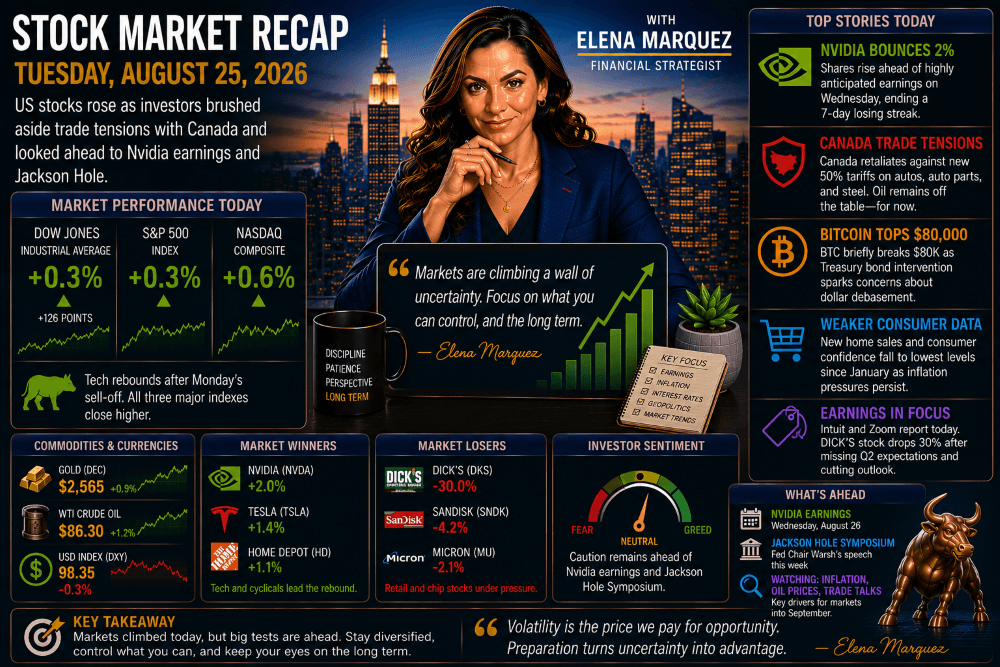
Wall Street bounced back Tuesday as investors put Monday’s technology sell-off behind them and turned their attention to the week’s two biggest events: Nvidia’s earnings and the Federal Reserve’s Jackson Hole symposium.
The market also absorbed an escalating trade dispute with Canada, weaker consumer data, and another surge in Bitcoin and gold.
Market Performance
- 📈 Dow Jones Industrial Average: +0.3%
- 📈 S&P 500: +0.3%
- 📈 Nasdaq Composite: +0.6%
Technology led the rebound after Monday’s decline.
Nvidia Breaks Its Losing Streak
The market’s biggest story was Nvidia.
Shares rose about 2%, ending a seven-day losing streak ahead of Wednesday’s highly anticipated quarterly earnings report.
Expectations are extraordinarily high.
Investors aren’t simply looking for strong revenue growth anymore. They want evidence that the enormous spending on artificial intelligence infrastructure is translating into sustained demand for Nvidia’s chips.
After last week’s sell-off in semiconductor stocks, Wednesday’s report could become a pivotal moment for the entire AI trade.
If Nvidia exceeds expectations, it could reignite enthusiasm for the sector.
If it disappoints—even slightly—the market’s elevated expectations leave little room for error.
The U.S.-Canada Trade Dispute Escalates
Stocks managed to rise despite another escalation in trade tensions between the United States and Canada.
Canada announced retaliatory tariffs in response to the Trump administration’s new 50% duties on selected Canadian goods.
The rhetoric between the two countries has become increasingly sharp.
However, one important product has been left out of the dispute so far:
Oil.
That matters because Canada is one of the United States’ largest energy suppliers.
Keeping oil outside the tariff battle helps reduce the risk that the trade dispute immediately pushes gasoline prices even higher.
For now, the conflict remains focused on products such as steel, dairy and other manufactured goods.
Bitcoin Breaks $80,000
Another notable move came outside the stock market.
Bitcoin briefly surged above $80,000, its highest level in roughly three months.
Gold also continued climbing.
The rally in alternative assets follows the Treasury Department’s recent intervention in the bond market.
Some investors interpreted the government’s increased purchases of long-dated Treasury securities as another reason to worry about the long-term purchasing power of the dollar.
Whether or not that interpretation proves correct, the market’s behavior is notable.
When investors become concerned about government debt, currency debasement or financial repression, assets such as Bitcoin and gold often attract additional attention.
The Consumer Continues to Weaken
While financial markets were upbeat, the latest economic data painted a less encouraging picture.
Both new home sales and a measure of consumer confidence fell to their lowest levels since January.
Those reports add to a growing list of evidence suggesting households are under pressure.
In recent weeks we’ve seen:
- weaker retail sales,
- declining consumer sentiment,
- Walmart customers making spending trade-offs,
- Home Depot shoppers choosing smaller projects,
- and now weaker housing demand and confidence.
Consumers are still spending.
But they’re becoming increasingly cautious.
That matters because consumer spending remains one of the biggest drivers of the U.S. economy.
Earnings: Winners and Losers
The earnings calendar also produced some sharp moves.
Software companies Intuit and Zoom reported results that investors will study for clues about the health of the software sector.
The biggest disappointment came from DICK’S Sporting Goods.
Shares plunged roughly 30% after the retailer missed quarterly expectations and cut its full-year forecast, citing difficult conditions in the athletic marketplace.
It’s another reminder that consumers aren’t treating every category equally.
Value-oriented retailers such as Ross Stores and BJ’s Wholesale Club have recently performed well.
Some discretionary retailers, however, are finding the environment much more challenging.
Jackson Hole Comes Into Focus
The other major event this week is the Federal Reserve’s annual Jackson Hole Economic Policy Symposium.
Fed Chair Kevin Warsh is scheduled to deliver his first major speech there as chairman.
Markets will listen carefully for clues about the future of interest rates.
The Fed faces an unusually complicated situation.
Inflation has cooled.
The labor market has weakened.
Consumer confidence has softened.
But oil remains expensive and government borrowing remains enormous.
Investors will want to know whether policymakers believe those risks justify another rate hike—or whether they can afford to wait.
The Bottom Line
Tuesday’s rally showed that investors remain willing to buy stocks despite a growing list of concerns.
The Nasdaq recovered.
Nvidia bounced.
Bitcoin crossed $80,000.
But underneath the market, some warning signs continue to accumulate.
Consumers are becoming more cautious.
Housing is slowing.
Trade tensions are increasing.
And the market’s most important company reports earnings tomorrow.
Wednesday’s Nvidia results could determine whether the AI rally regains its momentum—or whether investors continue questioning whether the enormous cost of building the AI economy can ultimately justify the expectations already embedded in stock prices.
With Jackson Hole immediately afterward, the next two days could shape the market’s direction well beyond this week.
Other Stock Market blog posts