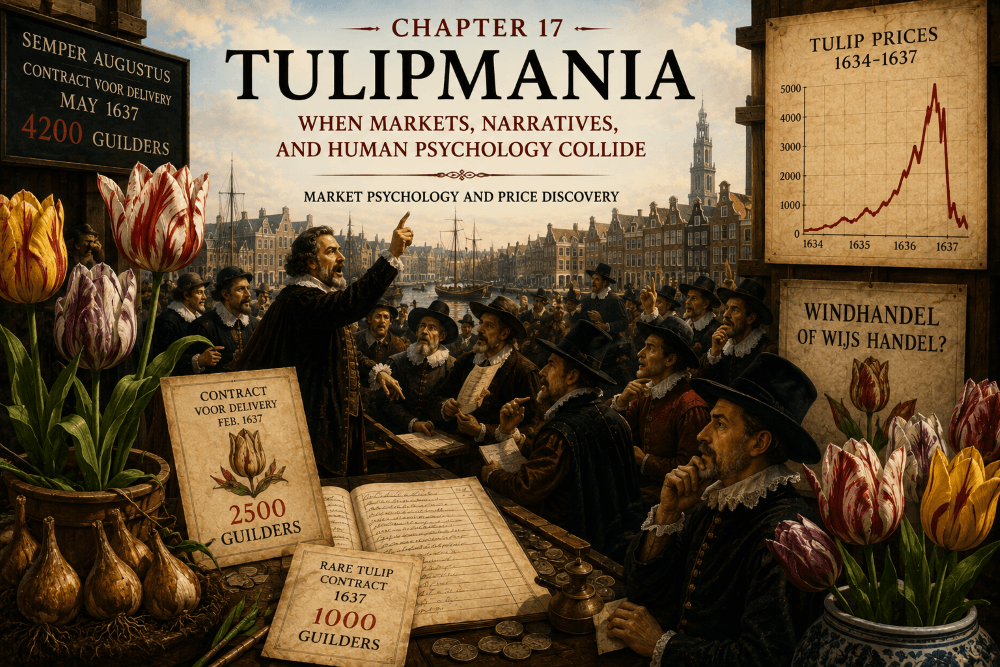
Tulipmania is often described as one of history’s greatest examples of financial insanity.
The popular story is irresistible.
In seventeenth-century Holland, ordinary people supposedly became so obsessed with tulips that they sold houses, farms, and life savings to buy flower bulbs.
Prices skyrocketed.
Everyone became a speculator.
Then the market collapsed.
Fortunes disappeared.
The Dutch economy was devastated.
There is only one problem.
Much of that story is exaggerated.
Tulip prices really did rise dramatically.
Speculation really did occur.
Some contracts reached extraordinary prices.
And the market really did fall suddenly in 1637.
But modern historical research suggests the phenomenon was far narrower than the famous legend.
Tulipmania is still important.
Just not for the reason most people think.
Its real lesson is about something much more enduring:
How scarcity, narratives, social pressure, expectations, and market psychology influence price.
What Was Tulipmania?
Tulipmania refers to a period of intense trading and rapidly rising prices for certain tulip bulbs and tulip contracts in the Dutch Republic during the 1630s, culminating in a sharp reversal in early 1637.
The Netherlands was one of Europe’s richest and most commercially sophisticated societies.
Amsterdam had:
- International trade
- Banks
- Securities markets
- Wealthy merchants
- Active investors
- Sophisticated financial contracts
The Dutch East India Company had already helped popularize tradable shares.
Financial markets were becoming increasingly advanced.
Tulips entered this environment as highly desirable luxury goods.
Why Were Tulips So Valuable?
Tulips had arrived in Western Europe from the Ottoman world during the sixteenth century.
They were exotic.
Beautiful.
Unusual.
And difficult to reproduce rapidly.
Some varieties developed dramatic streaks and patterns that collectors found especially desirable.
At the time, growers did not understand that some of these color patterns resulted from a plant virus.
Rare bulbs became status symbols.
Owning unusual tulips communicated:
Taste.
Wealth.
Sophistication.
Social standing.
This matters because luxury products operate differently from ordinary commodities.
A loaf of bread is valuable primarily because you can eat it.
A rare painting can be valuable partly because very few people can own it.
Tulips entered that world of scarcity and status.
Scarcity Can Create Extraordinary Prices
Imagine 1,000 people want an object.
Only five exist.
The price can rise dramatically.
That is not necessarily irrational.
Rare objects often command extraordinary prices.
Collectors pay millions for:
- Paintings
- Cars
- Watches
- Coins
- Sports memorabilia
- Wine
The object does not need enormous practical usefulness.
Scarcity itself can create value.
The same principle helped rare tulips command high prices.
The trouble begins when something else changes.
Buyers stop purchasing because they want the object.
They start buying because they expect the price to rise.
When an Investment Becomes a Speculation
Suppose you love a rare tulip and would happily pay 500 guilders to own it.
That is one kind of purchase.
Now suppose you believe the tulip is worth only 500 guilders but pay 1,000 because you expect someone else to pay 2,000 next month.
That is speculation.
The question changes from:
“What is this worth to me?”
to:
“What will someone else pay me?”
This is sometimes called the greater-fool theory.
You may know the price is excessive.
But if another buyer is willing to pay even more, the trade can still be profitable.
Until the next buyer disappears.
Price Is Not the Same as Value
This is one of the most important lessons entrepreneurs and investors can learn from Tulipmania.
Price is observable.
Value must be estimated.
If someone pays $1 million for something, its market price is $1 million.
But that does not automatically mean its economic value is $1 million.
Price can reflect:
- Income
- Utility
- Scarcity
- Growth prospects
But also:
- Fashion
- Status
- Fear
- Greed
- Momentum
- Social pressure
- Easy credit
- Expectations about future buyers
Markets are economic systems.
But they are also psychological systems.
Narratives Move Markets
Why does one asset suddenly attract enormous attention?
Usually there is a story.
Tulips were rare.
Prices were rising.
Collectors wanted them.
Some people appeared to be making money.
That creates a powerful narrative:
Tulips are valuable.
Then:
Tulips are getting more valuable.
Then:
Everyone knows tulips are getting more valuable.
Then:
If I don’t buy now, I’ll miss the opportunity.
At that point, rising prices become part of the marketing.
Higher prices attract attention.
Attention attracts buyers.
Buyers push prices higher.
The story begins reinforcing itself.
FOMO Is Hundreds of Years Old
Modern investors call it FOMO:
Fear of missing out.
Imagine watching your neighbor make more money trading tulip contracts in a few months than you earned during an entire year.
At first, you think he is foolish.
Then prices rise again.
And again.
Soon you begin questioning yourself.
Maybe he understands something you don’t.
Maybe this is your opportunity.
Maybe everyone is getting rich except you.
Financial decisions become social.
We compare ourselves with other people.
That makes speculative markets contagious.
Social Proof Can Become Dangerous
Human beings regularly use other people’s behavior as information.
You see a crowded restaurant.
You assume the food is good.
You see an empty restaurant.
You hesitate.
This shortcut—social proof—is often useful.
But markets create a problem.
What if everyone is watching everyone else?
I buy because you bought.
You bought because someone else bought.
That person bought because the price was rising.
The price was rising because people like us were buying.
The crowd becomes its own evidence.
No one needs to know why the asset is valuable anymore.
They only need to know that everyone else believes it is.
Tulip Contracts Made Trading Easier
Tulips presented an obvious problem for traders.
Bulbs grow seasonally.
They cannot always be dug up and physically exchanged.
So buyers and sellers increasingly used contracts for future delivery.
Two people could agree today on a price for a bulb that would change hands later.
That made trading more flexible.
But it also separated trading from physical ownership.
People could trade claims involving tulips without necessarily holding the tulips themselves.
Financial abstraction had increased again.
Earlier chapters in our History of Entrepreneurship showed the same progression:
Money became abstract.
Credit became abstract.
Bills of exchange became abstract.
Company shares became abstract.
Now contracts allowed claims on flowers to circulate independently of the flowers.
What Was Windhandel?
Some critics referred to speculative tulip trading as windhandel, or “wind trade.”
The term suggested people were trading promises rather than physical goods.
That criticism echoes modern debates about financial markets.
What does a speculator actually produce?
The answer is complicated.
Speculators can perform useful functions.
They can:
- Provide liquidity
- Take risks others do not want
- Help markets discover prices
But financial activity can also become detached from productive economic activity.
The difference often depends on how the instrument is used.
Financial Tools Are Neither Good Nor Bad
Consider a futures contract.
A farmer can use it to lock in the future price of grain.
That reduces risk.
A trader can use the same contract purely to bet on prices.
That increases risk.
Same instrument.
Different purpose.
Tulip contracts illustrate an important entrepreneurial principle:
Financial innovation is neutral.
Its usefulness depends on how people use it.
Why Did Tulip Prices Rise So Fast?
Tulip prices rose for several reasons.
Rare bulbs had genuine collectible value.
The Netherlands was prosperous.
Collectors competed with one another.
Trading expanded.
Prices themselves attracted new participants.
And eventually speculation became more intense.
Some historians, including economist Peter Garber, have argued that very rare bulbs may have behaved more like expensive collectibles than classic irrational bubbles.
The strongest speculative excess appears to have occurred in the rapid price increases for more common bulbs near the peak.
The distinction matters.
Not every expensive asset is a bubble.
A price can appear ridiculous to outsiders and still reflect genuine scarcity.
Then Buyers Stopped Showing Up
In early February 1637, something changed.
At some tulip auctions, buyers failed to appear at expected prices.
Confidence weakened.
Suddenly the assumption supporting the market became questionable.
Yesterday, every buyer expected someone else to buy tomorrow.
Now tomorrow’s buyer was missing.
That can cause speculative markets to collapse rapidly.
The cycle reverses.
Rising prices create enthusiasm.
Falling prices create fear.
Buyers become sellers.
And if everyone wants to sell at the same time?
There may be no buyers.
Liquidity Can Disappear
This is one of Tulipmania’s most useful lessons.
An asset is liquid only when someone else wants it.
During a boom, liquidity seems endless.
There are buyers everywhere.
People assume they can sell whenever they choose.
Then confidence changes.
Buyers vanish.
Suddenly the asset that looked like cash becomes difficult to sell.
Modern financial crises repeatedly expose the same illusion.
Liquidity feels permanent during good times.
It rarely is.
Paper Wealth Is Not Realized Wealth
Suppose you buy something for $100.
Soon the market says it is worth $1,000.
You feel $900 richer.
But you haven’t received $900.
You own an asset that someone currently appears willing to buy for $1,000.
That distinction is crucial.
Entrepreneurs encounter it too.
Suppose a startup raises money at a $100 million valuation.
Does the founder personally have $100 million in cash?
No.
The wealth exists largely on paper.
It depends on:
- Future company performance
- Investors
- Liquidity
- Market conditions
- Whether the shares can actually be sold
Tulip traders confronted the same difference between quoted wealth and realized wealth.
Contracts Created Counterparty Risk
Imagine someone agrees to buy your tulip bulb in the future for 1,000 guilders.
Then the market crashes.
The bulb is suddenly worth 200.
Your contract still says 1,000.
But the buyer has a powerful incentive to walk away.
This creates counterparty risk.
A contract is valuable only if the person on the other side can and will fulfill it.
Modern finance still depends heavily on this principle.
A financial promise is only as reliable as the counterparty behind it.
Tulipmania Did Not Destroy the Dutch Economy
The dramatic popular version claims Tulipmania ruined thousands of families and damaged the Dutch economy.
Historical evidence does not support that picture.
The market appears to have involved a relatively limited group of participants.
There is little evidence of widespread economic collapse caused by tulips.
The Dutch Republic remained one of the world’s most prosperous commercial powers.
The consequences appear to have been more concentrated among specific participants, disputes, relationships, and reputations.
That is an important correction.
Tulipmania was real.
The legend became much bigger than the event itself.
How Did Tulipmania Become Such a Famous Story?
Much of the enduring mythology emerged after the crash.
Pamphlets mocked speculators.
Moralists warned about greed.
Stories grew.
Two centuries later, Charles Mackay’s Extraordinary Popular Delusions and the Madness of Crowds helped popularize colorful accounts of Dutch citizens supposedly sacrificing fortunes for flowers.
The story survived because it is memorable.
People became greedy.
They went mad.
They lost everything.
Simple.
Entertaining.
And easy to repeat.
But history is usually more complicated.
The Tulipmania Myth Proves the Power of Narratives
There is an irony here.
The distorted story of Tulipmania demonstrates exactly what Tulipmania teaches us.
Narratives spread.
A compelling story gets repeated.
Repeated stories become familiar.
Familiar stories begin to feel true.
Eventually people stop asking for evidence.
Markets can work the same way.
A story gains attention.
Attention produces buyers.
Buyers increase prices.
Rising prices appear to confirm the story.
The story becomes stronger.
Entrepreneurs should understand the power of storytelling.
But they should also understand its danger.
Entrepreneurs Need Narratives Too
Every entrepreneur sells a story about the future.
Why does this product matter?
Why will customers adopt it?
Why should employees join the company?
Why should investors provide capital?
Why will this market grow?
Great entrepreneurs are often great storytellers.
But narrative should support economic reality.
It should never replace it.
A powerful story can raise money.
It cannot permanently save a bad business.
A Great Technology Can Still Be Overpriced
Speculative bubbles often begin around something genuinely valuable.
The internet really changed the world.
Housing really has value.
Blockchain introduced real technological ideas.
Artificial intelligence genuinely has enormous potential.
That doesn’t mean every investment in those areas is reasonably priced.
The dot-com bubble demonstrated this dramatically.
Investors were correct that the internet would transform civilization.
They were wrong about the value of many individual companies.
This leads to a powerful investing principle:
You can be right about the future and wrong about the price.
Being Early Can Feel Like Being Wrong
Imagine believing tulip prices are absurd.
You refuse to buy.
Prices double.
You still refuse.
They double again.
Your friends make money.
You look foolish.
This is one of the hardest psychological experiences in financial markets.
A rational decision can appear stupid for a long time.
Markets can remain expensive much longer than skeptics expect.
Being right eventually is not always enough.
You must also survive long enough for reality to matter.
Momentum Can Become Self-Reinforcing
People naturally extrapolate recent trends.
An asset rose yesterday.
It rises today.
Investors expect it to rise tomorrow.
That expectation creates new buying.
The buying pushes the price higher.
The trend appears validated.
Momentum can continue far longer than fundamentals alone would suggest.
But momentum is not value.
Eventually the economic reality beneath the price matters.
The difficulty is knowing when.
Bubbles Usually Contain a Grain of Truth
Tulips really were rare.
The internet really was transformative.
Railroads really changed transportation.
Housing really is necessary.
AI really can change industries.
The presence of speculation does not mean the underlying asset or technology is worthless.
Often the opposite is true.
The most powerful bubbles form around something genuinely exciting.
The mistake occurs when investors conclude:
Important technology = unlimited valuation.
That equation does not work.
What Tulipmania Teaches About AI, Crypto, and Modern Markets
Every generation believes its speculative episodes are unique.
But the psychological patterns are remarkably consistent.
A powerful narrative.
Scarcity.
Rising prices.
Social proof.
New investors.
FOMO.
Optimism.
Then eventually doubt.
The object changes.
Tulips.
Railroads.
Internet stocks.
Real estate.
Cryptocurrency.
AI-related companies.
The human behavior underneath changes much less.
That does not mean every booming market is a bubble.
It means entrepreneurs and investors should always ask:
What is the underlying value?
And how much of the current price reflects expectations about future buyers?
Is Speculation Bad?
Not necessarily.
Speculation can serve useful economic functions.
Speculators provide liquidity.
They accept risks other participants prefer to avoid.
They help markets incorporate information.
They challenge existing prices.
Without people willing to disagree, markets would not function effectively.
Speculation becomes dangerous when participants stop understanding the risk.
Especially when:
- Leverage becomes extreme
- Fraud spreads
- Easy credit encourages reckless buying
- Market prices become substitutes for analysis
- Participants assume prices can only rise
The problem is not that people speculate.
The problem is believing speculation is risk-free.
The Entrepreneur’s Toolbox
Market Psychology and Price Discovery
The VOC taught us that ownership could become tradable.
Tulipmania teaches us what happens once markets begin pricing expectations.
Market prices contain information.
But they can also contain:
- Narratives
- Fear
- Greed
- Scarcity
- Momentum
- Status
- Social proof
- FOMO
- Liquidity
Entrepreneurs should therefore understand markets as both economic and human systems.
Five Lessons Modern Entrepreneurs Can Learn From Tulipmania
1. Price Is Not Value
A rising price does not automatically mean the underlying business or asset is becoming more valuable.
2. Stories Move Money
Narratives influence customers, employees, investors, and markets.
Use storytelling—but keep it grounded in reality.
3. FOMO Is Dangerous
Someone else’s profits do not automatically make an opportunity attractive.
4. Liquidity Is Never Guaranteed
The ability to sell an asset today does not mean buyers will exist tomorrow.
5. Great Ideas Can Become Overpriced
A technology or asset can be revolutionary and still be a terrible investment at the wrong price.
Frequently Asked Questions
What was Tulipmania?
Tulipmania was a period of rapidly rising prices and speculation involving tulip bulbs and contracts in the Dutch Republic during the 1630s, followed by a sharp collapse in early 1637.
Did people really sell their houses for tulips?
The famous stories of ordinary Dutch citizens selling homes and life savings for single tulip bulbs are largely exaggerated. Modern historical research suggests participation was narrower than later popular accounts claimed.
Did Tulipmania crash the Dutch economy?
No. There is little evidence that the collapse caused a major national economic crisis. The broader Dutch economy remained strong.
Why were tulips so expensive?
Rare varieties were difficult to reproduce, visually distinctive, exotic, and prestigious. Genuine scarcity and collector demand contributed to high prices before speculation intensified.
Was Tulipmania the first financial bubble?
It is often called the first recorded speculative bubble, but speculative episodes existed earlier and historians debate how closely Tulipmania fits the modern definition of a bubble.
What caused Tulipmania to collapse?
In early 1637, buyers stopped appearing at expected prices. Confidence weakened, demand fell rapidly, and prices declined.
What does Tulipmania teach investors today?
It teaches that price and value are different, narratives can influence markets, liquidity can disappear, and even genuinely valuable assets can become overpriced.
The Entrepreneur’s Toolkit So Far
| Chapter | Entrepreneurial Contribution |
|---|---|
| Chapter 1 | Exchange |
| Chapter 2 | Surplus |
| Chapter 3 | Accounting |
| Chapter 4 | Professional Merchants |
| Chapter 5 | Money |
| Chapter 6 | Standardization |
| Chapter 7 | Continuous Improvement |
| Chapter 8 | Networks |
| Chapter 9 | Competition |
| Chapter 10 | Scale |
| Chapter 11 | Knowledge & Financial Innovation |
| Chapter 12 | Risk-Sharing & Commercial Institutions |
| Chapter 13 | Organizational Scale |
| Chapter 14 | Portable Trust |
| Chapter 15 | Pooled Capital |
| Chapter 16 | Tradable Ownership & Permanent Capital |
| Chapter 17 | Market Psychology & Price Discovery |
For the first time in our story, the entrepreneur must understand more than production, trade, finance, or customers.
He must understand investor psychology.
That will become increasingly important as capital markets grow.
Continue the Journey: The Industrial Revolution
For thousands of years, most economic production remained constrained by physical energy.
Human muscle.
Animal power.
Wind.
Water.
Then entrepreneurs learned to harness another force.
Steam.
Machines could perform work previously requiring dozens—or hundreds—of people.
Factories could produce enormous quantities of goods.
Coal provided concentrated energy.
Railroads transformed transportation.
Cities expanded rapidly.
The cost of manufacturing fell.
And entrepreneurship moved from the merchant’s marketplace into the industrial factory.
This would create a completely new kind of business leader:
The industrialist.
In Chapter 18, we’ll explore:
The Industrial Revolution
When Machines Multiplied Human Productivity
The next great entrepreneurial contribution will be:
Mechanization and productivity.
Related Articles
- The Amsterdam Stock Exchange: Where Shares Were Born
- The Dutch East India Company: How the VOC Helped Create the Modern Corporation
- The Fall of Constantinople: The Trade Shock That Built Empires
- Vasco da Gama: Building the Portuguese Spice Monopoly
- Christopher Columbus: Exploration as a Business Pitch
- Prince Henry the Navigator: The First Venture Capitalist
- The Age of Exploration: When Entrepreneurship Went Global
About The History of Entrepreneurship
This article is part of The History of Entrepreneurship, an ongoing series exploring how civilizations, technologies, merchants, investors, institutions, and individual entrepreneurs gradually created the foundations of modern business.
Each chapter asks:
What entrepreneurial tool did this period add to the world?
For Tulipmania, the answer is:
Market psychology and price discovery.
Markets do not simply measure value.
They reflect what human beings believe about value—and what they believe everyone else will believe tomorrow.
North Star
Tulipmania teaches that markets are not calculators operated by perfectly rational machines. They are social systems populated by human beings who respond to scarcity, status, stories, momentum, fear, and the behavior of everyone around them. Prices can contain valuable information—but price and value are never automatically the same thing. The entrepreneur who understands both economics and psychology possesses an advantage over the entrepreneur who understands only numbers.