Wall Street entered the week worrying about AI spending, inflation, oil prices, high bond yields and the possibility that the Federal Reserve isn’t finished raising interest rates.
By Friday, investors had received answers to two of the biggest questions hanging over the market.
Nvidia demonstrated that demand for artificial intelligence remains extraordinarily strong.
Then Federal Reserve Chair Kevin Warsh reminded investors that inflation remains too high for the Fed to relax.
Despite those concerns, stocks proved remarkably resilient. All three major indexes finished the week higher.
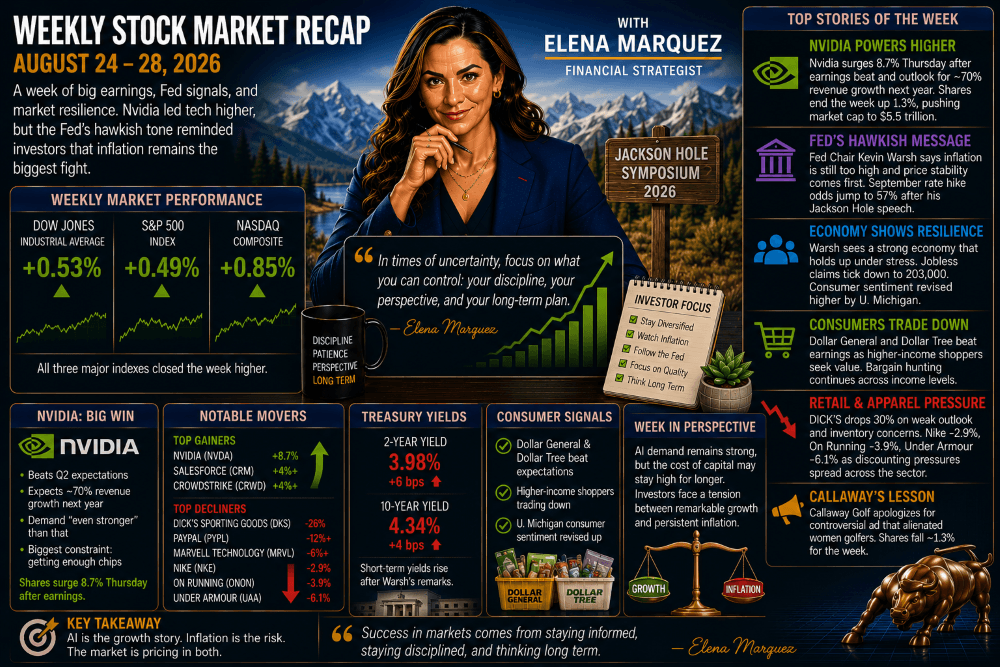
Weekly Market Performance
- 📈 Nasdaq Composite: +0.85%
- 📈 Dow Jones Industrial Average: +0.53%
- 📈 S&P 500: +0.49%
The gains weren’t spectacular, but considering everything Wall Street had to digest this week, finishing in positive territory was an accomplishment.
Nvidia Breaks Its Post-Earnings Curse
The biggest corporate story of the week was once again Nvidia.
Going into Wednesday night’s earnings report, expectations were enormous.
That has actually worked against Nvidia recently.
Before this week, Nvidia shares had fallen the day following six of its previous eight earnings reports. Investors had become so accustomed to spectacular growth that merely beating expectations wasn’t always enough.
This time was different.
Nvidia surged 8.7% Thursday, its biggest one-day gain in more than a year.
The reason wasn’t simply another earnings beat.
It was the outlook.
Nvidia said it expects revenue to grow approximately 70% during its next fiscal year, dramatically exceeding the roughly 45% growth analysts had been expecting.
CEO Jensen Huang suggested demand could be even stronger.
The company’s biggest constraint isn’t finding customers.
It’s finding enough chips and components to satisfy them.
That is an extraordinary problem to have.
Nvidia Is Now Worth $5.5 Trillion
Despite Thursday’s spectacular rally, Nvidia finished the entire week only about 1.3% higher, illustrating just how volatile the stock had been beforehand.
Nevertheless, the rally pushed Nvidia’s market capitalization to approximately $5.5 trillion, reinforcing its position as the world’s most valuable company.
That’s an astonishing valuation.
But Nvidia’s earnings also demonstrated why investors continue assigning the company such an enormous premium.
The AI infrastructure boom isn’t slowing yet.
If anything, Nvidia says demand is accelerating.
But Nvidia’s AI Financing Creates a New Risk
Nvidia’s success doesn’t eliminate the bigger questions surrounding artificial intelligence.
One particularly interesting development is Nvidia’s increasing willingness to use its own balance sheet to help customers finance AI infrastructure.
There’s an obvious advantage.
Helping customers finance data centers allows them to buy more Nvidia chips.
That can extend the AI investment cycle and support Nvidia’s extraordinary revenue growth.
But it also creates additional risk.
Nvidia isn’t simply selling picks and shovels during the AI gold rush anymore.
Increasingly, it’s helping finance the miners.
If AI demand eventually slows, Nvidia could therefore be exposed not only through weaker chip sales but also through investments and financing tied to the broader AI ecosystem.
That’s why the next stage of the AI boom may be less about asking:
“How many chips can Nvidia sell?”
And more about asking:
“Who is ultimately paying for all this infrastructure—and what returns will they earn?”
Kevin Warsh: The Fed May Not Be Finished
Nvidia dominated the corporate side of the week.
Federal Reserve Chair Kevin Warsh dominated the macroeconomic side.
During his first Jackson Hole speech as Fed chair, Warsh made it clear that inflation remains the central bank’s biggest concern.
His message was essentially this:
The Fed needs convincing evidence that inflation is returning toward its target. Otherwise, there’s more work to do.
Markets immediately reacted.
Expectations for another rate hike increased and short-term Treasury yields jumped.
Stocks surrendered some of their earlier Friday gains.
But Warsh’s message wasn’t entirely negative.
He also expressed confidence in the underlying economy, emphasizing its resilience despite numerous shocks.
That distinction matters.
Warsh isn’t necessarily saying:
The economy is weak, so we need restrictive monetary policy.
He’s suggesting something closer to:
The economy is strong enough to tolerate restrictive monetary policy if that’s what defeating inflation requires.
For stock investors, that’s a very different message.
The Economy Remains Surprisingly Resilient
That resilience may be one reason stocks managed to finish the week higher despite the Fed’s hawkish tone.
Corporate earnings remain generally healthy.
Unemployment claims remain relatively low.
Consumers are still spending, although they’re increasingly hunting for bargains.
AI capital spending remains enormous.
And companies continue investing.
The problem isn’t necessarily economic growth.
The problem is that strong growth combined with stubborn inflation could keep interest rates higher for longer—or even produce another hike.
That’s the balancing act investors face heading into September.
Nike Gets Hit by Someone Else’s Bad News
One of the more interesting lessons of the week came from the athletic-wear industry.
Nike didn’t need to report bad earnings to see its shares decline.
DICK’S Sporting Goods did it for them.
DICK’S shares plunged more than 30% Tuesday after the retailer lowered its annual profit outlook.
Executive chairman Ed Stack warned that the sneaker industry is carrying too much inventory.
When there’s too much inventory, retailers discount.
When one retailer discounts, competitors often follow.
Eventually, promotions spread across the industry.
That’s bad news for manufacturers such as Nike, which was already struggling with weaker demand and heavier discounting.
For the week:
- DICK’S Sporting Goods: -26%
- Under Armour: more than -6%
- On Running: nearly -4%
- Nike: -2.9%
The message from the consumer is becoming increasingly clear.
People are still buying.
But pricing power is weakening in parts of the economy.
Callaway Golf Learns an Expensive Marketing Lesson
Not every stock-market lesson this week came from earnings or the Federal Reserve.
Callaway Golf found itself dealing with a self-inflicted marketing controversy.
A promotional video produced with Good Good Golf showed a male golfer shoving a woman to the ground while protecting his new driver.
The video generated millions of views—and considerable backlash.
Both companies eventually apologized, with Callaway’s CEO acknowledging that the advertisement’s approval should never have happened.
Callaway shares declined approximately 1.3% for the week.
One week’s stock movement doesn’t tell us whether the controversy will cause lasting financial damage.
But there’s a larger business lesson.
Golf has spent years expanding beyond its traditional demographic, including attracting more women and younger players.
Marketing that alienates a growing customer base can undermine years of brand-building remarkably quickly.
The Bigger Story: AI Growth Meets Expensive Money
The most interesting part of this week wasn’t Nvidia alone.
And it wasn’t Kevin Warsh alone.
It was the combination.
Nvidia essentially told investors:
Demand for AI infrastructure is stronger than we expected.
Warsh essentially told investors:
Don’t assume the money financing that infrastructure is about to become cheaper.
Those two forces are now colliding.
The AI industry wants hundreds of billions—and potentially trillions—of dollars for data centers, chips, electricity and networking infrastructure.
Meanwhile, persistent inflation is keeping the cost of capital elevated.
That means investors will increasingly demand something they haven’t worried much about during the first stage of the AI boom:
Return on investment.
The Bottom Line
The week of August 24–28 was ultimately a good one for investors.
The Nasdaq gained 0.85%, the Dow added 0.53%, and the S&P 500 rose 0.49%.
But underneath those modest gains, two enormous forces are shaping the market.
Nvidia showed us that the AI boom remains very much alive.
Kevin Warsh showed us that the inflation fight isn’t necessarily over.
That sets up a fascinating tension heading into September.
AI companies want to spend more.
The economy remains resilient.
Corporate profits remain strong.
But capital remains expensive.
For the next phase of this bull market, simply demonstrating growth may not be enough.
Wall Street is increasingly going to ask whether that growth can generate returns large enough to justify the extraordinary amount of money being invested.
Other Stock Market blog posts