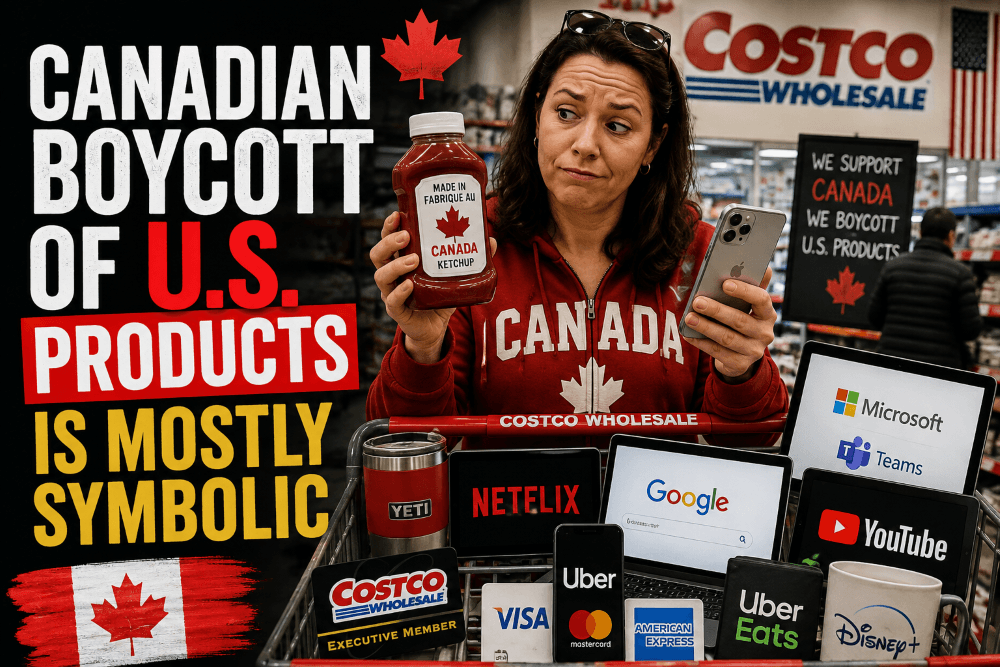
Today I came across an article with a provocative headline:
“‘If it’s made in the US, I don’t buy it’: Canadians on boycotting Trump’s America.”
I understand the sentiment behind the Canadian boycott of U.S. products. Many Canadians are angry about the deterioration of our relationship with the United States and the escalating trade war.
People want to do something.
So they stop buying American ketchup. They look for Canadian whisky instead of American bourbon. They cancel a vacation to Florida and perhaps travel within Canada or go to Europe instead.
There is nothing wrong with making those choices.
But we should recognize something uncomfortable:
Most of these actions are symbolic.
The Canadian economy is so deeply integrated with the American economy that completely boycotting the United States is nearly impossible.
The Contradiction of the Canadian Boycott of U.S. Products
Imagine someone passionately announcing:
“I refuse to support American companies!”
Fair enough.
But where are they announcing it?
Maybe from an Apple iPhone designed by a California company.
Perhaps they post their boycott message on Facebook, Instagram, X or another American social media platform.
Then they Google which Canadian products they should buy.
Or perhaps they ask an American AI chatbot how to boycott American companies more effectively.
There is something almost comical about it.
We can be furious with the United States, but much of the digital infrastructure of our everyday lives remains American.
And technology is only the beginning.
Try Going One Day Without an American Company
Consider how deeply American businesses are embedded in everyday Canadian life.
You might wake up and check your Apple iPhone or an Android phone running Google’s operating system.
You check Gmail.
Perhaps you browse Facebook, Instagram, YouTube or X.
At work, your company might use Microsoft Windows, Microsoft 365, Teams, Zoom, Slack, Salesforce or Google Workspace.
Your files might be stored on Amazon Web Services, Microsoft Azure or Google Cloud without you even realizing it.
At lunch, maybe you order something through Uber Eats.
Later you take an Uber somewhere.
You might shop at Canadian Tire (owned by Americans), Costco, Walmart or Amazon.
After dinner, you watch Netflix, YouTube, Disney+ or Amazon Prime Video.
Maybe you pay for some of these purchases with a Visa, Mastercard or American Express card operating through financial networks deeply connected to the United States.
Even many Canadian companies depend on American software, payment processors, advertising platforms, cloud computing services, machinery, components and suppliers.
You can avoid California wine.
Avoiding the American economy is much harder.
Buying Canadian at Costco Illustrates the Problem Perfectly
There has been a strong movement encouraging Canadians to check labels and buy Canadian products.
I support that instinct.
If two comparable products are sitting next to each other and one is produced by a Canadian business, there is nothing wrong with choosing the Canadian one.
But there is an irony when we drive to Costco to search the shelves for Canadian products while shopping inside an American retail corporation.
That doesn’t mean we should stop shopping at Costco.
It demonstrates how interconnected our economies have become.
The same thing happens online.
We might proudly purchase something manufactured in Canada, but we discovered it through Google, saw an advertisement served by Meta, bought it through Shopify using an American credit-card network, and had parts of the transaction processed through American technology infrastructure.
The label on the product doesn’t tell the entire economic story.
Canada and the United States Built an Integrated Economy
This dependence did not happen accidentally.
For decades, Canada and the United States deliberately built one of the world’s most integrated economic relationships.
Our geography makes this logical.
We share a massive border. Our transportation systems connect. Our energy infrastructure connects. Our manufacturing supply chains cross the border repeatedly.
The United States remains by far Canada’s largest export market.
According to Global Affairs Canada, 72.5% of Canadian merchandise exports went to the United States in 2025, although that percentage declined from 76.3% in 2024.
Think about that number.
Nearly three out of every four dollars of Canadian merchandise exports went to one country.
That has been tremendously profitable for Canada.
But it has also created a vulnerability.
The Boycott Isn’t Completely Meaningless
I don’t want to dismiss Canadians who are deliberately changing their spending habits.
Consumer choices matter.
If thousands or millions of Canadians buy Canadian food, visit Canadian tourist destinations or discover Canadian businesses they previously ignored, some Canadian companies will benefit.
Boycotts can also send political messages.
And choosing Canadian products can encourage people to learn more about where the things they buy actually come from.
All of that is positive.
But we shouldn’t confuse a political gesture with an economic strategy.
Canada will not achieve economic independence by switching ketchup brands.
We need to think much bigger.
The Real Problem Is Canada’s Lack of Alternatives
Canada’s problem isn’t that Canadians buy too many American products.
The deeper problem is that Canada depends too heavily on a single economic partner.
The United States should remain one of our largest trading partners.
Americans are our neighbours, customers, suppliers, investors and friends. Even during political disagreements, destroying that economic relationship would be foolish.
But friendship and dependence are two different things.
A healthy Canadian economy should be capable of saying:
“We want to trade with you, but we don’t have to depend almost entirely on you.”
That requires alternatives.
Canada Should Find More Customers, Not Fewer Products
This is why I believe the long-term response to the current trade conflict should be trade diversification.
Canada should aggressively expand its economic relationships with:
- The European Union
- The United Kingdom
- Japan
- South Korea
- India
- Mexico
- Southeast Asia
- Australia
- Latin America
Fortunately, there are already encouraging signs.
Canada’s share of merchandise exports going to the United States declined in 2025, while the share going to Europe and Central Asia increased.
That is exactly the direction we should continue moving.
Not because we should abandon the United States.
Because we need more options.
We Need the Infrastructure to Reach Those Customers
Of course, saying “Let’s sell more to Asia and Europe” is easy.
Actually doing it requires infrastructure.
Canada needs better:
- Ports
- Railways
- Pipelines
- Highways
- LNG terminals
- Electricity transmission
- Warehousing
- Digital infrastructure
If a Canadian company produces something valuable in Alberta, Saskatchewan, Ontario or Quebec, we need efficient ways to get that product to customers around the world.
Our natural resources are enormously valuable.
But resources sitting underground don’t create geopolitical leverage.
Resources that can reach multiple competing customers do.
Canadians Should Support Trade Diversification
This is where I think Canadian patriotism can become more productive.
Instead of obsessing over whether the ketchup bottle came from Ohio or Ontario, we should pay much more attention to the policies that determine Canada’s economic future.
When governments attempt to build new ports, pipelines, railways, energy infrastructure and international trade relationships, Canadians should understand why those projects matter.
Of course, projects should still make economic sense.
Environmental standards matter.
Indigenous consultation matters.
Responsible regulation matters.
But we also need to recognize that economic infrastructure is part of national independence.
A country with only one customer has very little negotiating power.
A country with 20 customers has options.
Build Canadian Companies That Can Compete
There is another important part of this discussion.
Supporting Canada should not mean permanently protecting Canadian businesses from competition.
Canadian companies need to become good enough to compete internationally.
We should make Canada one of the easiest countries in the world to start, finance and grow a business.
We need more Canadian entrepreneurs building technology companies, manufacturers, financial businesses, energy companies and consumer brands that can compete globally.
Imagine if Canadians had more domestic alternatives to Amazon, Google, Microsoft, Uber, Netflix and the other American platforms we use every day.
Those companies cannot simply be created through patriotic slogans.
Entrepreneurs have to build them.
Investors have to finance them.
Consumers have to choose them because they’re competitive.
That is much harder than a boycott.
But it would also be much more valuable.
The Goal Shouldn’t Be Economic Separation
I recently wrote about this in my article “Canada Trade Independence: Time to Build a Stronger Economy.”
My argument was not that Canada should separate itself economically from the United States.
Quite the opposite.
The United States is our natural economic partner and will almost certainly remain so.
But there is a major difference between trade and dependence.
Canada should trade enthusiastically with the United States while simultaneously building stronger economic relationships everywhere else.
Think of it as diversification.
No sensible investor would put 75% of a portfolio into one company simply because that company had performed well for decades.
Countries should understand diversification too.
Don’t Boycott America. Build a Stronger Canada.
I understand why Canadians are angry.
If someone wants to stop buying American bourbon or spend their vacation in Quebec instead of Florida, that’s their choice.
Maybe those decisions even help Canadian businesses around the margins.
But let’s not pretend they solve the fundamental problem.
You can delete Netflix.
You can avoid American wine.
You can inspect every tomato at the grocery store.
And you can proudly announce your boycott from your iPhone.
None of that changes Canada’s fundamental economic vulnerability.
The real solution is much more difficult.
Build more.
Build Canadian companies.
Build pipelines.
Build ports.
Build railways.
Build energy infrastructure.
Build technology.
Build relationships with Europe.
Build relationships with Asia.
Build relationships with Latin America.
And create an economy where Canadian businesses have customers all over the world.
Anger at the United States may be understandable.
But anger is not an economic strategy.
The best response to an unreliable trading partner isn’t to stop buying its ketchup.
It’s to make sure you have other partners.
Frequently Asked Questions
Does boycotting U.S. products actually help Canada?
Buying Canadian products can support Canadian businesses and keep more consumer spending within the country. However, consumer boycotts alone cannot significantly reduce Canada’s broader economic dependence on the United States because the two economies are deeply integrated.
How dependent is Canada on the United States?
The United States remains Canada’s dominant merchandise export market. In 2025, approximately 72.5% of Canadian merchandise exports went to the United States, illustrating why diversification is an important long-term economic objective.
Should Canadians stop buying American products?
Canadians who prefer Canadian products should certainly buy them when they offer good value. But Canada’s long-term strategy should focus more on creating competitive Canadian businesses and developing additional international trading partners than on attempting to eliminate American products from everyday life.
How can Canada become less dependent on the United States?
Canada can diversify by increasing trade with Europe, Asia and other regions, expanding ports and transportation infrastructure, developing energy export capacity, reducing interprovincial trade barriers and making Canada a more attractive place to build globally competitive businesses.