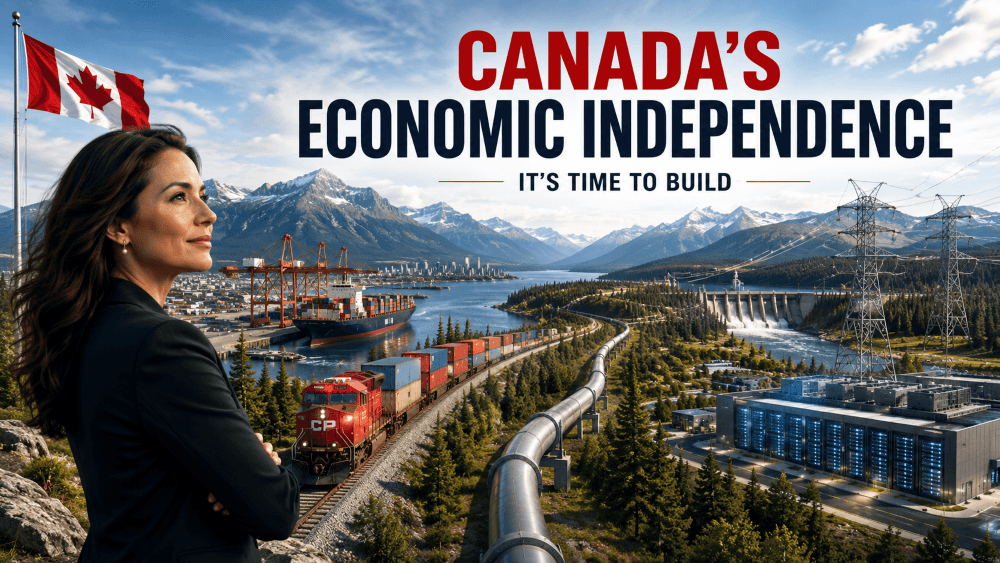
Canada trade independence has suddenly become much more than an economic talking point. The escalating trade conflict with the United States is exposing a weakness Canadians have tolerated for decades: we have built an enormously wealthy country that remains extraordinarily dependent on one customer.
The United States recently imposed 50% tariffs on $27.6 billion of Canadian goods, and Canada has announced matching counter-tariffs beginning September 8.
The natural response is anger. But anger is not an economic strategy.
Instead of simply asking, How should Canada retaliate against the United States?, we should ask a more important question:
How can Canada become so economically strong and diversified that the next trade war hurts us much less?
The answer begins at home.
Canada Trade Independence Starts With One Canadian Economy
One of the strangest features of the Canadian economy is that we negotiate free-trade agreements with countries thousands of kilometres away while maintaining regulatory barriers between our own provinces.
A company operating successfully in Alberta should be able to expand into British Columbia, Ontario or Quebec without encountering a new collection of unnecessary regulations, certifications and administrative obstacles.
Likewise, skilled workers should be able to move where their skills are most valuable.
Canada has already started moving in this direction. The federal Free Trade and Labour Mobility in Canada Act, which came into force January 1, 2026, removes certain federal barriers and recognizes comparable provincial requirements. But importantly, the legislation does not eliminate provincial and territorial requirements themselves.
That means there is still work to do.
Canada has 41 million people. That is already a substantial domestic market.
We should start behaving like one.
Removing unnecessary interprovincial barriers would allow Canadian businesses to scale nationally before attempting to compete internationally. It would increase competition, improve labour mobility and potentially reduce prices for consumers.
The federal and provincial governments are now discussing further mutual recognition of regulations, services, construction standards and food trade.
The trade war should give those efforts greater urgency.
Build Pipelines to Both Oceans
Canada possesses something most countries would love to have: enormous quantities of energy.
Oil.
Natural gas.
Hydroelectricity.
Uranium.
Nuclear expertise.
And increasingly, renewable electricity.
Yet having natural resources is not enough. You need the infrastructure to deliver those resources to customers.
For decades, Canada’s easiest energy customer has been the United States. Geography made that relationship logical and profitable.
But dependence on one customer creates vulnerability.
Canada should continue expanding its ability to export energy through the Pacific while also developing economically viable routes to Atlantic markets.
Imagine Canadian energy having multiple competing buyers in the United States, Europe and Asia.
Suddenly Canada has bargaining power.
Canada is already beginning to diversify. In July, the federal government announced a binding agreement involving the Ksi Lisims LNG project in British Columbia and Germany’s Uniper, explicitly presenting expanded international energy exports as part of building a more independent Canadian economy.
We should accelerate that strategy.
This does not mean building every pipeline proposed. Projects still have to make economic sense and satisfy reasonable environmental and Indigenous consultation requirements.
But Canada’s default attitude toward major infrastructure should change from “How do we stop this?” to “How do we responsibly build this?”
Turn Canada Into a Global Data Centre
Oil and gas aren’t Canada’s only energy opportunity.
Artificial intelligence is creating enormous demand for computing power, and computing power requires data centres. Those data centres consume tremendous amounts of electricity.
Canada has several natural advantages:
- Abundant hydroelectric, nuclear and other energy resources
- A relatively cool climate
- Large amounts of land
- Political stability
- Strong universities and technical talent
- Proximity to major American technology markets
- The potential for massive additional electricity generation
The federal government’s own AI strategy recognizes these advantages, specifically pointing to Canada’s geography, climate, energy resources and network infrastructure as reasons the country is well positioned to attract data-centre investment.
This is an enormous opportunity.
Instead of exporting only electricity or natural resources, Canada can use that energy to export computation.
Google, Microsoft, Amazon, Meta and the next generation of AI companies will need extraordinary amounts of computing infrastructure.
Canada should tell the world:
Bring your servers. We have the land, energy, stability and talent to power them.
At the same time, Canada should develop its own sovereign computing capacity so that Canadian companies, universities and governments aren’t completely dependent on foreign infrastructure.
Canada has already launched programs aimed at expanding sovereign AI supercomputing capacity.
We should think much bigger.
Build Ports, Railways and Transmission Lines
Canada cannot diversify its customers without infrastructure.
If we want to sell more products to Europe and Asia, we need the capacity to move those products efficiently from Canadian factories, mines, farms and energy projects to ports.
That means investing in:
- Ports
- Railways
- Highways
- Pipelines
- Electricity transmission
- LNG terminals
- Warehousing
- Digital infrastructure
Infrastructure spending should be viewed as productive investment when it increases the country’s capacity to generate future income.
A railway that allows Canadian minerals to reach an Asian customer faster isn’t merely government spending.
It is economic infrastructure that can generate wealth for decades.
Turn Canada’s Critical Minerals Into Industries
Canada possesses enormous mineral resources.
But digging something out of the ground and shipping it overseas captures only part of its economic value.
Whenever economically feasible, Canada should attempt to move further up the value chain.
Instead of simply exporting lithium, nickel, copper, cobalt and other critical minerals, Canada should attract businesses that refine those materials and transform them into higher-value products.
That could include:
- Battery materials
- Batteries
- Electrical equipment
- Semiconductor components
- Advanced manufacturing
- Aerospace components
- Nuclear technology
Natural resources should become the foundation for additional industries rather than simply products we put on ships.
Make Canada the Easiest G7 Country to Build a Business
Canada cannot become more competitive simply by spending more government money.
We also need to make it easier for entrepreneurs and investors to build things.
A major industrial project should not require a decade of uncertainty before investors know whether they are allowed to proceed.
Canada should establish clear standards and predictable approval timelines.
Protect the environment.
Consult affected communities.
Respect Indigenous rights.
Then make a decision.
Yes or no.
Capital can tolerate regulation. What capital hates is uncertainty.
If Canada wants hundreds of billions of dollars invested in mines, factories, data centres, power generation, housing and infrastructure, investors need to know the rules before they put their money at risk.
Attract the World’s Best Entrepreneurs
Canada’s immigration system should increasingly focus on economic competitiveness.
We should aggressively recruit:
- Entrepreneurs
- Engineers
- Scientists
- Doctors
- Skilled tradespeople
- AI researchers
- Investors
- Experienced business operators
Canada has something valuable to offer: political stability, good institutions, excellent cities and access to a sophisticated economy.
But attracting talent is only the first step.
We also need to create an environment where ambitious people can build companies here rather than moving to Silicon Valley as soon as their businesses become successful.
Sell Canadian Products to the Rest of the World
The United States should remain one of Canada’s closest economic partners.
It would be foolish to deliberately weaken that relationship. We share the world’s longest international border and one of the largest trading relationships on Earth.
But there is a major difference between trading with the United States and depending on the United States.
In 2025, 71.7% of Canadian merchandise exports still went to the United States, although that was down from 75.9% in 2024. Encouragingly, Canadian exports to countries other than the United States increased 17.2% in 2025.
That is exactly the direction Canada should continue pursuing.
Canada should aggressively expand commercial relationships with:
- The European Union
- United Kingdom
- Japan
- South Korea
- India
- Mexico
- Southeast Asia
- Latin America
- Australia
Every new customer gives Canadian businesses another option.
Stop Trying to Win the Trade War. Win the Next 30 Years.
Tariffs are politically satisfying because they create the impression that we are fighting back.
You tax our steel?
We’ll tax your products.
You raise tariffs?
We’ll raise ours.
But tariffs ultimately create costs on both sides.
Canada’s greatest response to American protectionism would not be another tariff.
It would be becoming more competitive.
Remove internal trade barriers.
Build pipelines.
Expand ports.
Build electricity generation.
Construct data centres.
Develop critical minerals.
Attract global capital.
Recruit talented immigrants.
Reduce unnecessary regulation.
Help Canadian businesses reach global markets.
And above all, start thinking of Canada as a single economic unit rather than ten provincial economies loosely connected to each other.
Canada Doesn’t Need Economic Isolation. It Needs Options.
Canada and the United States will almost certainly remain major trading partners long after the current political leaders are gone.
That’s good.
Americans are our neighbours, customers, suppliers, investors and friends.
Canada trade independence should therefore not mean economic separation from the United States.
It should mean something much simpler:
Canada should never again find itself in a position where one foreign government can threaten a huge portion of our economy simply by changing its trade policy.
The current trade war is painful.
But perhaps it can also be useful.
Sometimes a crisis exposes weaknesses we should have fixed decades ago.
Canada has energy, minerals, farmland, technology, educated workers, enormous geography and access to three oceans.
Few countries have been given so many economic advantages.
Now we need to start using them.
Frequently Asked Questions
Why is Canada so dependent on trade with the United States?
Geography, integrated supply chains, shared infrastructure and decades of free trade have made the United States Canada’s natural largest customer. In 2025, 71.7% of Canadian merchandise exports went to the U.S.
How can Canada reduce its economic dependence on the United States?
Canada can reduce its dependence by eliminating internal trade barriers, expanding energy export infrastructure, improving ports and railways, developing critical minerals, attracting investment and increasing trade with Europe and Asia.
Could Canada become a major location for AI data centres?
Yes. Canada has significant advantages including abundant electricity, a cool climate, political stability, technical expertise and substantial land. Canada’s national AI strategy is already emphasizing domestic compute and data-centre capacity.
Should Canada stop trading with the United States?
No. The United States is a natural and extremely valuable trading partner. Canada’s objective should be diversification rather than separation: maintain strong U.S. trade while developing enough alternative customers that the Canadian economy is less vulnerable to changes in American trade policy.