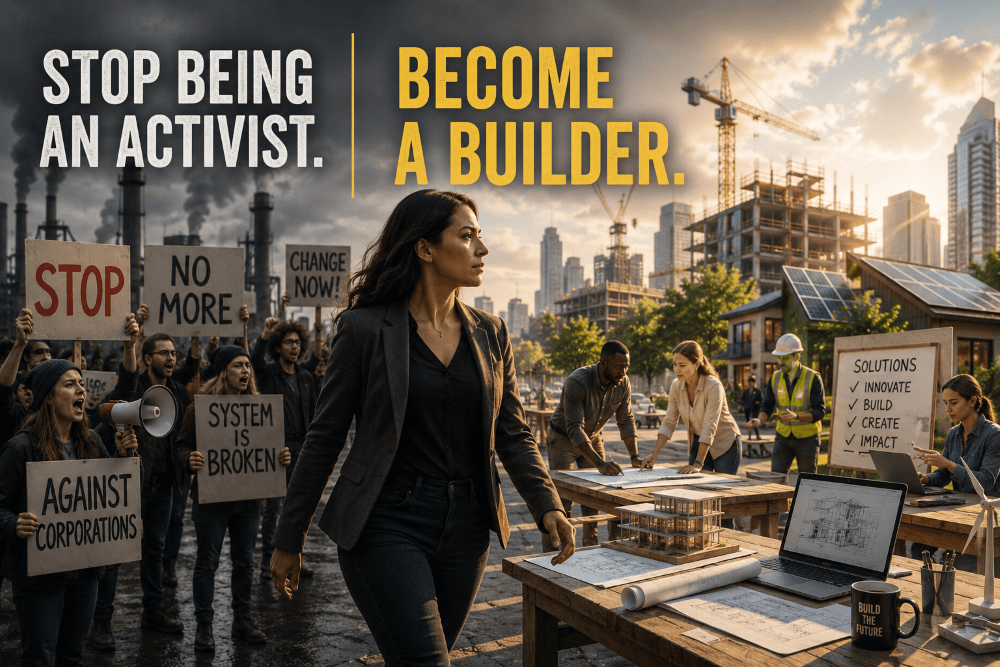
Activism has become one of the most celebrated ways to demonstrate that you care about the world.
We teach young people that if they care deeply about climate change, inequality, racism, poverty, housing, corporations, or any number of social problems, one of the most honorable things they can become is an activist.
I disagree.
I think we have elevated activism into a moral ideal while undervaluing something much more difficult and useful: building.
The world doesn’t need more people telling us what’s wrong.
We already have plenty of them.
The world needs more people willing to create solutions.
The Problem With Activism
Activism almost always begins with opposition.
You are against the fossil fuel industry.
Against corporations.
Against capitalism.
Against the patriarchy.
Against racism.
Against inequality.
Against landlords.
Against whichever institution has been identified as responsible for the problem.
There may be legitimate criticisms behind any of these movements. Industries pollute. Governments make terrible decisions. Corporations sometimes behave badly. Discrimination exists.
But activism has a tendency to frame problems around villains.
Someone else is doing something bad, and I am one of the good people fighting against them.
That framing can be psychologically satisfying.
It is also much easier than solving the problem.
Anyone Can Be a Critic
Anyone can identify a problem.
Housing is too expensive.
Energy is dirty.
Corporations are greedy.
Governments are incompetent.
Inequality is too high.
The education system is broken.
Fine.
Now solve one of them.
That’s where things become difficult.
The easiest thing in the world is criticism. The most difficult thing is coming up with a plausible solution—and then making that solution work in the real world.
Criticism requires almost no capital.
You don’t need a factory. You don’t need employees. You don’t need engineering knowledge. You don’t need customers, financing, permits, suppliers, or a distribution network.
You don’t even need to be right.
Building something is different.
Activism vs. Building
Imagine an activist standing outside a corporation holding a sign explaining everything the company is doing wrong.
Perhaps some of those criticisms are legitimate.
But inside that building are people trying to manufacture something customers want, pay thousands of employees, satisfy regulators, manage suppliers, compete with rivals, raise capital, control costs, develop new products, and solve hundreds of unforeseen problems.
That doesn’t mean the corporation is always right.
It doesn’t mean the activist is always wrong.
It means something much simpler:
Creation is harder than criticism.
Yet our culture increasingly gives moral prestige to the critic.
I think we have it backward.
Stop Protesting the Problem. Try Solving It.
Suppose you believe climate change is one of humanity’s greatest problems.
You can protest fossil fuels.
Or you can stop eating meat. Factory farming is one of the greates poluters of the plannet. Just by not eating meat, you didn’t contribute to the slaughter of 21 chikens, 0.13 cows, 0.33 pigs, and 20 fish. You saved many animal lives and you didn’t contributute the the polution of the planet.
Or you can study nuclear engineering.
You can condemn oil companies.
Or you can develop better batteries, more efficient solar panels, improved electrical grids, carbon-capture technology, or an entirely new source of energy.
Suppose you’re angry about housing costs.
You can protest landlords.
Or you can become a YIMBY and vote for housing zoning that would allow more hosing development.
Or you can figure out how to build housing more cheaply.
You can become an architect, construction worker, developer, engineer, entrepreneur, urban planner, or politician willing to reform regulations that prevent housing construction.
Suppose you’re concerned about pollution.
You can condemn corporations for creating waste.
Or you can invent a manufacturing process that creates less waste and then persuade companies to adopt it.
The second option in each example is much harder.
That’s precisely the point.
What Are We Teaching Young People?
This is where I think our culture has made a serious mistake.
We frequently present high school and university students with the idea that one of the highest demonstrations of caring is opposition.
If you care about climate change, protest.
If you care about inequality, march.
If you care about housing, demonstrate.
If you care about corporations, condemn them.
But why don’t we communicate with equal moral enthusiasm:
- Study engineering.
- Become a scientist.
- Start a company.
- Build houses.
- Create jobs.
- Develop cheaper energy.
- Invent something.
- Discover a new medicine.
- Build a better school.
- Create a better product.
- Become an entrepreneur.
- Solve the problem.
Imagine if young people received as much social recognition for starting a small business as they receive for joining a protest.
Imagine if universities celebrated builders as enthusiastically as activists.
Imagine telling an 18-year-old:
If you really care about a problem, dedicate the next 20 years of your life to becoming competent enough to solve part of it.
That is a much bigger commitment than carrying a sign for an afternoon.
Builders Need Skills. Critics Don’t.
One reason criticism is attractive is that the barriers to entry are incredibly low.
There are no prerequisites for criticizing an entrepreneur.
You don’t have to understand accounting, supply chains, marketing, engineering, payroll, financing, taxation, regulations, customer acquisition, or management.
You can simply announce what the entrepreneur should have done differently.
The builder doesn’t have that luxury.
Builders need ingenuity, dedication, motivation, talent, perseverance, and sacrifice.
They have to make decisions without knowing whether those decisions will work.
And most importantly, builders face consequences.
If customers don’t like an entrepreneur’s product, the entrepreneur loses money.
If an engineer’s bridge doesn’t work, the bridge doesn’t stand.
If an inventor’s technology isn’t competitive, nobody buys it.
Reality grades builders every day.
Activism Can Become an Identity
There is another problem with activism that we rarely discuss.
What happens when fighting a problem becomes your identity?
Suppose your career, friendships, social status, fundraising, and sense of personal purpose are all connected to fighting a particular problem.
What happens if that problem gets substantially better?
Suddenly, solving the problem creates an uncomfortable incentive.
This doesn’t mean activists consciously want problems to continue. Most probably don’t.
But incentives matter.
An organization created to fight a problem has an institutional reason to keep finding evidence that the problem remains urgent.
A builder faces almost the opposite incentive.
If an entrepreneur claims to have invented a cheaper battery but the battery doesn’t work, eventually the market exposes the failure.
If it works, customers buy it.
The builder must eventually produce results.
Bernie Sanders and Greta Thunberg are professional discredited activists
Bernie Sanders and Greta Thunberg have long relied on alarmist, repeatedly postponed deadlines to frame climate change as an imminent civilizational collapse, a tactic that has eroded credibility even among those who accept the underlying science of warming and its risks.
Sanders, active on the issue for decades, has invoked short windows—such as roughly five years left to avoid irreversible damage, or comparisons to Pearl Harbor-level urgency—while warning of dystopian futures if fossil fuels are not rapidly abandoned; these rhetorical flourishes recycle the same existential panic long after earlier implied thresholds have passed without the predicted end of the world.
Thunberg has done likewise, amplifying claims of tipping points around 2030 that would end “civilization as we know it,” and earlier amplifying (then deleting) a 2018 quote about humanity being wiped out unless fossil fuels were abandoned within five years.
The planet has not ended, ecosystems and human societies continue to function amid measurable warming and extreme weather, yet the same catastrophe narrative persists largely unchanged. This pattern of crying wolf invites justified skepticism: it prioritizes moral theater and political mobilization over precise, falsifiable forecasts, and it leaves many observers wondering why the messaging never adjusts when the most dramatic timelines fail to materialize.
Activism as a form of virtual signaling
A lot of today’s protests look less like efforts to change a real law or policy and more like virtue signaling—showing everyone that you’re one of the good people who holds the “correct” view. Take the “Free Palestine,” “Stop ICE,” and “BLM” movements. In many of these rallies and online campaigns, it’s hard to pin down exactly what law the people want passed, repealed, or fixed. Instead, the main point seems to be showing up, holding the sign, posting the selfie, and making sure everyone knows which side you’re on.
There’s nothing wrong with sharing your values. But just displaying moral feelings is not the same as creating actual change. If activism is going to do any real good, we should ask clear questions: What exactly do you want changed? What’s your better plan? And what are the likely results if that plan actually happens?
Activist Are Supressors of Free Speech
Activism becomes particularly troubling when activists stop exercising their own right to protest and begin trying to prevent other people from exercising their right to speak. A university, of all places, should be where students encounter arguments they dislike and learn how to challenge them with better arguments—not where the loudest group gets to decide which ideas everyone else is permitted to hear.
There have been striking examples. In 2017, protesters disrupted political scientist Charles Murray’s appearance at Middlebury College; the college president later wrote that a large group of student protesters had disrupted his talk. That same year at Claremont McKenna College, roughly 170 protesters blockaded entrances to prevent people from attending a lecture by author Heather Mac Donald, an action the college said deprived others of the opportunity to hear and question the speaker. At UC Berkeley, Milo Yiannopoulos’s scheduled appearance was canceled after protests were infiltrated by masked agitators who engaged in violence and property destruction; Berkeley itself said their actions interfered with the speaker’s and audience’s First Amendment rights.
You don’t have to agree with Murray, Mac Donald, Yiannopoulos—or any controversial speaker—to defend their ability to speak. Free speech matters most precisely when the person speaking is saying something you strongly oppose. Protest the speaker. Challenge the argument. Ask difficult questions. Organize a competing event. But once activism becomes an attempt to prevent other people from hearing an opposing view, it stops defending an open society and begins undermining one of its most important principles.
But What About the Civil Rights Movement?
There is an obvious objection to my argument.
Activism has sometimes changed the world for the better.
The abolitionist movement fought slavery. Women’s suffrage movements fought for voting rights. The civil rights movement challenged legal segregation and discrimination. Dissidents have stood against dictatorships.
Those movements mattered enormously.
So my argument isn’t that activism has never accomplished anything.
It clearly has.
Activism can be extraordinarily important when institutions prevent people from voting, competing, building, speaking freely, starting businesses, participating in society, or exercising basic rights.
Sometimes barriers need to be confronted before people are free to build.
But that suggests a different way of thinking about activism.
Activism should be a means, not an identity.
The purpose of tearing down an unjust barrier should ultimately be to allow people to build something better afterward.
Protest may open the door.
Someone still has to build what comes next.
Builders Have Changed Our Lives
Think about how much of your daily life exists because somebody built something.
The electricity coming into your home.
The smartphone in your pocket.
The grocery store filled with inexpensive food.
The airplane that can take you across an ocean overnight.
The medicines that allow millions of people to live longer.
The internet.
The automobile.
The washing machine.
The refrigerator.
The computer.
None of these things appeared because somebody complained loudly enough.
They required scientists, entrepreneurs, engineers, investors, workers, inventors, and countless other people willing to take ideas and turn them into reality.
Many failed.
Some lost fortunes.
Some spent decades pursuing ideas that never worked.
But they tried to create.
Entrepreneurship Is Applied Problem Solving
This is one reason I admire entrepreneurship.
At its best, entrepreneurship is simply organized problem solving.
An entrepreneur notices something people want and asks:
Can I provide it?
Can I make transportation cheaper?
Can I make food taste better?
Can I help people communicate more easily?
Can I make financial services less expensive?
Can I build houses faster?
Can I educate people more effectively?
Can I create cleaner energy?
And there’s a beautiful mechanism for determining whether the entrepreneur actually solved the problem.
Customers decide.
Nobody is forced to buy the product.
If the entrepreneur creates something people value, customers voluntarily hand over their money.
If the entrepreneur fails, customers walk away.
That feedback mechanism can be brutal.
But it forces builders to confront reality.
The World Needs More Builders
We should change the message we give young people.
Don’t tell them that the greatest demonstration of compassion is outrage.
Tell them that caring about a problem is only the beginning.
Learn something difficult.
Become competent.
Take risks.
Create something.
Accept criticism.
Fail.
Try again.
And eventually, perhaps, solve a small piece of the problem that bothered you in the first place.
You don’t have to solve climate change.
Maybe you design a more efficient air conditioner.
You don’t have to solve poverty.
Maybe you create a company that employs 20 people.
You don’t have to fix the entire education system.
Maybe you become an extraordinary teacher.
Small solutions multiplied across millions of people are how civilization advances.
Don’t Tell Me What’s Wrong. Tell Me What You’re Building.
There will always be reasons to criticize the world.
There will always be injustice, incompetence, greed, corruption, pollution, and bad ideas.
Pointing those things out has some value.
But criticism shouldn’t be confused with accomplishment.
The next time something about the world makes you angry, ask yourself a harder question.
What can I build?
What can I invent?
What can I improve?
What business can I start?
What skill can I learn?
What solution can I offer?
Anyone can tell us what’s wrong.
The world has enough critics.
Become a builder.
Frequently Asked Questions About Activism
Is all activism bad?
No. Activism has played an important role in movements against slavery, segregation, political oppression, and other barriers to human freedom. The argument is that activism should be a tool for achieving change rather than automatically being treated as a higher moral calling than building practical solutions.
What is the difference between activism and problem solving?
Activism generally seeks to raise awareness, change public opinion, influence institutions, or oppose something considered harmful. Problem solving requires developing and implementing a workable alternative. Both can matter, but creating solutions generally requires different skills and direct accountability for results.
Can activists also be builders?
Absolutely. The distinction isn’t necessarily between two groups of people. An activist who identifies a problem and then creates an organization, technology, company, policy, or institution that addresses it has moved from criticism toward building.
Why should young people focus on becoming builders?
Building develops skills, competence, responsibility, creativity, and accountability. Instead of merely identifying what is wrong with society, young people can learn how systems work and acquire the expertise necessary to improve them.